|
Reflecting on NRSC's Revised HD Radio Standards
|
At the Fall Radio Show, the Digital Radio Broadcasting Subcommittee of
the NRSC adopted an updated standard for HD Radio. This new standard is
available for inspection at the NRSC website, www.nrscstandards.org. It
reflects a range of improvements and enhancements which improve the flexibility
and performance of HD Radio, most of which have been under discussion and
testing for some time.
The National Radio Systems Committee is
a joint venture of the Consumer Electronics Association and the National
Association of Broadcasters. It serves as a standards-setting body for
technical aspects of the over-the-air broadcast industry, helping to ensure
that working radios are available to consumers as technology evolves.
DENSE AND INTERLOCKING
At first glance, NRSC-5-C is a bit hard
to dissect. The actual standard, for all its 53 pages, feels incomplete,
although the outlines of the HD Radio system can be seen in all the definitions
and diagrams. The real meat is to be found in the reference documents, which
detail all aspects of the operation and design of the HD Radio system.
Reviewing these reference documents reveals all the newest and latest features,
both existing and proposed. From the document dates, it appears that iBiquity
made a major set of revisions in August of 2011, which are just now being
adopted by the NRSC. Some are familiar and some may not be, but the changes
reflect the adaptations being made by HD Radio to survive and thrive in the
marketplace.
IMPROVEMENTS TO THE SYSTEM
One good example of this flexibility is the
formal allowance of asymmetric levels of digital sidebands on both FM and AM
stations using HD. This was really an essential answer for instances where
digital broadcasting by one station would result in unintended interference to
an adjacent or first adjacent station. By permitting lower digital sidebands on
one side, HD now offers a satisfactory engineering and regulatory response to
such interference.
A second improvement addresses one of the major
criticisms of the original HD system — lack of adequate reception, particularly
indoors. In response, the new standard includes operation with up to a 10 dB
increase of power in the digital sidebands. Coupled with the asymmetrical
sidebands above, this allows stations to offer the most digital power possible
without analog conversion. HD Radio now has the signal strength to compete as
originally intended.
One of the most important strengths of HD Radio is the ability to
operate in a hybrid mode during the difficult period of transition when
literally hundreds of millions of receivers need to be replaced without losing
the entire radio industry. But there were many who complained that the original
AM HD systems forced analog stations to limit their audio modulation to a 5 kHz
bandwidth. The NRSC-5-C standard unveils two new modes of AM operation that
improve the analog bandwidth to 8 kHz and 9.4 kHz respectively. This may
encourage some to sample AM HD again, now that limits to the host channel no
longer hurt station competitiveness relative to other analog-only AMs.
LONG-TERM PROPOSITION
It seems like a long time since the first test stations
began to implement HD Radio on hacked together computer platforms. Although the
industry was still embroiled in a furious debate over whether HD Radio was
necessary, the early days of conversion saw literally thousands of stations
take the plunge into digital radio. But then conversions slowed to a crawl as
the economy fell into a recession and they have never really recovered since.
These days if I bring up the topic of HD Radio
with fellow engineers, it is easy to see that most were disappointed by digital
radio and feel the technology has no future. This feeling is especially strong
in the ones who have given their lives and hearts to music formats. Ironically,
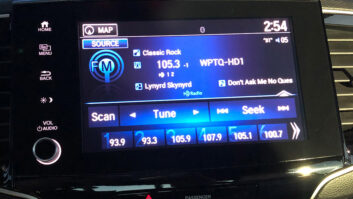
we’re at a moment where millions of HD radios are being sold every year now
that car manufacturers have decided to get out of the radio business and back
to selling cars. IBiquity President and CEO Bob Struble recently reported to
Radio World that over 10 million HD receivers had been sold and that 11 million
was not far behind.
My own thinking on HD was that it was never going to be possible to
transform the radio marketplace with digital radios unless and until it was
accepted by car manufacturers as a standard. With hundreds of millions of
radios out there in consumer hands, it was just asking too much to expect them
to trade in a radio for a new one that delivered nearly the same performance.
However, with the regular 10–12 year replacement cycle of the automobile, it
could be accomplished at a measured pace. The question is whether other
competitive entertainment services would overtake radio while we waited for
digital.
So far that hasn’t happened. HD Radio has shown
itself to be flexible and on a path to slowly improve its performance and
features.
Will it be in time?
Michael LeClair is chief
engineer for radio stations WBUR(AM/FM) in Boston; he has been technical editor
of Radio World Engineering Extra since its inception in 2005.
|