Vinay Purohit is founder and CTO of CloudJuncxion. Steve Shultis is CTO of New York Public Radio.

Broadcasting is in the middle of a rapid transformation. Audiences demand flawless content delivery across more platforms, while broadcasters face relentless cost pressures and the need to modernize infrastructure.
Traditional networks, built on expensive private circuits, rigid topologies and manual operations are increasingly unfit for this new environment.
Seeker SD-WAN provides a fresh and transformative approach for how networks are envisioned, built and operated. Purpose-built for demanding broadcast environments, it combines software-defined networking (SDN) with military-grade self-healing and security, while reducing deployment and operational complexity.
Broadcasters such as New York Public Radio have embraced Seeker to simplify their networks, cut costs and dramatically improve resilience. The result is an overall network with lower expenses, significantly lower over-the-air outages, and improved agility required to thrive in the digital-first era.
Hitless transmission
Broadcast networks have long relied on leased fiber and MPLS links to deliver content reliably. But these private circuits are costly and inflexible, limiting a broadcaster’s ability to expand or adapt quickly.
Seeker SD-WAN removes this dependency by intelligently aggregating affordable consumer-grade broadband, LTE/5G and Starlink connections, while also supporting P2P microwave links when available. The result is hitless transmission at the same or better performance while lowering costs.
For New York Public Radio, one of the nation’s largest and most respected public broadcasters, this was a breakthrough.
[Related: “NYPR Uses CloudJuncxion for Bandwidth Boost”]
By replacing costly traditional transport with Seeker, NYPR cut operating expenses while simplifying its network footprint. Broadcast audio quality also saw a big improvement as NYPR was able to switch to uncompressed audio feeds direct to transmission sites instead of using compressed audio.
Broadcast-grade resilience
Reliability is non-negotiable as outages erode the customer experience and, consequently, revenue. Viewers and listeners expect uninterrupted, high-quality programming that’s impervious to network impairments.
Seeker SD-WAN was designed with distributed intelligence — instead of centralized routing controllers — for hitless transmission, ensuring seamless content delivery even during disruptions of transport links to transmission sites.
Key resilience features include:
- Sub-Second Failover: Traffic instantly reroutes around a failed link without interrupting live streams.
- Disconnected-Spoke Routing: Sites autonomously route around failures without requiring any centralized orchestration.
- Advanced QoS: Mission-critical traffic, like live audio or video feeds, is prioritized to maintain consistent quality.
For New York Public Radio, this meant unprecedented reliability across its distributed network. Even during connectivity challenges, programming continues without disruption, reinforcing NYPR’s reputation for dependable, high-quality broadcasts.
Intelligent distributed orchestration
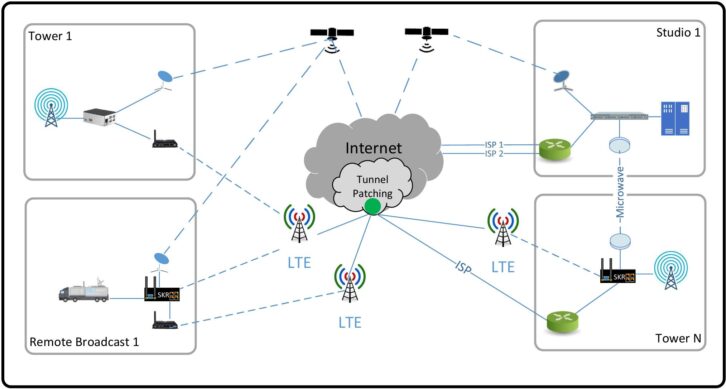
Managing a broadcast network has traditionally been labor-intensive. Engineers spend countless hours configuring equipment, monitoring connections and troubleshooting failures. Legacy SD-WAN solutions entail complex centralized orchestrators that require networking expertise to deploy and manage.
Seeker SD-WAN removes this burden with intelligent distributed orchestration with each node capable of making complex routing and network-healing decisions completely autonomously, ensuring superior uptime and eliminating single points of failure. Centralized management remains available when desired, but without creating bottlenecks or dependencies.
For broadcasters like NYPR, this means fewer staff hours spent on maintenance and troubleshooting, and more time available for innovation and content delivery. Operations become simpler, more predictable and less costly.
Scaling with confidence
As broadcasters grow, networks must scale seamlessly. Adding affiliates, integrating regional hubs or supporting remote production environments can be slow and costly with traditional infrastructure.
Seeker SD-WAN was designed with scalability in mind. Networks can expand to thousands of nodes in any topology, whether hub-and-spoke, full-mesh or any partial mesh topology. Once deployed, sites require almost no intervention due to the autonomous nature of the software in handling transport outages.
This scalability is delivering value for New York Public Radio, which operates a wide-reaching network of stations and affiliates. Short-term events like concerts at parks or amphitheaters are easily supported using any and all available transports at that location. With Seeker, NYPR can expand and adapt its distribution footprint quickly, without introducing new risks or complexities.
Future-proofing workflows
The broadcast industry is shifting rapidly toward IP-based workflows, cloud integration and remote production. Networks must support this evolution while staying cost-efficient and reliable.
Seeker SD-WAN provides the foundation for this shift. By aggregating any mix of terrestrial internet, satellite or wireless, and private links, it enables broadcasters to design agile networks that adapt to new workflows.
For NYPR, this future-proof design ensures that its network can evolve alongside its programming and audience engagement strategies, without being locked into rigid, outdated models.
Tangible advantages
The Seeker SD-WAN advantage can be summarized in the strategic outcomes it delivers to broadcasters:
- Reduced Costs: Replace expensive private circuits with low-cost broadband or satellite while improving up times.
- Resilient Delivery: Hitless transmission and sub-second failover ensure uninterrupted radio and television broadcasts.
- Simplified Operations: Distributed orchestration automates resilience, cutting management overhead.
- Scalable Growth: Expand to hundreds of sites quickly while reducing manual complexity.
- Agility and Flexibility: Connect pop-up and home studios, remote production teams or affiliates with speed and confidence in a single platform
- Future-Readiness: Support IP-based workflows, hybrid connectivity and evolving digital-first distribution models.
New York Public Radio’s adoption of Seeker demonstrates how these advantages play out in practice. They’ve realized significant cost savings, simplified their network operations and gained the confidence of broadcast-grade reliability, a combination that positions them for long-term success in an increasingly competitive industry.
Broadcasting is at a crossroads. Legacy networks are expensive, rigid and increasingly unsuited to the demands of modern distribution. At the same time, competition for audience attention has never been more intense.
Seeker SD-WAN provides a proven alternative.