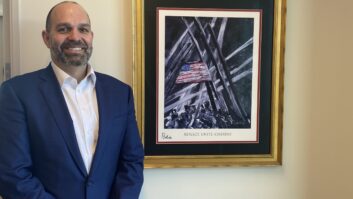
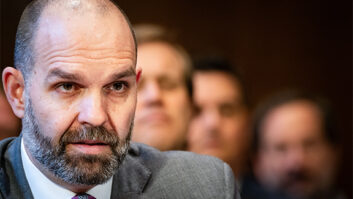
New FCC Commissioner Olivia Trusty and her staff learned this week about the policy preferences of the National Association of Broadcasters.
NAB President/CEO Curtis LeGeyt and the association’s Chief Legal Officer Rick Kaplan met last Monday with Trusty, her chief of staff/senior counsel and her acting legal advisor, according to an ex parte filing.
Trusty’s approval by the U.S. Senate in June created a 2–1 Republican majority on the commission. Two seats remain open.
Broadcasters with deregulation in mind believe that this FCC and this presidential administration will be more sympathetic to the idea of revamping or removing rules that restrict further broadcast consolidation.
[Read: “Conservative Groups Push Carr to Lift Ownership Caps”]
“Our conversation focused on two urgent and interrelated issues vital to the continued vitality of local broadcasting,” NAB wrote in its summary.
It cited “the need for long-overdue reform of the commission’s broadcast-only ownership restrictions; and the critical role the FCC must play in completing a nationwide transition to ATSC 3.0.”
Regarding the restrictions on radio and TV broadcasters, NAB told Trusty there is a “pressing need” for the commission to update its broadcast ownership rules and the national TV ownership cap.
“These regulatory frameworks were designed for an era that simply no longer exists. Today’s broadcasters face unprecedented competition from national and global digital platforms that are unconstrained by local service obligations, structural limits, or public interest requirements,” NAB wrote.
“Without the ability to operate at meaningful scale, local broadcasters struggle to make the investments necessary to serve their communities with trusted local journalism, emergency information and culturally relevant content.”
It said that broadcasters are disadvantaged “in a land of unconstrained non-broadcast media giants.”
On the technology side, NAB said broadcasters are committed to the next-generation ATSC 3.0 standard.
“Stations are investing significant resources without seeking additional spectrum to deliver the enhanced features that ATSC 3.0 enables, including more precise emergency alerts, improved picture quality, mobile viewing and interactive public service offerings.”
But NAB believes the transition “cannot be sustained indefinitely and demands regulatory clarity.” It asked Trusty to support “a clear path forward to complete the transition as set forth in NAB’s petition earlier this year.”
Noting opposition to this approach, LeGeyt and Kaplan told Trusty that “certain players in the ecosystem that are clearly threatened by a competitive free video service available to consumers throughout the nation.”