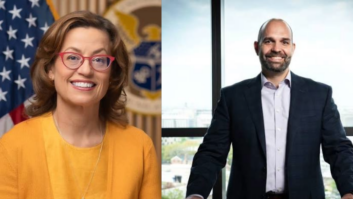
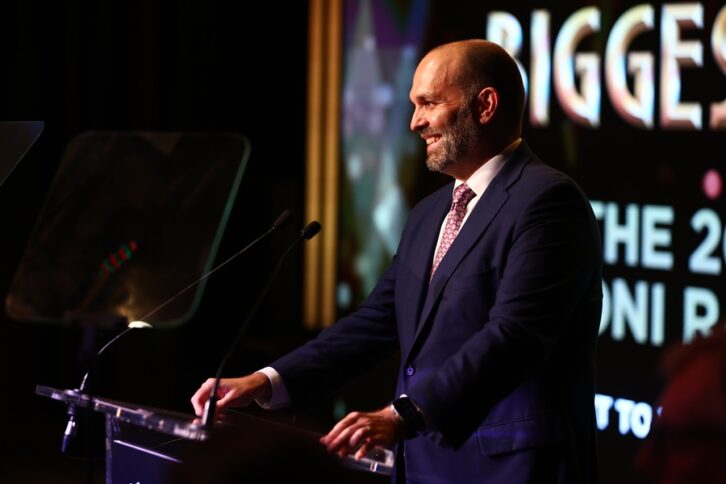
Curtis LeGeyt is entering into the fifth year of his tenure as president and CEO of the National Association of Broadcasters. We asked him to discuss the association’s priorities in the new year. He spoke with Radio World in late December.
Radio World: First, what do you consider your chief successes for radio of 2025?
Curtis LeGeyt: It’s been a tremendous year through the lens of reaffirming policymaker interest and ensuring that this medium can continue to thrive.
From the go last Jan. 20, there has been something to react to every day in Washington, and a lot of noise. It can be very difficult to break through.
We have been unified as an industry in telling our story, and policymakers have reacted. To have gotten the “AM for Every Vehicle Act” out of the gate so quickly — more than 300 House co-sponsors, more than 60 Senate co-sponsors, a filibuster-proof majority, and moving the bill with near-unanimity in both the House and Senate Commerce committees — it’s a tremendous accomplishment and testament to our members’ work across the country in a difficult environment.
We obviously are dealing with a new chair at the FCC, frankly new commissioners across the board. They’ve been solicitous and open to understanding the challenges facing the radio industry, the need to allow radio to better compete on a level playing field with the tech platforms who have siphoned those advertising dollars out of local communities.
We’ve seen the commission move quickly to open its latest quadrennial review of local ownership rules. We feel that the commission is very open to our perspective as to why those rules need to be updated to allow broadcasters to better serve our community.
And then the perennial issue that radio needs to win, year in and year out, to secure the future of our medium is the performance tax.
The music industry continues to pour substantial resources into that fight, adverse to the interests of local radio. In spite of their energy and in the wake of a contentious hearing in the Senate Judiciary Committee, we’re again showing that members are willing to step up and support local radio in this fight. We’ve got more than a majority of the House of Representatives supporting the Local Radio Freedom Act.
A new administration, a new Congress, gives a clean slate to reaffirm our values, our service. We don’t register Republican, we don’t register Democrat, we register local and trusted. In a divided Washington, because of the work of our members, we’ve been able to tell that story.
RW: Have you been disappointed about not accomplishing something in particular?
LeGeyt: Washington is never going to move as quickly as the marketplace nor the needs of our membership.
We are at an existential moment for local radio, with heavy disruption from the tech platforms. We are competing with behemoths. We need Washington to act on these issues.
By any measure within the beltway, we’re achieving tremendous success; but it’s simply not quickly enough to address the day-to-day needs of our members and communities.
My disappointment is just that the machinations of Washington seem to be moving slower and slower every Congress. But I am comforted and thrilled that within those constraints, we have managed to break through, garner bipartisan support, get movement of our legislation through committees in terms of substantive policy.
This [AM legislation] is the most co-sponsored bill in the House of Representatives this Congress. We’ve got all the tools we need to get this over the finish line. But institutionally, Washington is moving a little slower than we would like.
The funding of the federal government alone has taken up substantial time and bandwidth of policymakers. We’ve got to work within the constraints of the institution. My disappointment is that the institution cannot move more quickly; but we’re going to prevail in spite of that.
RW: Regarding local radio ownership caps, you’ve talked before about Chairman Carr’s generally supportive attitude; and the outcome certainly felt almost assured to me, given the 2–1 Republican majority. But then President Trump made remarks about not wanting to help TV companies that he considers left-leaning. Is this going to have any impact on the radio discussion?
LeGeyt: The reason we’re even having this conversation about modernization of the rules is because listeners and viewers across the country have reached out to Washington, expressing the need to allow local radio to better compete.
We got out of the gates very quickly this Congress with a media blitz, educating policymakers on the need for the FCC to act quickly on this issue. We were bolstered by a court decision over the summer that clarified the FCC ability to further deregulate in this space.
Chairman Carr has a broad purview over all areas of telecom and broadcast, and for local ownership to rise to the top of his “to do” list is a testament to the fact that local listeners and viewers have engaged with Washington. More than 200,000 of them, and nearly 100 bipartisan lawmakers, have reached out to Chairman Carr saying this is the time to modernize these rules to allow broadcasters to better compete.
There are well-heeled adversaries that we need to deal with. But we feel we are right, not just on the policy but the politics. We’re continuing to show Chairman Carr that it’s an imperative of his allies across Washington to level this playing field.
I’m very optimistic that he’s been open to hearing our argument on this, and that he’s got a lot of support to move quickly.
RW: Do you agree with Chairman Carr that the FCC is not an independent agency?
LeGeyt: Our job at the National Association of Broadcasters is to meet regulators where they are. We’re telling our story to Chairman Carr, to Commissioner Gomez, to Commissioner Trusty, irrespective of legal questions as to how the FCC ought to be treated. For local broadcasters, we don’t get focused on those side shows.
RW: After the Jimmy Kimmel situation, you said that government pressure over content is not new and has come from both parties. But isn’t what President Trump and his administration have done historically unusual? He’s been vocally blunt in a way that many people interpret as pressure on broadcasters, to the point of threatening licenses. Isn’t that different?
LeGeyt: Look, our credibility as local radio stations is going to be dependent on our independence from political interference. Our audiences need to be able to trust that what they’re hearing over our airwaves is based on independent decision-making and views that aren’t being influenced by any president or any government official.
Our role at the National Association of Broadcasters is to reinforce our First Amendment right to deliver our programming free of government influence. I’m going to pound the table on that every opportunity I get, not just over the course of this administration but over the course of any administration, as we’ve done in the past.
RW: Is it a foregone conclusion that the rest of the C-band is going to be taken, based on what Congress has told the FCC to do?
LeGeyt: From our perspective, this is about allowing broadcasters to continue to deliver this programming. We have expressed our concerns around our usage within the C-band and how undermining that, absent a technical substitute solution, will impede local communities, impede the quality of our broadcast and drive costs up for our stations.
Yes I expect that the commission is going to continue to move forward, but we’re going to ensure that local broadcast stations are protected.
RW: You’re saying, “If you’re going to move us, you’d better help pay to move us.”
LeGeyt: That’s exactly right. And you’d better ensure that the substitute works from a technical perspective, so there’s no gap in our ability to serve our communities. The FCC has been open to that argument. I have every confidence that they’ll get this right.
RW: You’ve made an internal realignment to accelerate development and deployment of the Broadcast Positioning System. Technology executives Sam Matheny and Tariq Mondal have roles exclusively focused on BPS. You also launched an Industry Affairs and Innovation department, led by April Carty-Sipp. Why is BPS so important to your members?
LeGeyt: This is one of those unique moments where broadcasters have the ability to serve the country while creating additional business opportunities for local stations and bolster the reputation of our industry and our use of our spectrum.
The vulnerability of the GPS system is a major national security concern. The first Trump administration issued an executive order calling for viable complements to GPS, because if it goes down, you’re talking about major disruption to our financial systems, our energy grid, our transportation systems.
Although a lot of interests have explored solutions, none has what local broadcasters have: an infrastructure already in place across the country in 210 markets to solve this problem, one that is land-based, not satellite-based and susceptible to the same type of spoofing that GPS is susceptible to.
Our team has done incredible work over five years to explore what is now an active proof-of-concept that our technology can serve as a viable complement to GPS.
We’ve entered into a partnership through the Department of Transportation with Dominion Energy so we can test our technology alongside a meaningful critical infrastructure partner. We’re thrilled about the progress.
We have realigned our organization to further our focus. This is an existential challenge that the federal government must solve for the security of our country.
We want to step up and show that this is something that the NAB is focused on solving alongside them. We can’t do it if it is a project that a couple of NAB employees spend 20 to 30% of their time on. Sam and Tariq will spend 100% of their time while building out a team to take this from concept to reality.
The federal government has been receptive to this technical solution. We’ve been working not just with the Department of Transportation, but with the Department of Energy and the Department of Commerce. We’ve had continual touch points with the White House.
For broadcasters, it’s just another example of how we’re using our spectrum, our technology, and that where other forms of technology fail, we’ve always been there in times of emergency. This is a further use case that demonstrates broadcasters’ role in our civic life.
Beyond BPS this realignment also allows us to focus our efforts on technology issues that really sit at the intersection of business and innovation. Whether you’re talking about the connected car, AI, how we rate on search platforms … increasingly our technology issues are also business issues, and vice versa. Aligning our remaining technology team within a new Industry Affairs and Innovation team breaks down a silo that will also help us address other issues that are existential to our radio and television members.
RW: I’m sure there are competitors for the role of GPS backup system. What would success look like for you — are you looking for government funding? Are you looking for an endorsement as the government’s official secondary backup system to GPS?
LeGeyt: We start with the second piece, which is agencies across the federal government recognizing the viability of this technology to secure our critical infrastructure. And if we do that, the other pieces will take care of themselves.
RW: NAB has spent a lot of time engaging with carmakers about the dashboard. But every year we see headlines that this or that car isn’t going to have AM or even FM. And it is increasingly hard to find radio within the menus. How can radio counter these trends?
LeGeyt: First of all we need to get the AM for Every Vehicle Act passed.
The core of that bill is AM radio and ensuring that every newly manufactured automobile includes access to it; but that overlooks two important points.
Radio’s viability as a whole, including FM, is tethered to the future of AM radio. Policymakers have stepped up because of some of the unique attributes of AM radio, but realistically AM’s place in the dashboard secures radio’s place in the dashboard. It will allow us to focus on how we better innovate this product, rather than getting distracted day in and day out on the even larger question of how to keep our product in the automobile.
Also, the bill not only ensures that AM — and therefore radio — is going to be in the automobile, but that it’s readily accessible. As we are competing in this screen-based environment in the car with endless numbers of apps, it’s getting more and more difficult to locate radio. This bill, if implemented correctly, will right-size that.
All we’re looking for is the ability to compete on a level playing field. The motivation of these tech companies, and by extension the automakers, is to prioritize products that they can sell with a subscription service or where they can monetize the data. Radio sits outside of that.
Yes, policymakers are embracing this legislation because of public safety, but they are also doing it because they recognize the competitive imbalance and the incentives for the autos to make access to radio difficult.
We’ve got to get the bill over the finish line, but we also need tell our story better. We’ve focused on direct engagement with the autos, especially on a global stage. April Carty-Sipp, Sam Matheny, John Clark and David Layer have focused on telling this story to the automakers, reminding them of the enduring popularity, the hundreds of millions of listeners.
This is often overlooked, because who are they hearing from every day? It’s the tech platforms. Radio is fragmented, so we don’t always do a great job of speaking with one voice.
We are getting better at that, and you’re seeing the results in terms of responsiveness from the automakers. But especially once we get on the other side of this bill, this is something that we need to do even better.
RW: You’ve talked about consumer anxiety over effects of AI on content and news coverage. Recently the administration issued an executive order pushing back on state laws about artificial intelligence, saying they can slow innovation. What are the ramifications for broadcasters?
LeGeyt: The administration rightfully recognizes the difficulty that a patchwork of state laws will mean for businesses that need to operate and are trying to innovate, including broadcasters.
But there are major issues here, and the NAB has flagged those relevant to local broadcasters — protecting the image and likeness and voices of our local personalities, as well as ensuring that, when our local and news content is used by these platforms, we have the ability to control how that content is used, achieve attribution and be compensated if our content is monetized by the platforms.
We’ve seen it for the last decade in the context of traditional search through Google and Facebook. Our own content is not only being used or accessed by those platforms, without our permission at times, but it’s being used to compete against us for advertising dollars. We’re effectively undermining our own medium because of our lack of control and market power.
Those issues are exacerbated in the AI context. This is something policymakers need to recognize. We are pushing for one standard federal set of rules, because that is preferential to a patchwork of state laws. But one way or the other, policymakers need to deal with this.
RW: NAB had a lot to say when the chairman invited comments in his “Delete, Delete” initiative [see “NAB’s Roadmap for the FCC”]. You made some proposals of your own and talked about third-party ideas that your organization keeps an eye on such as LPFM power increases, eliminating FM allocation requirements and others. Some seem pretty far-fetched. Are there issues that you’re keeping a particular eye on?
LeGeyt: It all falls by the wayside if we don’t achieve meaningful ownership modernization. We structured our “Delete, Delete” comments saying that until you address this first issue, we don’t want to talk about the others.
We submitted them for the record, because they further tell the story that local radio is far and away the most over-regulated medium, and we’re competing against behemoths that don’t have to abide by any of these regulations, creating an unlevel playing field. Hopefully those are 2027 and 2028 priorities, and we can have a further discussion about them.
But we are laser-focused on getting ownership rules modernized and ensuring radio’s ongoing place and prominence in the automobile. Those are our priorities.
RW: Is it possible the FCC would act on ownership this coming year?
LeGeyt: We have seen from the chairman, as well as the other commissioners, a real openness for digging into this and an understanding of the existential moment that we are in for local radio. I don’t control the timetable, but I can assure our members that this is very much top of mind for the chairman, fueled by the fact that hundreds of thousands of broadcast listeners and viewers have engaged with policymakers. They’ve responded and are pressing the FCC chair to act quickly here.
RW: Anything else you’d like radio people, owners, managers, engineers, to know?
LeGeyt: It’s a thank you for the tremendous service being done at local radio stations across the country. We know the challenges grow by the day. The most rewarding part of my job is when I get out of Washington, visiting stations and ensuring that our advocacy agenda is in sync and matches the needs of our members. I’m in awe of the work being done.
There’s such a fascination right now with tech, with AI, how all of these innovations are going to shape our society. But no one is doing what local radio does, which is that local community presence. It is hard. And in those times of emergency radio does its best work. That’s in our DNA, and I love telling that story.
Comment on this or any story. Send letters to the editor to [email protected].
[Do you receive the Radio World SmartBrief newsletter each weekday morning? We invite you to sign up here.]