When Wendell Lonergan landed a job at Nautel — formerly Nautical Electronic Laboratories — fresh out of college in 1978, he didn’t realize it would be the one and only job he would ever apply for. Now, after 47 years with the Canadian radio equipment manufacturer, the broadcast veteran has officially retired.
Lonergan joined the Nautel team just nine years after the company’s inception in 1969. He recalls those early days fondly.
“Nautel was a young, developing company with a fantastic culture and huge scope to learn,” said Lonergan.

Back then, Nautel’s product line consisted of navigational beacons for coastlines and aeronautical use.
“When I joined, I was extremely lucky to be positioned in the research lab with the founder of the company, Mr. Dennis Covill,” he said. “We needed to diversify to grow the company, and AM broadcast transmitters had the best synergy with our beacon families.”
After having worked as an engineer at Nautel for 20 years, Lonergan said he eventually moved to sales as the company’s broadcast offerings grew.
“It became that I was doing as much work with sales as I was in engineering, as there were only two sales guys. And so I said, ‘Well, you know, I don’t care. I like engineering and sales, and sales in this type of industry is as much engineering as it is sales.'”
Towards the end of his career, Lonergan served as Nautel’s director of global broadcast sales, a torch that has since been passed to Tracey Connolly.

Lonergan said Nautel’s first big, commercial win was a tender for three 10 kW transmitters to Radio New Zealand; and, while those transmitters were in ocean transit, the company sold another 10 kW transmitter to CJFX(FM) in Nova Scotia — which also happens to be where Nautel is headquartered.
“To my knowledge that was the first solid-state AM 10 kW transmitter on-air. The rest is history.”
When asked about some of the biggest ways he’s seen the broadcast engineering world change since 1978, Lonergan notes that the transition from tube-based technology to solid-state amplifiers in the 1980s is definitely one of the main highlights.
“Pulse Duration Modulation, or Pulse Width Modulation, was the backbone of the modulating technologies, while competing manufacturers chose different forms of pulse step modulation each with their own limitations and benefits.”
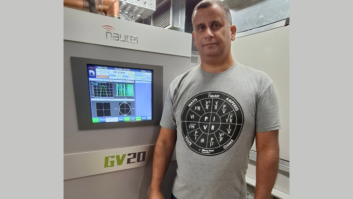
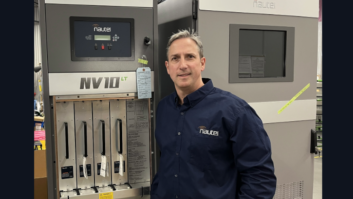
Click on the photo to see Lonergan present-day vs. his 1983 self.


During his tenure, Lonergan also said he had the good fortune to work with the “incomparable” Greg Buchwald from Motorola to develop the AM Stereo circuitry for Nautel.
Looking back on the 1990s, Lonergan highlighted the introduction of OFDM (Orthogonal Frequency Division Multiplexing) technology to broadcast industry signals to enable digital broadcasting for both AM and FM transmissions.
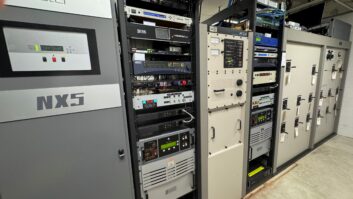
“The turn of the millennium saw a move to the inclusion of sophisticated measurement equipment and improved transmitter monitoring included inside the transmitter,” he said. “Items like the internal Network Analyzer were extremely useful to tune up an AM site for optimum AM digital operation.”
Lonergan added: “Now, with digital broadcast operation becoming such an important tool for the broadcaster, there is a move to move to an all-software solution to reduce the capital costs for the transmitters.”

As for his proudest professional moments during that time, Lonergan recalls the sale of a 2 MW AM transmitter to Antenna Hungária.
The contract was unique because it was agreed upon without an existing product offering from Nautel.
“It was most bizarre because Antenna Hungária had been courted by one of our competitors, Transradio, who did have a high-power transmitter, but a very old design.”
When a rep from Hungary called to discuss a project proposal, Lonergan said he was quick to buy a plane ticket.
“So we went in there and we told them about our technology,” he said. “The design of our system was five, 400 kilowatt transmitters with a very unique combining system that allowed any one of the five transmitters to be taken out of circuit for maintenance purposes; and the rest would still contribute equal and without dumping program into a reject load. So they were very intrigued with us.”

When an offer was officially extended, Lonergan said he was alarmed to discover that Antenna Hungária expected a brand-new 2 MW transmitter in just nine months … with a large delay penalty if Nautel was late in delivering.
After intense negotiations, Lonergan said he helped strike a deal so that Nautel would have until the end of the following year to hand over the product.
“We finally came to a contract, and then all we’d have to do is design a 2 MW combiner, which is a huge feat to do in a short period of time, but we did it. It was so big that we couldn’t even run the transmitter at our facility here in Hackett’s Cove [Nova Scotia].”

Because of its size, Lonergan said the transmitter had to be built on-site; but, when commissioning day finally rolled around, he said the transmitter went up “happy as a clam,” and has been performing wonderfully for about seven years now.
“It was without a doubt the greatest project I was associated with.”
With such a long career in the broadcast industry, Lonergan was honored with several retirement parties and sendoffs — something he is very modest about. Last month, immediately following the IBC Show in Amsterdam, Nautel hosted a riverboat cruise celebrating his career. “I got more than I deserve,” said Lonergan.
Click on the photo to toggle through images of Lonergan’s celebration cruise in Amsterdam.


As someone who admits to the fact that he could probably recite Nautel’s entire catalog of products and product descriptions in his sleep, the transition to retired life might take some getting used to. However, Lonergan is already lining up his next adventure … crossing Cabot Trail in Nova Scotia off his bucket list. The scenic highway on Cape Breton Island is 298-km-long (or 185 miles) and is renowned as one of the world’s most beautiful drives.
As he reminisces on years past, and thinks back on all the changes Nautel has seen over its 56 years, Lonergan leaves the company with nothing but well wishes.
“When I was interviewed at my exit interview, they asked, ‘What would you change?’ And well, I don’t know if I’d change much of anything,” he said. “It was a wonderful career.”