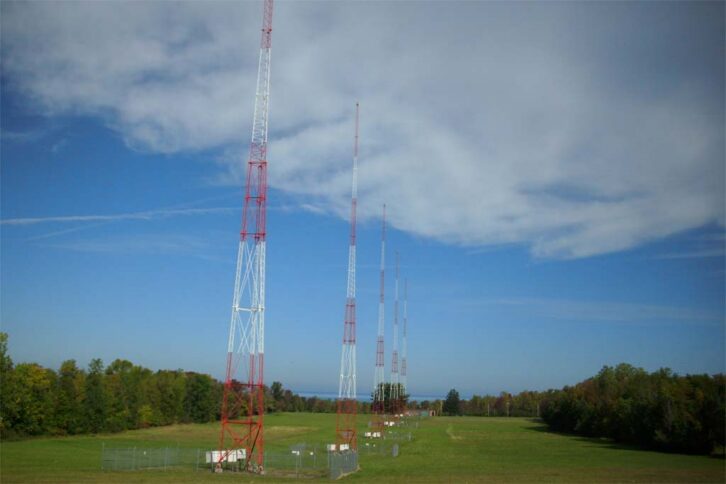
In talking with folks who still do AM allocations work, I have noticed a trend. Station owners are looking for ways to reduce the number of towers in their antenna systems as a means of reducing costs and sometimes freeing up land for other uses.
Many AM stations employ multitower directional antennas for different modes of operation. Some are nondirectional day and directional at night. Others are directional both day and night. And still others have a third “critical hours” mode that may require a different power level, different directional pattern or both.
Towers aren’t cheap to operate and maintain. Those that are over 200 feet in height will generally require marking (aviation orange paint alternating with white) or medium-intensity white strobes for daytime and red lights at night.
Painting a typical tower of 200 to 400 feet can easily run $10,000 or more, which is one of the reasons changing to dual medium-intensity white and red lights is such an attractive option. In less than two paint cycles, the cost of conversion is paid for.
But even doing away with the paint budget with new 24-hour lighting doesn’t totally eliminate the expense. Tower lighting systems require maintenance and they do fail, especially when lightning is a regular thing.
So it’s no wonder station owners are looking to get rid of some of their towers.
The thing is, usually (but not always), the directional antenna pattern is employed to protect co- and adjacent-channel spectrum neighbors from interference. That requirement doesn’t go away as long as those neighbors are still there.
So one of the first steps required when considering downsizing a directional array is to look at the allocation picture for that mode of operation.
If the spectrum neighbors are still in place, the maximum nondirectional power can be determined by finding the minimum permissible inverse distance field (IDF) toward each of those neighbors.
During daytime hours, that will be a simple number expressed in mV/m at 1 km. For night operation, it will also include a range of vertical angles, meaning that the station cannot radiate more than “X” mV/m between those two vertical angles, known as θMIN and θMAX or theta min and theta max.
The maximum power is then determined using the efficiency of the nondirectional antenna, dividing the permissible IDF by either the §73.190 Figure 8 1 kW IDF of the non-directional radiator or the licensed 1 kW IDF of the radiator, and then taking the square of that number.
For example, if the maximum permissible IDF for a station is 33 mV/m and the Figure 8 IDF of the nondirectional radiator is 306 (typical for a quarter-wavelength tower), the maximum power would be (33/306)2 = 0.012 kW or 12 watts.
If we’re talking about a night facility, you would first divide the maximum permissible IDF number by the f(θ) (the function of theta), or the reduction in inverse distance field at the vertical angle. The formula for computing f(θ) is contained in §73.160 of the FCC’s rules.
In our quarter-wavelength (90°) tower example above, if the lowest vertical angle (θMIN) is 25 degrees, f(θ) would be 0.8691, so we would take the associated maximum permissible IDF (33 mV/m) and divide by 0.8691, which would yield 38 mV/m. Then we would use our power formula as follows: (38/306)2 = 15 watts.
One other case bears mentioning. It’s possible — likely, even — that because of rule changes or other factors, an existing overlap exists with a spectrum neighbor, meaning that the field currently radiated toward that neighbor exceeds what is permissible under the current rules.
The FCC will permit existing overlaps to remain, so you would take the existing minimum IDF toward that neighbor and use it in the power formula.
So, what about principal community coverage? §73.24 requires that the daytime 5 mV/m contour covers 50% of the area or population of the principal community, and that the nighttime 5 mV/m or interference-free contour (whichever is higher) covers 50% of the area or population of the community.
What if a station owner wants to ditch their night directional antenna, but the resulting night non-directional power will not produce that required coverage?
The answer is that they would have to downgrade that station from a Class B to a Class D station. Nighttime operation would be secondary and not protected from interference. That same scenario would exist if the night power were less than 250 watts or the night IDF of less than 107.5 mV/m, regardless of community coverage.
A station’s daytime facility must produce the required principal community coverage.
Ditching a directional antenna and going nondirectional can be a good option for some struggling stations, keeping them on the air and, for many, feeding their FM translators 24 hours a day. The land once occupied by the other towers can be sold or leased out, raising cash to further help the operation. It’s certainly something worth considering.
[Do you receive the Radio World SmartBrief newsletter each weekday morning? We invite you to sign up here.]
