I’m sitting in the office and really glad the air conditioning is working. The temperature outside is 99 degrees Fahrenheit. Nobody is complaining. Well, some people are complaining, but about the heat, not the air conditioning, which is functioning properly.
Being a broadcast engineer, I like to focus on broadcast or production projects. But we engineers must realize that many factors affect our team’s ability to deliver those projects. Which is why I make sure the preventive maintenance for the HVAC has been completed.
Around a year ago, I wrote an article about air conditioning and broadcast equipment. The main point bears repeating: Operating temperatures are very important for both equipment and people.
Temperature specifications for equipment typically are provided in the equipment manual. Unfortunately, the optimal temperature for people is an estimate. Humans do not come with a manual (yet), and if you ask 10 co-workers to name the best thermostat setting, you may get 11 temperature recommendations. Especially if the group includes more than one gender.
For facilities, operating temperature is controlled by an HVAC system, which of course stands for heating, ventilation and air conditioning.
An air conditioner is a large refrigeration system. You should be familiar with basic terminology and concepts so you can communicate intelligently with your vendor or technician.
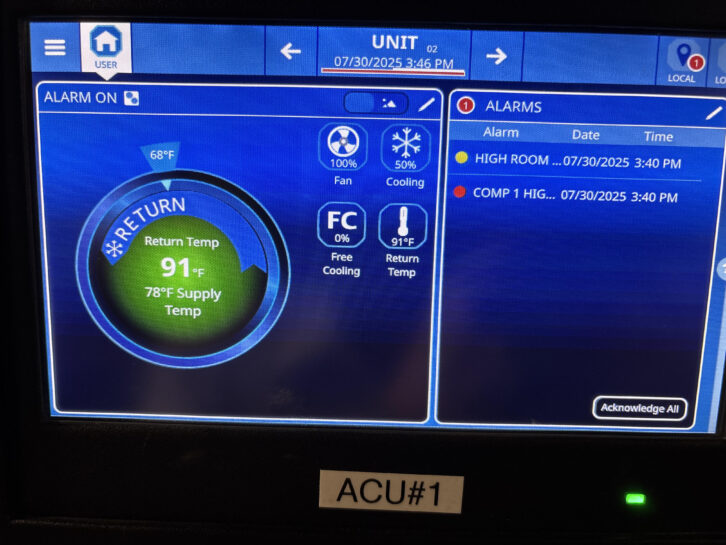
An AC “return” is a vent that draws inside air from inside and moves it to a system that cools it and recirculates it. The number of intake returns is dependent on your system design. There typically are filters capturing the air particles before they enter the return. Dirty filters lessen the efficiency of the system. I try to replace filters on a regular schedule.
An “air handler” is responsible for circulating and distributing the cooled air in the facility. Keep this clean. You will be surprised how it can build up with dust. (Use a vacuum — a blower simply relaunches the dirt in the air.)
The air conditioner “condenser,” usually located outside, has coils filled with refrigerant. It dissipates the heat to produce the cooling. Keep the coils clean. Dirty coils also lessen the efficiency of a system. Most of the time a little soapy water does the job.
Refrigerant coolant is important. To protect the ozone layer, the Environmental Protection Agency phased out the use of Freon (R-22). No new R-22 is available, and you can only get it as recycled or reclaimed. This has caused the prices of maintenance and repair of older systems to skyrocket.
Recently, R-410A and R134A refrigerant have been phased out, causing similar issues. New systems use R-454B as the refrigerant. Some systems use R-32, a component of R-454B. Unfortunately, coolants are not interchangeable, and you cannot retrofit an older system with new components. Bringing an HVAC system into compliance can be costly.
Invest in a modern thermostat. These can be controlled from a web page, can provide restricted access and can send you alerts if the temperature goes out of tolerance. The location of the thermostat is key to the performance of the system. The thermostat has a thermometer to read the temperature, so place it in the most crucial area.
You may also be asked about heat pumps. Heat pumps offer an energy-efficient alternative to furnaces and air conditioners for all climates. Like your refrigerator, heat pumps use electricity to transfer heat from a cool space to a warm space, thus supplying heating or cooling.
Someone may ask, “How do I know what capacity of cooling I need?” The question often is not given enough consideration. You might be told how many people will populate the area but not any equipment being used. Your HVAC vendor can help you to the correct answer.
There is a lot of detailed information online about these concepts. It’s worth spending time becoming more conversant with them so you can speak more intelligently to your HVAC vendor and get the most out of that business relationship. Remember, cooling is a crucial year-long event.