The author is founder of Ordo Digital.
Artificial intelligence dominated the conversation at NAB Show New York, where some 11,500 attendees gathered, with industry leaders debating both its transformative potential and its ethical issues. As part of the Radio + Podcast Interactive Forum, I moderated a packed session titled “The Evolution of AI in Radio and Podcasting” featuring Matt Kellogg, VP of sales and business development at SoundStack, and Sheryl Worsley, VP of podcasting at Bonneville International.
What emerged was a nuanced discussion about how broadcasters and podcasters can harness AI’s efficiencies without sacrificing the human authenticity that makes audio so powerful. Here are some key takeaways from our conversation.
AI Could Slash Production Costs by 40%
Kellogg predicts radio stations could reduce production costs by as much as 40% by implementing AI tools across their workflows. SoundStack uses AI to convert audio clips into short videos by adding contextually-relevant gifs, a process that previously required Final Cut Pro and significant editing time. “AI can do that in a matter of minutes, based on the translation that it does with the transcripts,” Kellogg told the NAB audience. “Whether it’s video or audio as your source content, it’ll create a clip. It’s simplifying and speeding up the process”.
The technology also tracks trending topics across platforms like Reddit, Facebook and Google Trends, then automatically surfaces relevant clips from a station’s archives for repurposing. For podcasters, AI tools can identify the top people mentioned in a series and resurface clips about them when they start trending. “I think that could help stabilize the market,” Kellogg said of the potential cost savings.
True Crime Podcasts Face Revenue Challenges With AI Use
Worsley, who oversaw production of the Dave Cawley hosted podcast “Cold,” which has generated more than 80 million downloads, raised concerns about AI-powered brand safety services that flag potentially offensive content for advertisers.
SoundStack has partnered with Barometer to bring AI-driven brand safety tools to podcast advertising. The automated risk grading helps advertisers avoid inappropriate content through transcription and keyword-based scoring. But Worsley argues these systems lack the nuance to distinguish between exploitative content and ethical journalism.
“We go out of our way to make sure we’re not being graphic or exploitative of the people and their tragedies,” Worsley said. “So, I take exception with companies that flag all of those words that need to be used in a true crime podcast. I think it needs to get better, because we’re missing revenue because of it. I’m bitter. Can you tell?”
Kellogg acknowledged that blunt algorithms can overcorrect, particularly in sensitive genres like true crime, and stressed that human review remains essential for context, accuracy and revenue protection.
The challenge highlights a broader tension: As AI tools promise to make podcast advertising more efficient and scalable, they risk penalizing quality content that discusses sensitive topics responsibly. According to a Pew Research study, roughly one quarter of the most-listened-to podcasts in the U.S. are in the true crime genre, yet many brands remain hesitant to advertise in them.
Beyond revenue concerns, Worsley emphasized that Bonneville runs its AI systems in a closed environment to prevent data leakage and protect intellectual property; an increasingly critical consideration for broadcasters experimenting with automation. The company uses AI for transcription, translation and AI-read articles, describing it as a tool that boosts speed and convenience without replacing people.
Radio Industry Is an Early Adopter of AI
Unlike previous technological shifts where radio lagged behind, the industry is embracing AI quickly. “Radio is early on the ball this time with AI, which is great,” Kellogg said. “I do believe that the resurrection of radio is possible and we’re seeing that already”.
Worsley noted that AI quality has improved dramatically in just two years. “The rate at which it gets great is going to accelerate even more, and that means we will use it more,” she said. With many media companies reducing workforces, AI can help stations maximize their talent. “If your talent wants to do something like a podcast, look for the efficiencies in their day that you can glean from AI so that they can produce more original content,” Worsley explained.
News reporters can use multimodal, AI-powered tools like Reka AI to create social media posts from their stories, freeing them to focus on original reporting. “There are a lot of things that AI is going to be able to do for us. We’ve just got to be willing to look,” Worsley said.
Human Authenticity vs. AI Audio Slop
Both Kellogg and Worsley emphasized that audiences can distinguish between human-created and AI-generated content. Bonneville sometimes includes a disclaimer in podcast credits stating “No AI was used in making of this podcast” when certain personalities might inadvertently sound like AI. Worsley experienced this firsthand when listeners mistakenly thought Bonneville’s “Stolen Voices” podcast host was AI-generated due to her unique speaking style.
The discussion extended to cloned and synthetic voices already entering radio and television workflows. Meteorologist Amy Freeze was cited as an early adopter, having created an AI version of herself that delivers personalized weather forecasts based on National Weather Service data. The panel agreed that clear disclosure is vital when using AI narration to maintain listener trust.
“But in general, people can tell the difference,” I noted during the session, emphasizing the need to distinguish between AI that brings tremendous efficiencies and the “AI audio slop” that’s becoming more prevalent. The term AI slop refers to low-quality, AI-generated content.
As AI tools become easier to use and more sophisticated, AI-generated content is becoming more prevalent online across all platforms. The Guardian found that nine out of the top 100 fastest-growing YouTube channels feature AI-generated content. Companies like Inception Point AI are creating 3,000+ AI-generated podcast episodes a week. And according to the SEO firm Graphite, 52% of written content online is already AI-generated.
“Human intervention matters,” Kellogg stated, acknowledging that while AI can automate many tasks, human judgment remains essential for maintaining content quality and authenticity.
AI Enables Smarter Audience Insights
Beyond production efficiencies, AI is transforming how broadcasters understand and reach their audiences. Worsley used AI to discover that 86% of women 55 and older consume content on YouTube, prompting Bonneville to shift its marketing strategy for that demographic.
SoundStack leverages AI for sophisticated podcast ad targeting, matching advertisers with the right podcasts and even the right episodes based on IAB categories and trending content. “There may be a specific episode about a certain type of technology that is going viral, and we can see the stats that are being generated by that,” Kellogg explained. “So, a sales exec can quickly go out and say, ‘Hey, we’ve got some trending stuff. Let’s get you on the air right now'”.
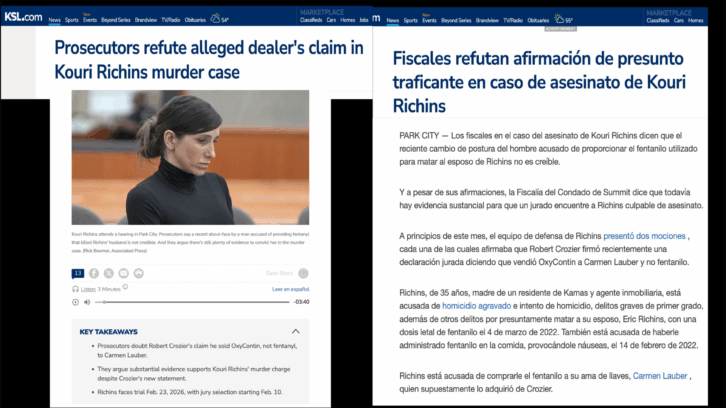
Bonneville’s KSL website demonstrates AI in action with tools that allow readers to listen to print-based news articles, generate key takeaways from articles and translate stories into Spanish. The website discloses that AI is used for these functions, modeling the transparency that builds audience trust.
The Path Forward: Careful Optimism
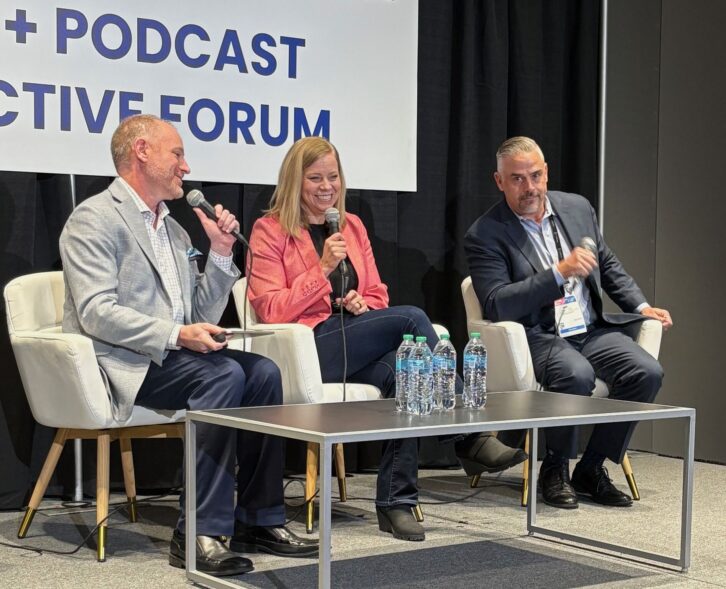
Worsley summed up the industry’s challenge with a simple directive: “Be willing to try, but be careful.” As broadcasters and podcasters navigate AI adoption, they must balance efficiency gains with ethical considerations, protect copyrights, negotiate voice licensing rights and maintain the authentic human connection that makes audio such a powerful medium.
The cost savings AI delivers can be reinvested in talent retention and content quality. But as the flood of AI-generated content increases, the value of human-created, ethically-produced journalism and storytelling will only become more apparent to discerning audiences. The panel’s consensus: be willing to try AI, but always be careful and transparent about its use.
[Read More Radio World Stories About Artificial Intelligence]