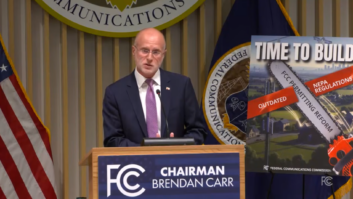
First, lawmakers on the the U.S. House Energy and Commerce Committee launched an investigation into FCC Commissioner Brendan Carr, claiming “bogus” investigations into entities disfavored by President Trump.
As a result, Carr wrote back in defense of his actions since becoming chairman. His approach, he explained, is in fact a change from what Carr described as the politically-laden decisions of past commissions.
Carr penned separate letters in response to criticisms from House representatives earlier this year. The members had alleged unequal treatment in the FCC’s investigations of NPR, PBS, CBS and Audacy. They argued that Carr was “weaponizing” his position as chair.
He issued the responses in the spring.
Inside Radio first reported the series of letters.
Improperly targeting broadcast networks
Dated April 29, Carr sent his first series of letters to Democratic Representatives Yvette D. Clarke (D-N.Y.) Doris Matsui (D-Calif.) and Frank Pallone (D-N.J). In their initial letters to Carr, the lawmakers had alleged he was improperly targeting broadcast networks and media companies for what he perceived as unfavorable coverage of President Trump’s administration. They also accused him of misusing agency resources on “bogus investigations.”
In his response, Carr argued that his commitment to “basic fairness and even-handed treatment” is a departure from previous years, where he claimed politics often determined the outcome of FCC decisions. He said his letter was an opportunity to clarify misconceptions about the FCC’s work.
The Democratic lawmakers had pointed to Carr’s investigation of Audacy’s KCBS(AM) in San Jose for broadcasting the locations of undercover U.S. Immigration and Customs Enforcement agents. They noted that Carr had previously highlighted Audacy’s connection to a fund owned by George Soros and had threatened to delay Audacy’s business before the commission.
Carr countered with accusations of a “two-tiered approach” from the previous administration. He claimed that under President Joe Biden, the commission had created a “special Soros shortcut” to expedite the transfer of Audacy’s licenses — a process he said had never before been used to approve the transfer of a single broadcast license without following federal law.
He also argued that Democrats had pressured the commission to block the sale of Spanish-language 1260 WSUA(AM) Miami for “purely political reasons” during the Biden administration.
Addressing the lawmakers’ criticism of unequal treatment for CBS TV versus Fox, Carr stated that the commission was following established precedent. He cited the commission’s 2023 request for public comment on a petition to remove the license of WTXF(TV), the Philadelphia Fox affiliate, contrasting it with what he called the previous commission’s “different” approach to the “60 Minutes” news distortion complaint.
Carr also highlighted what he described as the “unprecedented failure” to process Sinclair license renewals from 2021—2024.
“The list of Biden-era weaponization goes on and on,” he wrote, “but at the FCC we are now putting those days in the rearview mirror.”
Public media inquiries
Carr also responded to a separate March 26 inquiry from Matsui, Mark Amodei (R-Nev.) and Andre Carson (D-Calif.) regarding the FCC’s investigation into NPR, PBS and their member stations. The lawmakers emphasized the importance of federal funding for public broadcasting, especially for remote or rural communities that rely on public radio and television for local news and educational content.
This inquiry was made before the “claw back” of funds that led to the shuttering of the Corporation for Public Broadcasting.
In his April 28 response, Carr explained that noncommercial stations must not air commercials or promos for for-profit entities. He said the investigation was to determine whether NPR and PBS’ underwriting announcements “cross the line” into commercial advertising.
He did not mention their funding source in his letter. He responded similarly during his May testimony before the U.S. House Appropriations Subcommittee on Financial Services and General Government.
Carr said the commission’s investigation is still ongoing.
The FCC’s workforce reduction
Finally, Carr addressed concerns from Representative Steny Hoyer (D-Md.) about the agency’s “large-scale reductions” in force.
On May 7, Carr provided a chart showing that, as of April 28, the FCC had 1,426 employees. Of these, 69 had accepted the commission’s deferred resignation program and there had been 44 new hires. Carr noted that the commission had realized approximately $3 million in reductions to its salaries and expenses.
However, due to salary increases and inflation, the commission had to absorb $2.5 million in payments for unused leave for employees who had left the agency, Carr wrote.
Comment on this or any article. Email [email protected].