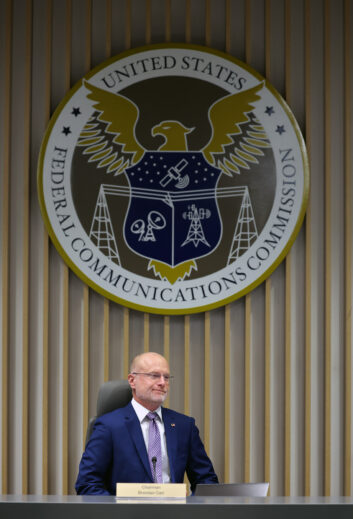
The Federal Communications Commission is making it clear to TV and radio stations: Your license is a privilege, not a right.
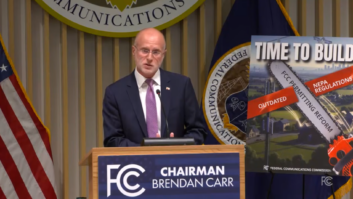
An unsigned seven-page notice distributed Thursday amounted to an unusual public defense from the GOP-led commission for the regulatory approach taken under Chairman Brendan Carr.
But it reiterated, amidst a contentious regulatory backdrop, that if the FCC finds a licensee is not serving “the public interest,” there will be consequences.
The document also emphasized how quarterly issues and programs lists in a station public file are a “significant and representative indication” that a licensee is meeting the needs of its community.
The notice does not cite any recent regulatory items that have gained headlines — such as the FCC’s call for public comment on “The View” or its order that Disney’s ABC-owned TV stations must file for early license renewal — though it did specifically mention licensees are prohibited from “news distortion.”
[Related: “LeGeyt Says FCC License Action Creates ‘Significant Uncertainty’”]
But the order also comes on the day that Disney was to file license renewals for all of its TV stations.
In a letter attached to one of the license renewals submitted Thursday, ABC’s WABC(TV) said that the early license renewal order “opens the door to an assault on the station’s license, while the commission searches for a legal pretext to achieve its desired goal.”
But if the FCC finds that a broadcaster has failed to serve the public interest, it reiterated that it may take disciplinary actions. These include enforcement, granting a renewal with conditions or on a short-term basis, requiring an early license renewal application or designating an application for a hearing.
Carr took to X in support of the notice’s messaging, writing that “the agency will take appropriate actions to ensure compliance.”
Conversely, Commissioner Anna Gomez, the lone Democrat of the three-commissioner agency, told broadcasters to ignore “these latest threats” and “stiffen their spine.“
“The ‘public interest’ does not mean this administration’s interests,” Gomez said on X.
But the public notice repeatedly emphasized what the commission said is a difference between First Amendment rights and a licensee’s public obligations.
“The mere denial of a license because ‘the public interest’ requires it ‘is not a denial of free speech’,” the commission wrote.
(Read the commission’s public notice to broadcasters.)
Finite spectrum
Unlike newspapers or streaming platforms, the commission wrote, no one can broadcast without a license “due to the unique technical aspects of the public resource they operate on.”
The seven-page document is written with TV licensees in mind — “there are far fewer broadcast TV stations available to potential speakers than broadcast radio stations,” the commission noted.
But in totality, the FCC views licensees as public trustees of the radio spectrum, not permanent owners.
“Spectrum auctions routinely bring in billions of dollars for the same spectrum broadcasters use for free,” the commission noted.
Pointing to what Congress charged the commission with dating back to the Communications Act of 1934, if the commission finds a licensee is not operating in a manner that serves “the public interest, convenience and necessity,” it acts as the steward to both enforce rules and investigate public interest violations.
“In exchange for broadcasters obtaining free access to that valuable public resource, Congress has provided the American people and their local communities with something in exchange — broadcasters’ commitment to operate in the public interest,” the commission wrote.
Serving the community
“Programming decisions by broadcasters must be made in service of the public and be responsive to the needs of the local community that they are licensed to serve, not the private interests of national networks,” the FCC added.
Even as the FCC has embarked on deregulatory efforts to ease the burden on broadcasters — pointing to the elimination of the main studio rule, the program origination rule and ascertainment requirements — the role of the commission in determining whether broadcasters have met their public interest obligation “has not faded.”
The commission pointed to stations’ online public files and program lists — which detail the significant community issues covered and the specific programming that addressed them — as a cornerstone of this public obligation.
The commission also emphasized how broadcasters must provide equal opportunities to political candidates.
Additionally, the commission said that it promotes “traditional public interest goals of promoting competition, localism and viewpoint diversity” when reviewing broadcast ownership structures.
Enforcement examples
As evidence of past enforcement of public interest obligations, the commission pointed to two recent radio-related cases:
In 2007, Entercom station KDND(FM) in Sacramento, Calif., held an on-air water-drinking contest, after which a female participant, Jennifer Strange, died from water intoxication. The FCC subsequently designated Entercom’s license renewal for KDND for a hearing to determine if the station had operated in the public interest over its previous license term.
Then, in 2021, the FCC’s Media Bureau designated a hearing to determine whether to renew WJEH(AM)’s Gallipolis, Ohio license following the station’s extensive periods of silence and operations at reduced power.
“The commission will not hesitate to exercise its statutory authority to ensure that broadcasters either fulfill their public interest obligation or provide the privilege of being a broadcast licensee to someone that will fulfill that duty,” the FCC concluded.
[Do you receive the Radio World SmartBrief newsletter each weekday morning? We invite you to sign up here.]