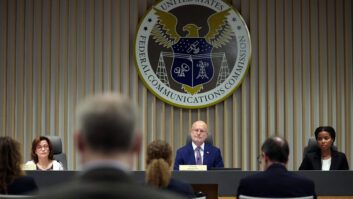
A packed room and a busy agenda of items on the docket set the stage for the Federal Communications Commission’s July open meeting, where it passed all six of its proposed initiatives.
Among the items the FCC approved included an update to bidding rules to enable the upcoming auction of AWS-3 spectrum licenses, as well as removing existing rules that Chairman Brendan Carr deemed as “outdated and useless.”
We summarized the proceedings. You can also watch the meeting below.
Gomez dissents from direct final rule
As Radio World has covered, the confirmation of Olivia Trusty, a Republican, last month gave the GOP a 2–1 majority in the commission with Chairman Carr. Anna Gomez is the lone Democrat commissioner on the panel, which has two vacant seats. All three commissioners were present for the meeting.
The commission passed its agenda item for a direct final rule to remove 11 provisions — what it billed as 39 regulatory burdens, 7,194 words and 16 pages — as part of the “Delete, Delete, Delete” docket.
[Related: “Carr Lays Out His ‘Build America Agenda’”]
Carr and Trusty voted in favor, while Gomez dissented.
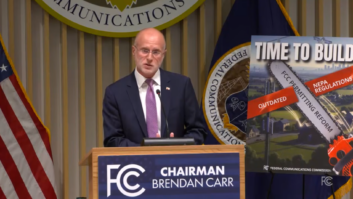
The chairman said the rules in question, which regulated telegraph services, “rabbit-ear” broadcast receivers and telephone booths, were for technologies considered outdated years ago. He said such regulations “often derail efforts to build high-speed networks and infrastructure across the country.”
You can see a full list of the rules that are being repealed here. They include repealing closed-captioning requirements for analog TV receivers. None of the repealed rules is specific to radio.
In Gomez’s remarks, she acknowledged the commission’s rules need to be “cleaned up,” but she was concerned about the erasure of rules without seeking public comment.
“If these rules are so obsolete, what difference would providing 30 days’ notice make?” she asked.
The number of reductions cited, Gomez said, “sound like big numbers intended to impress,” questioning, “what happens when a rule that actually matters is removed from the code of federal regulations?”
Carr cited the authority to fast track the elimination of rules through the Administrative Procedure Act. He said that “absent any significant adverse comments,” the rules would as a result of the vote be repealed. There is a 10-day period to submit comments.
“When it comes to regulations that should not be on the books, there is no reason to just let them sit there needlessly,” Carr said in his post-meeting press conference. He said the commission is simply taking advantage of its existing authority to do so.
The D.C.-based nonprofit Public Knowledge laid out its objections to the direct final rule, writing Thursday that the procedure “creates a dangerous path for bureaus empowered” by Carr to gut any rules it deems “obsolete, unlawful, anticompetitive or otherwise no longer in the public interest.” It had previously urged Carr to drop the item from the meeting agenda.
One step closer to spectrum auction
The FCC voted to update competitive bidding rules to enable an upcoming auction of the AWS-3 spectrum, specifically the bands 1695—1710 MHz, 1755—1780 MHz and 2155—2180 MHz. Carr described the spectrum as “lying fallow for years.”
As part of the “One Big Beautiful Bill” signed by President Trump on July 4, Congress restored the FCC’s spectrum authority.
The commission said in a release that it will announce auction application deadlines and bidding procedures in the coming months.
Carr and Trusty voted in favor of the update to the bidding rules, while Gomez approved and concurred in part. She cited 12 commenters who supported a Tribal licensing window and she expressed interest in ensuring that Tribes have a “fair and meaningful opportunity” to secure spectrum rights.
Other agenda items approved
All three commissioners voted in favor of the following meeting items:
- It approved rules that require wireless providers to implement georouting to route 988 text messages to local crisis centers based on the general geographic location, rather than by area code.
- It also approved a notice for proposed rulemaking to modernize its slamming and truth-in-billing rules, which it said were originally established to protect consumers from having their local or long-distance service switched without their permission.
- The commission also approved updates to its pole attachment rules, which it said will make it easier and faster to deploy broadband networks.
- Finally, it launched a proposed rulemaking to accelerate the transition from copper line networks to more modern, IP-based networks.