Broadcasters are continuing their effort to convince the FCC to ease or eliminate local caps on how many radio stations a company can own.
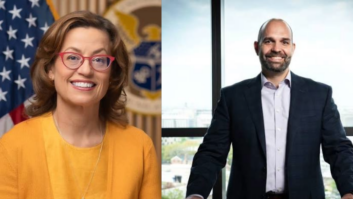
The commission is expected to launch its long-delayed 2022 quadrennial review of ownership rules this month. On Friday, representatives of the National Association of Broadcasters met with staffers of Commissioners Olivia Trusty and Anna Gomez.
NAB previously has proposed eliminating all restrictions on radio station ownership in Nielsen Audio markets 76 and smaller, as well as in unrated areas. In markets 1 to 75, it has proposed removing restrictions on AM station ownership and allowing broadcasters to own up to eight FM stations in a market.
Meeting with the FCC staffers, NAB pointed to data from Edison Research’s Share of Ear study for the second quarter of 2025, showing that AM/FM radio’s share of the time consumers spend listening to audio sources has fallen to 34 percent compared to 52.1 percent in the first Share of Ear report in spring of 2014. This image is from the NAB’s summary of the meeting:
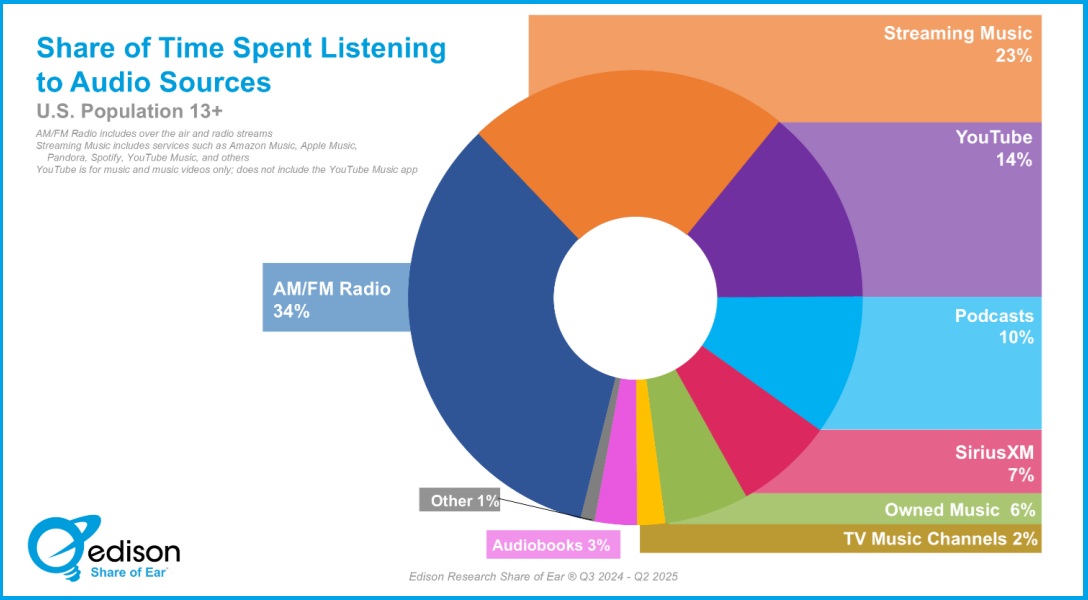
According to NAB, these numbers, which include both over-the-air and streaming listening, show that competition from digital sources such as streaming music, You Tube and podcasts continues to erode terrestrial radio’s audience share.
NAB President/CEO Curtis LeGeyt recently said, “Outdated rules have held broadcasters back for too long. Modernizing them means stronger local journalism, more investment in communities and the live sports fans count on.”
In the meeting, the NAB said competition for local advertising dollars from digital platforms has significantly undermined the financial position of the radio and TV stations it represents.
NAB says Borrell Associates’ 2025 advertising report estimated that local digital advertising reached $103 billion in 2024, accounting for about 70 percent of all local ad spending.
The report, it said, reconfirms that the “lion’s share of digital advertising” leaves local markets and “goes to the pureplay digital companies such as Google, Facebook and others,” with local media companies, including radio and TV broadcasters, only capturing about 15 percent of all locally spent digital advertising.
The association says changes to the Local Radio Ownership Rule would permit radio broadcasters to own additional stations in local markets, enabling them to expand their audiences and, thus, increasing the ad revenues that support their operations.
“Owning more stations locally enables broadcasters to program each outlet differently to attract different audiences with differing tastes and interests. This not only benefits the public by increasing the diversity of programming, but also benefits stations by increasing the size and variety of their audiences and their attractiveness to potential advertisers,” NAB wrote in an ex parte filing summarizing the meeting.
The NAB representatives also discussed the remaining TV ownership rules, noting that the national TV ownership cap “has not changed significantly since 1996 and not at all since 2004,” and that the local TV rule “continues to prevent ownership of more than two stations in the same Designated Market Area (DMA) in all cases, as it has since 1999.”
Chairman Brendan Carr, leading the GOP’s 2–1 majority on the current commission, appears eager to relaunch the 2022 Quad Review. He has been quoted over time saying that radio ownership rules should be abolished to ensure broadcasters have the resources to compete in the evolving media landscape.
Commissioner Gomez, a Democrat, has expressed concern over further consolidation in the broadcast industry. She said recently that each merger and consolidation limits voices and each closure of newsrooms limits discourse.
“The FCC’s proposal to lift the caps isn’t about innovation or competition, it’s about consolidation of viewpoints solely for financial gain,” she said at the Grass Roots Radio Conference earlier this month.
The commission will meet on Sept. 30. If it votes to launch the 2022 Quadrennial Review, it will begin accepting comments on the Local Radio Ownership Rule and any other proposed changes.