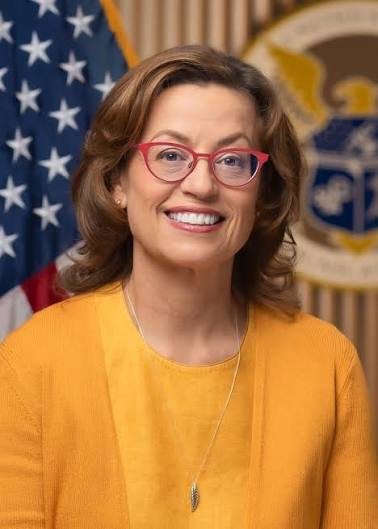
FCC Commissioner Anna Gomez has said she strongly opposes lifting broadcast ownership caps when it comes to television.
Knowing that, leaders of the National Association of Broadcasters recently met with Gomez to urge action on local radio ownership rules, while also addressing proposed changes to national TV ownership limits.
Led by President and CEO Curtis LeGeyt, NAB met with Gomez and her staff on Monday.
NAB also recently met with FCC Commissioner Olivia Trusty to support the commission’s recent proposal to remove the TV caps.
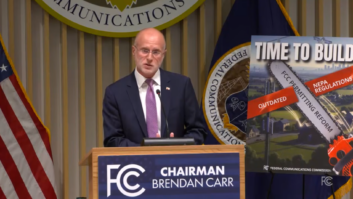
Following FCC Chairman Brendan Carr’s announcement of the upcoming Aug. 6 vote on that proposal, Gomez, the lone Democrat commissioner, did not mince words.
“This unlawful effort to hand control of the public airwaves to billionaire buddies of this administration will destroy local newsrooms, silence community reporting and drive-up costs for the American families who depend on local stations for news and emergency alerts,” Gomez said in a statement.
She added that Congress established the 39% national cap in federal law and that the commission lacks the statutory authority to waive it.
Radio’s viability at stake
According to a Tuesday ex parte filing, NAB, as it has in the past, emphasized that updating the local radio ownership rule, in NAB’s view, is necessary for the industry’s survival in a changing media landscape.
Under current regulations, a single entity is limited to owning up to eight radio stations in the largest markets, with no more than five on either the AM or FM band.
While there is no formal proceeding on the table to lift those caps, radio groups have been stepping up lobbying efforts to move the issue forward, as part of the FCC’s quadrennial review.
Critics of relaxing the caps argue that the Telecommunications Act of 1996 is part of the reason why radio’s local ad revenues are in a decline in the first place.
But NAB also wants those restrictions erased.
“Local radio broadcasters cannot survive in today’s digital audio and advertising markets while hamstrung by three decades-old restrictions on their scale,” NAB wrote in its filing.
The association pointed to data showing how big tech and digital advertising platforms dominate local ad markets to the detriment of radio stations and the services they provide.
“Owning additional local outlets on which to provide more and different programming, including niche formats or other content targeted to narrower audience segments, would benefit local consumers and increase stations’ listenership and thus their advertising revenues,” NAB said.
Localism, NAB said, is an expensive value, and radio’s ability to function is premised on its economic viability. “Today, that viability is in serious question, and the radio industry requires regulatory relief now,” it said.
On board with FCC’s TV proposal
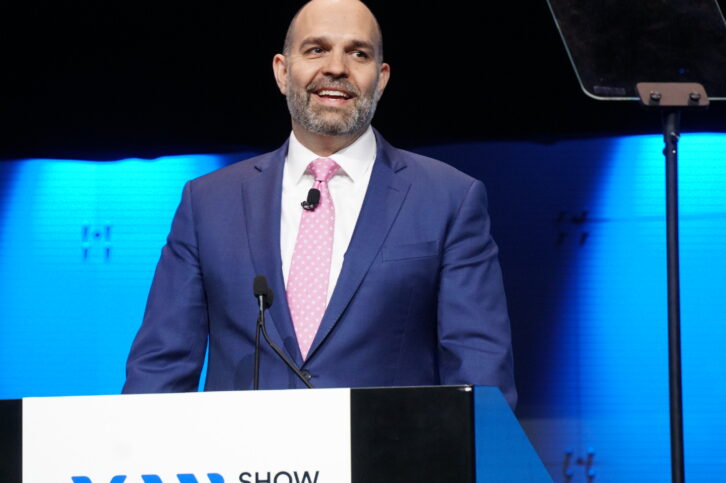
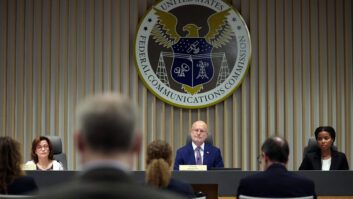
The meeting also focused on television ownership caps. The commission is scheduled to vote Aug. 6 on a proposal to replace the 39% national TV ownership cap with a case-by-case review.
NAB supports the FCC’s proposal. It said that the approach would give the commission flexibility to approve all TV transactions while preserving authority to review those that could raise public interest concerns.
In the meeting with Gomez, NAB representatives emphasized that analog-era national TV limits are “no longer tenable for the broadcast industry,” arguing that lifting them would preserve stations’ financial health while keeping free, over-the-air coverage viable nationwide.
Just like the radio rule, NAB said that the current national TV rule dates from a time “before the emergence and rapid growth of video streaming services, social media giants, massive digital advertising platforms, and smart devices ranging from phones to televisions.”
Removing those restrictions, NAB argued, would vindicate the FCC’s interests in promoting localism, competition and diversity, all the while still offering services “over-the-air and free to consumers across the country.”
[Do you receive the Radio World SmartBrief newsletter each weekday morning? We invite you to sign up here.]