The Federal Communications Commission realizes that in the forthcoming August NCE FM translator window, there will be conflicts to settle.
“Given the finite nature of and high demand for spectrum, the commission cannot authorize an NCE reserved band FM translator station to every qualified applicant,” it wrote on June 17 in its public notice announcing the highly anticipated filing window.
But prompted by that public notice, Michelle Bradley, CBT, founder of REC Networks, has raised what she considers a serious structural flaw with one of the FCC’s selection process criteria, one that could harm LPFM hopefuls and some full-service applicants.
For mutually exclusive (MX) applicants, the Media Bureau will use the same point-based mechanism utilized for full-service noncom FM windows.
The system awards points based on criteria such as established local ownership, statewide networks, technical parameters and local diversity of ownership.
To qualify for the two “diversity of ownership” points, the public notice requires applicants to certify that the 60 dBu contour of the proposed NCE FM translator does not overlap with the principal community contour of any full-service or LPFM station, or the 60 dBu contour of any non-fill-in translator in which they hold an attributable interest.
The fact that the 60 dBu contour is mentioned in the notice — and not the 70 dBu contour — is REC’s point of contention. By contrast, REC pointed out that during the 2021 NCE full-service filing window, the commission used the tighter 70 dBu contour to determine diversity claims.
It’s unclear if this was a typographical error by commission in the public notice. But listing 60 dBu, instead of 70 dBu, has several downstream impacts, which REC has laid out in detail. You can read Bradley’s analysis here.
For an LPFM station, the shift from 70 dBu to 60 dBu creates a regulatory Catch-22 under separate commission cross-ownership rules. Those rules state that an LPFM licensee’s translator must have an overlapping 60 dBu contour with the parent LPFM station to be permissible.
But by fulfilling the requirements as described in the public notice, in order to own the translator, an LPFM applicant is forced to create an overlap that automatically disqualifies them from receiving the two diversity points.
A clarification from the FCC, REC Networks wrote on its Substack, would not only rescue LPFM applicants but would also positively impact full-service NCE licensees seeking translators by reducing the geographic area subject to diversity claims.
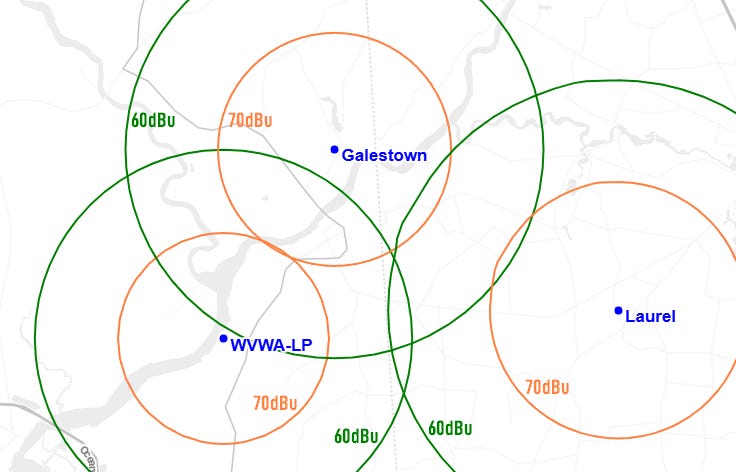
The 70 dBu contour is, by nature, smaller than the 60 dBu contour, and stands to align the window with the precedent set in the original 2000 report and order that established the point system for noncom stations that was used for three subsequent noncom FM filing windows.
REC Networks said it received an acknowledgment of its formal letter from the Media Bureau on Thursday. The bureau indicated it intends to review the matter in the coming week.
Race against the clock
Bradley also supports calls to delay the translator window’s filing dates, calling it a departure from historical timelines.
During the 2023 LPFM window, the FCC announced dates in June for a November window. Similarly, ahead of the 2021 NCE window, the commission issued its notice in April for a November filing period.
But in this instance, as we have reported, broadcasters received a June notice for an August timeline.
“While delaying the window will extend the amount of time applicants need to get budget approvals and other ‘green lights’ and it will relieve those who actually file the applications (such as REC), we are also in a race against the clock where it comes to the pendency of low-power TV and TV translator construction permits that were filed earlier this year when the FCC Video Division lifted a long standing filing freeze on such applications,” Bradley explained.
Aligning with previous windows and echoing concerns raised by groups like College Broadcasters Inc., REC stated it would support delaying the filing window to October or November to give operators adequate time to prepare, but not into the 2027 calendar year.
Comment on this or any article. Email [email protected].