Nick’s Signal Spot is a new feature in which Nick Langan explores RF signals, propagation, new equipment and related endeavors.
It was a three-day symphony in the ionosphere over North America.
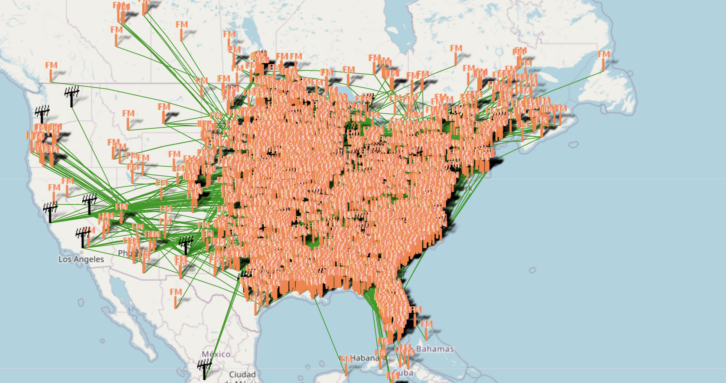
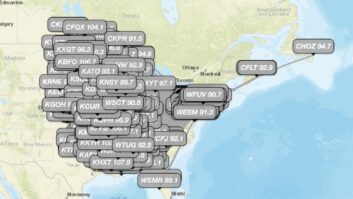
According to reporters on FMList — an excellent website we’ve referenced a few times that allows long-distance signal hunters to plot and track their logs — there were 1,441 FM E-skip logs in North America on June 8, 2,083 logs on June 9 and, for the crescendo on June 10, some 3,848 logs. On the 10th, the activity lasted all-day long at many locales east of the Mississippi River.
The activity has quieted down since, but no matter what happens in the sporadic-E season going forward, the amount of activity within the 72-hour period outdid some entire seasons recently, including 2024.
Here are some of the highlights we observed from various places online, including the WTFDA’s WLogger and FMList:
- William Hepburn in Grimsby, Ontario, logged Channel 7 KMNE(DT) in Bassett, Neb., on June 10. This is only the second such VHF high-band DTV reception via E-skip that we know of. Last year, Steve Rich’s Milford, Ill., DX site logged KNMD 8 in Santa Fe, N.M., which was an ATSC 3.0 signal.
- Randy Zerr (KW4RZ) in Goldfield, Nev. — who is like the “Showtime Lakers” of double-hop DX at this point — added several more long-distance catches. He grabbed multiple logs of over 2,000 miles into upstate New York, including 93.1 WNTQ(FM) on June 10. Later that evening, Zerr logged the pair of 90.9 WETA(FM) and 91.9 WGTS(FM) from the Washington, D.C., area. Check out his video!
- Ethan Hester in Sherwood, Ark., logged 92.5 KBEB(FM) in Sacramento on June 10 at a distance of approximately 1,630 miles.
- Saul Chernos in Burnt River, Ontario, logged 97.3 KLCE(FM) in Blackfoot, Idaho and 94.9 KENZ(FM) in Provo, Utah, netting two new states for the longtime DXer at likely double-hop distance.
- Mike Bugaj in Enfield, Conn., reported 98.7 KPRF(FM) Amarillo, Texas on June 9, at a distance of approximately 1,620 miles.
- DXers Steve Walko in Bucks County, Pa., and Michael Temme-Soifer in New Jersey reported 89.5 KENW(FM) Portales, N.M., on June 9, at around 1,600 miles.
- Many DXers, like Loyd Van Horn in Louisiana, Matt Sittel in Kansas and Les Rayburn in Alabama, also reported skip on June 10 into the NOAA Weather Radio 162 MHz band.
LIFETIME FIRST!!! 162.450 MHz – WWG88 in Crandon, WI – 1053 miles via Sporadic Es. @NWSGreenBay WFO heard in Mandeville, LA.
The ionosphere is certainly “on one” today. Never experienced 162 MHz Sporadic Es and I have been doing FM/VHF DX since 1995. #NOAAWeatherRadio… pic.twitter.com/hxLTkkRxL6
— DX Central (Loyd Van Horn-W4LVH) (@DXCentral) June 10, 2026
Andrew Knafel (K8EL), one of the most prolific DXers going right now from his location in Norton, Ohio, put it succinctly: It seemed as if the ionosphere, at the peak on June 10, was, well, vomiting signals everywhere.
It was overwhelming at times. Yours truly has a Radio World news desk to monitor, and as such it was hard for me to devote attention to the bevy of activity ongoing. But, that’s what autologgers and recordings are for.
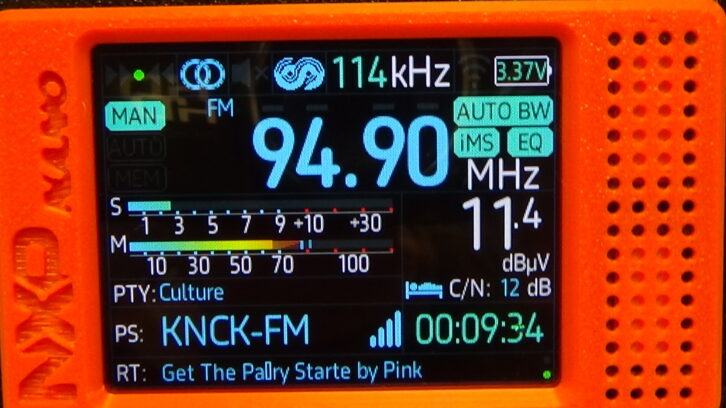
Steve Hemphill in Jim Thorpe, Pa., used his very neat looking Nano receiver, which uses the TEF6686 chip paired with an NXP ESP32 control process, to log 94.9 KNCK(FM) in Concordia, Kan., on June 9. Check out the QSL card he received!
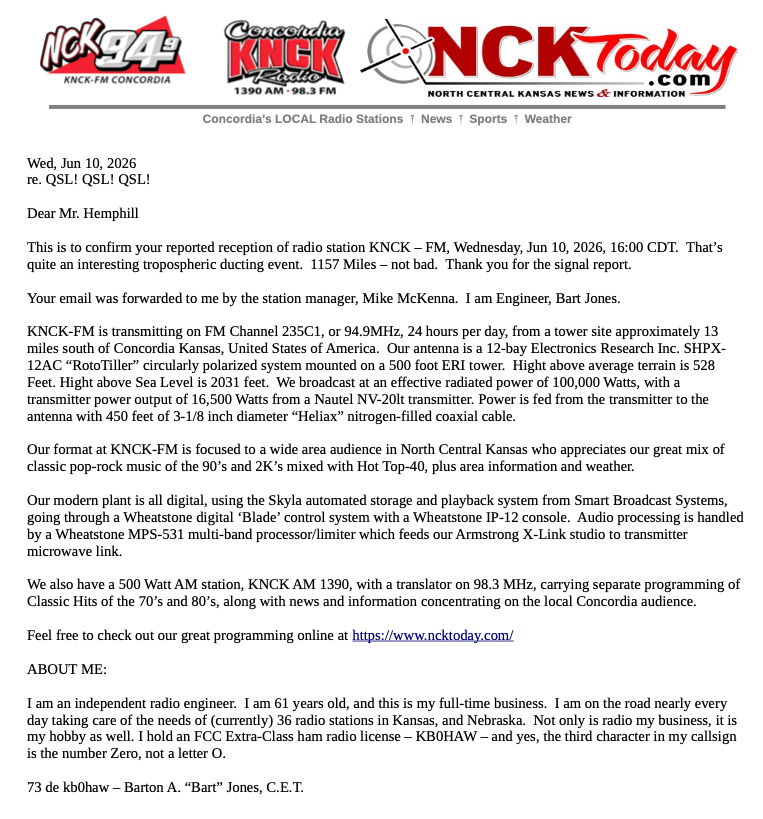
Some stations still do send out QSL cards! Of course, it’s also important to note what Hemphill heard was via E-skip — not tropospheric ducting, which is another propagation form we’ve written about.
In general, I asked Radio World nation to submit what they heard during the three-day period, and you delivered!
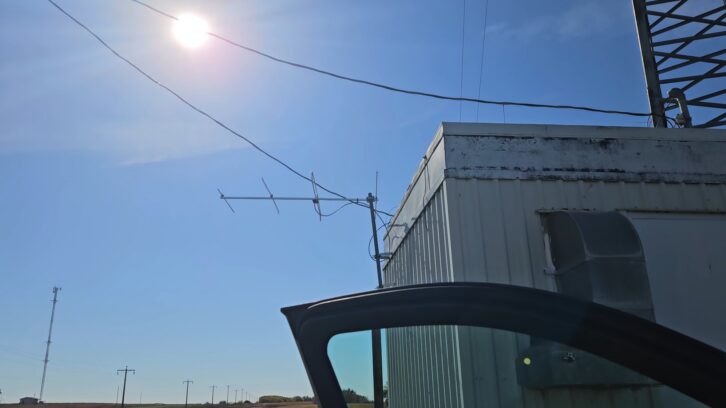
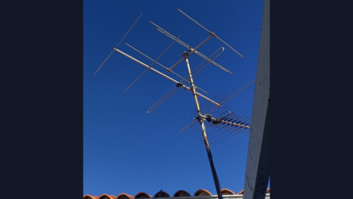
- Auke de Jong, a broadcast technician for Pattison Media in Brandon, Manitoba, reported E-skip bursts lasting from five seconds to a minute, as far away as 99.1 WDCH(FM) in Bowie, Md. Operating an automated logger from the Minnedosa transmitter site for the stations he manages, 91.5 CKLQ(FM) and 94.7 CKLF(FM) — equipped with a four-element Yagi at 10 feet and a generic RTL-SDR dongle — de Jong pulled in numerous logs despite heavy local signal interference.
- Mike Martin, operations manager at KQAL(FM) at Winona State University, caught WHRV(FM) 89.5 from Norfolk, Va., while driving 15 miles outside of Winona, Minn., on June 8. The signal was loud enough to completely cover KQAL’s own frequency and pull in RDS.
- Randy Selvidge, chief operator for KOLR(TV), KRBK(TV) and KOZL(TV) in Springfield, Mo., was driving midday on June 10, when he noticed a distant signal overriding a local LPFM station. His dashboard display confirmed it was WFLS(FM) 93.3 from Fredericksburg, Va.
- Brad Beahm, director of engineering for Flood Communications, had to explain long-distance propagation to his front desk staff after a listener called from Blairsville, Ga. — 748 miles away. The caller was picking up KBBX 97.7(FM) out of Nebraska City, Neb., and noted that the signal was strong enough for his receiver to successfully lock onto the station’s HD Radio carrier.
- Rusty Kinner (WA8ZID) in Surprise, Ariz., reported that the 6-meter amateur band was open all last week, netting him his first Hawaii contact at a distance of 2,900 miles and bringing him closer to a 50-state sweep on the band. Averaging a dozen new daily contacts and approaching 400 grid squares for his VUCC award, Kinner notes that keeping a radio tuned to the 50.313 MHz ham calling frequency is an excellent way to gauge whether the FM broadcast band is about to burst open.
- Jeff Parker (K4JLP), an engineer listening from Bedford, Va., on the evening of June 10, pulled in an impressive list of western plains signals using his 2017 Toyota 4Runner’s glass-mounted antenna and a Kenwood receiver. Between 7 and 9 p.m. local time, Parker logged KKPK 92.9(FM) out of Colorado Springs, Colo., with RDS data, 95.5 KAHE(FM) in Dodge City, Kan., KGBK(FM) 98.9 in Great Bend, Kan. and a 98.3 KATR(FM) in Otis, Colo., mixing with an unidentified Spanish-language station. He also caught CBW(FM) 98.3, the CBC Music signal from Winnipeg, Manitoba, which repeatedly faded in and out with its RDS text intact.
- Peter Morenus was driving on the University of Connecticut campus in Storrs, Conn., on June 9 when his car radio’s display pulled in the HD text for 90.1 WOI(FM) out of Ames, Iowa, despite still playing his local station, WECS(FM). Recognizing it as a sign of a big-time opening, Morenus tuned down to 89.7 — where he normally expects Boston’s WGBH — and instead received KIWR(FM) from Council Bluffs, Iowa. Before a meeting cut his DX session short, he also caught brief, fading Spanish-language audio on 87.7. “I wish I could have stayed in the car longer!” Morenus said. I know the feeling!
- Justin Szeliga in Bucks County, Pa., recalled hearing growing up how FM signals did not “skip.” Come to think of it, I remember hearing this myself some time ago. However, during the opening, Szeliga repeatedly picked up snatches of WFSU(FM) 89.1 from Tallahassee, Fla., which occasionally overrode his local station, WWFM(FM), especially when shielded by hills.
- Jim Van Damme was driving through the Catskills near Cooperstown, N.Y., on June 10 when KKOK 95.7(FM) out of Morris, Minn., came in from 1,100 miles away. Van Damme also captured other signals from Minnesota and Missouri that were strong enough to override local stations.
Did you hear something you’d like to share? Let me know!
Meanwhile, the ionosphere continues to recuperate, as it’s been quieter the past couple days here in North America. E-skip impossible to predict, as we’ve referenced, but considering the seasonal activity in the Northern Hemisphere often peaks the last week of June or first week of July, I believe there is much more to come! So don’t fret if you missed out on last week’s extravaganza.
E-skip goes mainstream
Allan Nosoff is a smart young meteorologist at WEWS(TV) in Cleveland, Ohio. He’s also ONE OF US — he’s an avid DXer! I had the chance to talk to him in 2024 about what he heard aboard a cruise from New York to Bermuda, for example.
He put together a wonderful feature on E-skip that ran on WEWS that is worth your time to check out. Northeast Ohio is a long-distance reception hotbed of sort, in Nosoff’s report, he interviews Jeff Rostron, a longtime DXer in Doylestown, and also references Knafel’s logs.
It’s a great primer if you are not well-versed in how this phenomenon happens. Nosoff makes the theory behind E-skip very accessible!
[Read the Signal Spot from Nick Langan for More DX-Related Stories]