When she was 10 years old, Julie Koehn’s career goal was to run a national labor organization.
Her path didn’t run that way. Today the 61-year-old with small-town radio roots plays an important role not only in Michigan broadcasting but in the national radio business. And she has the awards to prove it.
Koehn (pronounced Kane) leads Lenawee Broadcasting Co. and Southeast Michigan Media and serves on several state and national radio boards.
She has been president and CEO at Lenawee Broadcasting since 1990. Full-service WLEN(FM) in Adrian was founded by her father John in 1965. The station began transmitting in HD Radio in 2015, and its HD-2 channel, which has a sports format, is relayed on an FM translator.
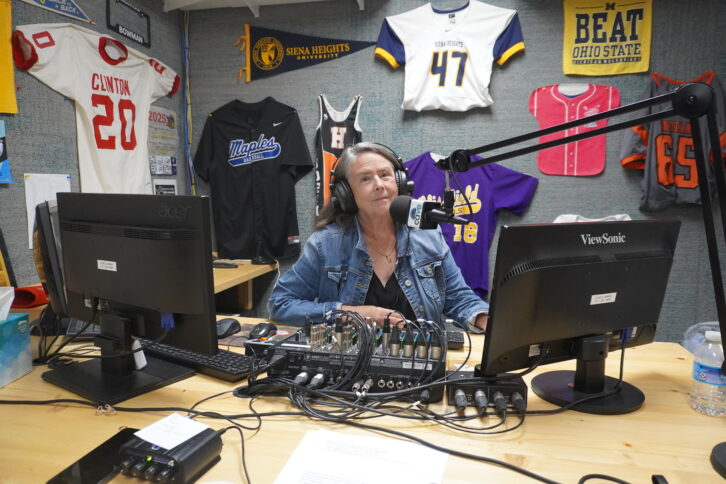
Meanwhile, Koehn has owned Southeast Michigan Media since 2020, including country station WQTE(FM) and sports simulcast WABJ(AM).
Adrian is a city of about 21,000 people, about 60 minutes southwest of Detroit. The radio stations are housed in the same facility. In all, they employ approximately 20 full- and part-time staff.
Her labor is in business
Koehn graduated from Michigan State University with two degrees unrelated to broadcasting. She never intended to follow in her father’s footsteps.
“My degrees are in labor relations and political science. I thought I’d be running the AFL-CIO someday. That was my original plan. I never figured I’d be in radio,” she says.
“But once I was bit by the radio bug I was all in.”
After a brief stint in Baltimore pursuing a job more aligned with her degrees, Koehn joined the family radio business in Adrian 1985 and took over its operation in 1990 after the passing of her father.
Koehn says broadcast radio faces many issues, but she is especially bothered by a misconception of the medium.

“We all know that that radio has a huge reach. But communicating that to clients and the advertising world is a very, very important issue, something that we’re all striving to do,” Koehn said.
“We know that radio is an effective medium, but with all of the noise of media in the world, digital and satellite and all of these things that are our competition, just telling radio’s story is really important.”
Headlines about radio often focus on how much debt some of the major groups carry or how radio in general is struggling. She says the industry needs to do a better job explaining its upside.
“There are a lot of positives out there. People are still buying and selling radio stations, and radio is still a very good business to be in.”
She describes herself as “wildly” optimistic.
“I think we have so many more opportunities we’ve never had. I had one radio station when I started. We’ve grown our group of stations to four,” Koehn says.
“We’re doing a lot of digital. We have a huge news product. We have thousands of people coming to our websites every day.” Lenawee TV is a newly launched online station that streams special programming including sports, community events and public meetings.
“There is so much opportunity out there as a media company, not just a standalone radio company. … Our goal is to extend our brand of providing free access with news and information and entertainment to the communities we serve.”
“Radio first”
Koehn says her group puts great faith in local news coverage to keep audiences engaged.
“News is so important. If we don’t have news, there’s no one to keep elected officials accountable. There’s no one to inform the public of crucial matters in their community,” she said.
“Let’s face it, on a national level, there are always lots of things happening, but when you come down to the local level, these are things that really impact people’s lives, and we need to be there to tell the story and to be able to provide people with information that helps them make informed, educated decisions.
“So while we do love to entertain people, we also know how big our responsibility is to keep our community informed about many aspects of life.”
She wants the stations to be available everywhere listeners want to hear them.
“Whether it’s on the air, whether it’s online, we want people to be able to consume us wherever they go.” And while digital platforms are important, she doesn’t want to lose sight of the radio component.
“We built a brand on the radio. Our brand has now transferred into our digital platform, but the radio product comes first for us. Understanding the power that radio brings to your digital is critical.”
Koehn values the opportunity to serve on the NAB Radio Board, where she works to represent broadcasters in small communities as chair of the Small and Medium Market Radio Committee. Someone once called her the poster child for small-market radio.
“I wear that as a badge of honor. I think it’s really important for the small broadcasters to have a voice. People would be very surprised at how much impact small-market broadcasting, whether it’s radio or television, has on a national level.
“There’s lots of things happening in small markets. We’re very agile, and we try things maybe other people wouldn’t try, just because we can.”
Many broadcasters talk about the importance of localism, and Koehn agrees it’s the key to winning in small-market radio, especially for smaller companies trying to compete across multiple platforms of digital.
She notes that in her market, listeners can hear 56 radio signals, including those in Detroit and Toledo. “We have a tremendous amount of competition for ears.” This makes local content yet more important.
“It affects their kids, it affects their schools, it affects their county and city governments, and so, thereby really affecting their lives.”
As part of that, it’s important that the station staff be seen and involved.
“We do tons of community service — and that’s our job. We try to do whatever we can to make our community a better place to live, because that translates into success and a positive; a positive for everyone.”
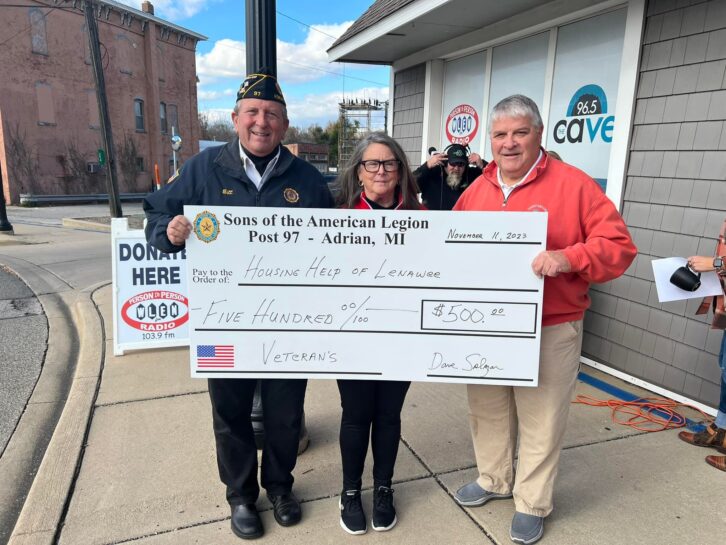
For example, WLEN/WQTE’s annual Thank a Vet Day has raised half a million dollars for local veterans over the years. In 2024, the station raised about $55,000 in 12 hours as the air staff hit the streets to collect donations. The money is distributed via the Veterans Dire Need Fund, managed by Housing Help of Lenawee.
“The impact of this event continues to grow each year, making a significant difference in the lives of those who have served our country.”
AI as assistant
When she began her career there were few women in leadership roles.
“I started in the business 40 years ago. Most of the mentors in experience and in my life were men for me, just because there weren’t women in those roles. Women and men lead very differently, but I feel I had a well-rounded opportunity to learn from different leaders.” Local broadcasters Dean Sorenson and Bud Walters were particularly important mentors.
Koehn spends time these days on finding strategic ways to improve the on-air product and better serve her advertising clients. She is tracking the evolution of artificial intelligence as a means to do both.
Her stations use AI for generating news story leads, rewriting content for broadcast and generating content for the web and social platforms. They also use AI for sales prospecting, generating leads and prompting ideas and text for ads and promotions.
“We have to be certain that we’re using it as a tool and not a replacement for something. It’s a great tool for information if you can verify [it] by multiple sources. It’s a great tool for concepts and ideas that you can make your own. I don’t see AI replacing people in our company, but I see it assisting us to work smarter and be able to stretch our time over more things.”
She also tracks regulatory matters in Washington. Koehn approves of the push by the NAB and others to eliminate or ease radio market ownership sub-caps and allow further consolidation.
“I’ve always been one of those people who believes in what the market will bear. It will take care of things. Once we were able to buy the other stations in the market, we were able to provide more localism and more content. And we did that because we had the scale to be able to do that. So we are now sharing resources among four radio stations, instead of among one or two.”
Since Koehn operates an AM, she is keenly aware of the AM for Every Vehicle Act that would require new cars to be equipped with AM radio. She predicts it will become law.
“The importance of AM radio for the Emergency Alert System and for redundancy across the country, if there ever were a catastrophic event, is critical. We’ve worked really hard to educate our representatives on the importance of AM remaining in vehicles. There’s been lots of momentum building in Congress.”
Honors
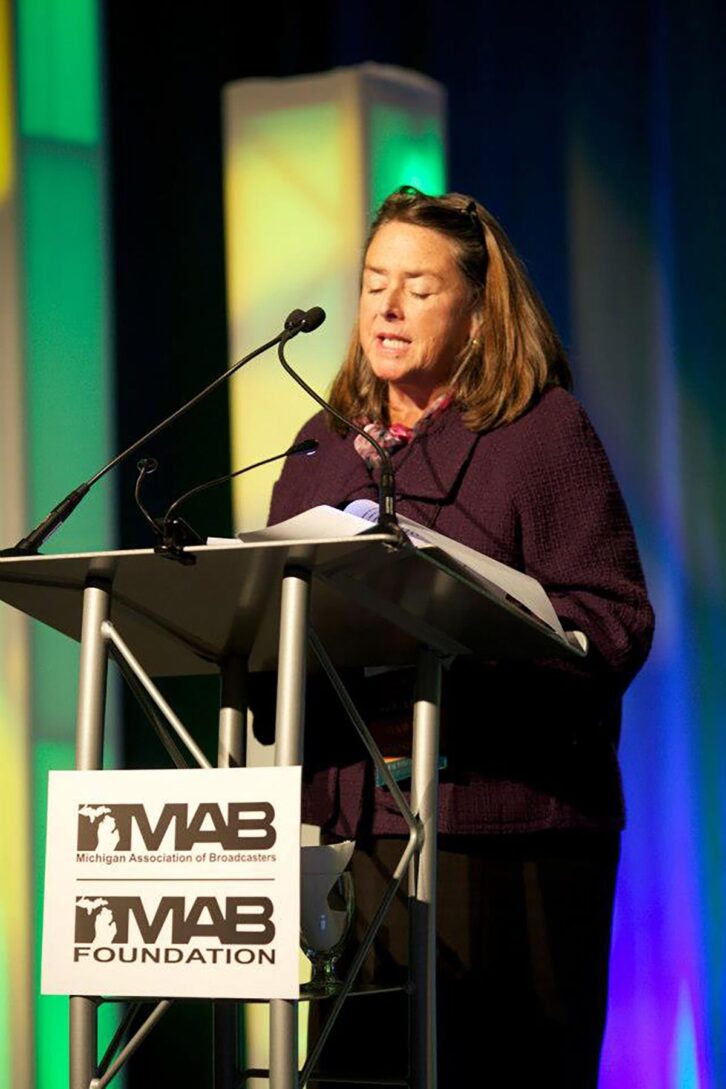
Koehn, who serves on the NAB Radio Board, has been a finalist for “Legendary Radio Manager of the Year” in the NAB Marconi Awards. She received the Michigan Association of Broadcasters Lifetime Achievement Award in 2016 and has been listed by Radio Ink as one of the most influential women in radio multiple times.
Yet she deflects fuss. “It’s nice to be recognized, but I’m part of a much bigger team that makes us successful,” Koehn says.
Her stations have five NAB Crystal Radio Awards, the NAB Crystal Heritage Award, five NAB Education Foundation Service to America Awards, and four NAB Marconi Awards — two for AC Station of the Year and two for Small-Market Station of the Year, according to her bio. In addition, WLEN has been MAB Station of the Year for 16 of the last 18 years in the category for its market size.