Long a key arbiter of U.S. communications policy, the FCC is actually stuck in a bygone era, argues economist Dr. Mark Jamison.
The American Enterprise Institute recently published his paper “Disbanding the Federal Communications Commission,” in which Jamison asserts that the agency’s independent commission model should be scrapped.
Jamison is a nonresident senior fellow at the AEI and director of the Public Utility Research Center and the Digital Markets Initiative at the University of Florida. He served on the Trump presidential transition team in 2015–16.
A regulatory dinosaur?
Jamison argues that the FCC is a relic of a world that no longer exists, one built around monopoly phone service and tightly limited broadcast spectrum. Today, he says, “broadcasting” is just one of many ways to deliver content and it no longer justifies its own regulatory silo.

“Because consumers increasingly view broadcast programming through non-broadcast channels and regard it as one option among many, broadcasting no longer constitutes an industry in the traditional sense and deserves no special licensing other than a right to use radio spectrum,” wrote Jamison.
The FCC was established in 1934 to oversee government-protected telephone monopolies and to manage scarcity in the number of broadcasters. Jamison said those conditions have long since evaporated.
“Given its loss of purpose and its institutional weakness, it appears that communications policy in the U.S. would be better off without the FCC,” Jamison wrote.
“There is no longer a need for the two core functions for which the FCC was created: common carrier regulation and broadcasting licensing.”
When market boundaries are dynamic, he argued, it is impossible to establish common carrier regulations that apply only in situations where customers are unable to exercise options.
“Shuttering the FCC would implement a deregulatory strategy for the communications sectors,” he said.
“Common carrier regulations for telecommunications would cease, as would content oversight of broadcasters.”
Jamison contends that, as the FCC’s core mission has faded, it has become easier to use it as a political tool without real economic cost.
“During the Obama years, the agency undertook newsroom inquiries, redefined internet services to fit the common carrier mold and advanced initiatives shaped heavily by congressional partisans,” he wrote.
“The Trump administration continued the trend, attempting to enlist the FCC into regulating social-media content. The Biden administration pursued sweeping rules to oversee broadband participants and even broadband supply-chain relationships. The recent Biden and Trump efforts demonstrate the eroded predictability that regulatory-commission design was meant to protect.”
His solution is to scrap the commission structure, move its staff and duties elsewhere in government and avoid tech-specific rules that quickly go stale and stifle innovation.
Revamp, renew, reorganize
Jamison’s plan is framed as an administrative reorganization rather than a shutdown of its core functions.
He emphasizes that the first step would be to identify which essential staff functions need to be preserved and immediately rehouse them within a different federal agency. The idea is continuity of work and expertise, with only the oversight structure changing.
“We can keep something that is like a ‘Federal Communications Department’ … but we just don’t need the commission,” Jamison told Radio World. “We can have staff and directors of staff that do that work quite well.”
If the FCC is dissolved, Jamison says its spectrum auction operations and staff should be transferred to an agency that is noted for its ability to manage technically complex functions. His candidates include the National Institute for Standards and Technology (NIST) and the Cybersecurity & Infrastructure Security Agency (CISA). He writes: “It might even be appropriate to form a new, specialized agency.”
As for other core FCC functions, Jamison says consumer protection would be better handled by the Federal Trade Commission.
Additionally, equipment authorization functions could be handled by NIST. Emergency services oversight could be handled by the Department of Commerce, CISA or Homeland Security. Space policy could be handled by NASA. And international relations are covered by the Department of State.

(Credit: Warrington College of Business)
Jamison says the way the FCC handles the distribution of broadcast licenses also needs to change.
Traditionally, a broadcast license includes both the spectrum in question and what the licensee is allowed to use it for.
“I’m suggesting that the last piece, ‘here’s what you can use it for,’ doesn’t belong anymore. You can have the license to use the radio spectrum but we’re not defining how it’s used.”
Political chess
According to Jamison, as the FCC’s founding purpose receded and the economic cost of politicizing it fell, administrations began using the agency as a political tool rather than an independent regulator, with each executive power redefining the “public interest” to suit its own agenda.
As the reasons for its creation disappeared, a mission vacuum was created.
The FCC’s public interest standard requires radio and TV broadcast licensees to operate in the “public interest, convenience and necessity” — a broad mandate stemming from the Communications Act of 1934, obligating broadcasters to serve local needs with diverse programming rather than just maximizing profit.
“‘Public interest’ is a very general term, and I suspect that the Trump administration probably defines it quite differently than the Biden administration, which probably is quite different than the Obama administration, than the Clinton administration and either Bush administration,” said Jamison.
“Everybody gets their own definition.”
But he told Radio World that the FCC’s public interest standard is vague, subjective and in conflict with the First Amendment.
“When a broadcaster is influencing people to think differently than you do, you would view that as contrary to the public interest,” he said. This is one reason the FCC is so vulnerable to political pressure.
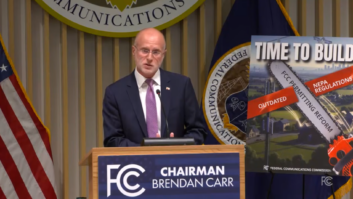
Since Brendan Carr was appointed FCC chairman by President Trump in January 2025, the rights and responsibilities of broadcasters and networks have been debated widely.
President Trump criticized ABC, NBC and CBS for what he called bias following the murder of activist Charlie Kirk.
Carr warned the networks that he could and would use his powers to block mergers or pull the licenses of broadcasters who did not operate in the public interest. ABC’s suspension of Jimmy Kimmel in the face of such pressure resulted in widespread backlash.
Carr also launched investigations into NPR and PBS, questioning whether their corporate underwriting violated federal laws against commercials. The investigation helped propel Trump’s effort to end federal funding for public media, framing it as a move against perceived “liberal bias.”
Jamison said the FCC’s pressuring of broadcasters isn’t anything new. He said President Obama’s second term marked an “unprecedented rise in partisanship” at the agency.
He pointed to research by the Technology Policy Institute on commission votes from 1994 to 2016. It found that, during Chairman Thomas Wheeler’s term, 26% of votes were split along party lines, more than triple the rate under other Democratic chairs (8%) and more than five times that under Republican chairs (4%). Wheeler was appointed by Obama in 2012.
Likewise, TPI reported that fewer than half of the votes in this era were unanimous, compared with averages of 65% and 58% under other Democratic and Republican leaders, respectively.
“The FCC experienced more party line votes from late 2014 through 2015 than in its previous 43 years,” wrote Jamison.
In the cases of both Presidents Trump and Biden, Jamison wrote that there is “inadequate” evidence that the FCC was doing a president’s bidding. “Nevertheless, the policy swings demonstrate that the agency is not providing the dependable regulatory environment that it was created to deliver.”
Innovation is key
Jamison warns that keeping outdated communications laws on the books traps broadcasters in “boxes that are not economically viable.”
He argues that rules designed for a bygone era hold back innovation and should be rethought so stations can adapt to today’s media and technology landscape.
Broadcasters “should be released to innovate and do things differently… not being bound by things that have lost their importance.”
He said: “If you write regulations with a particular type of technology in mind, the technology is going to race beyond you, and your regulations won’t be accomplishing what you would think they should. In fact, they may work against the very things that you’re trying to accomplish.”

As an example, Jamison questions the FCC’s standing regulations on fixed line telephone service, noting those rules were written in the 1930s and stopped being relevant in the ’80s.
His view is that radio’s future depends on regulatory frameworks loosening so stations can adapt and innovate, rather than being preserved through legacy, broadcast‑specific protections.
This is an area where Jamison and Carr seem to agree. Under the direction of the chairman, the FCC opened up a “Delete, Delete, Delete” docket last March and has since scrapped countless “outdated” rules with the help of public feedback.
As to his broader conclusion, Jamison acknowledges that more research would be needed.
“It is unclear how expertise and statistical histories can be transferred without loss of skill, professionalism and proficiency. Work is also needed on how to protect from political interference agencies that take on FCC functions, especially those related to radio spectrum and subsidies.”
He added that the research will be even more important if the Supreme Court rules that independent agencies as currently constructed violate the Constitution.
“While political interests are legitimate for providing laws, they can be destructive when applied in the execution of the laws.”
Read Jamison’s white paper here.