KEXP Seattle and KEXP Bay Area (KEXC) are operated by Friends of KEXP, a non-profit organization based in Seattle.
“We are replacing the audio playout platform and asset management system in nine studios, including three remote,” said Director of Engineering Jamie Alls.
“This function was handled by Dalet Galaxy platform for the past 10 years and was a single platform doing both functions. The new system will replace the asset management function with OrangeLogic OrangeDAM, a cloud-based asset management system.”
The playout function will be handled by the Myriad 6 Playout platform from Broadcast Radio and will be on-prem.
KEXP requirements for a playout system are unique in that it has a library of a million titles and content assets.
“That library needs to be searchable and available to play to air within three seconds of selection,” Alls said.
“KEXP curates their music programming ‘on the fly’ by a live DJ 24/7. Therefore the normal automation tools prevalent in the industry have limited use at KEXP.”
That tight turnaround for playout required an on-prem solution and then a sync function between the two platforms.
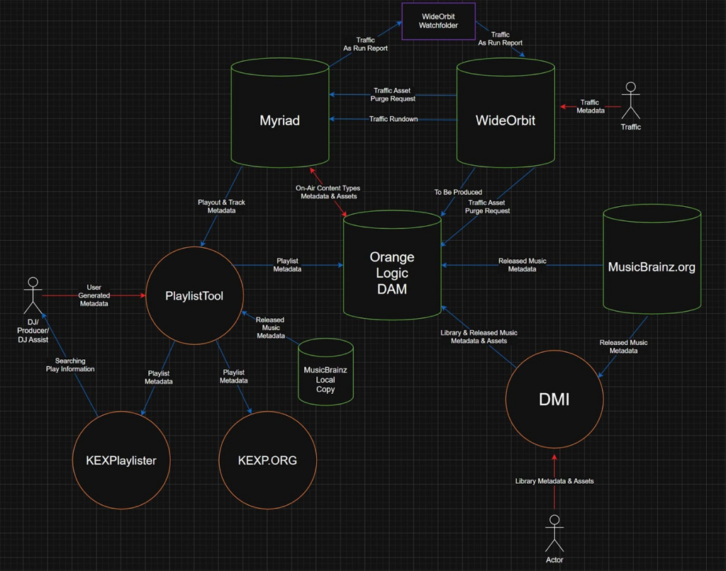
“We’ve developed custom software for achieving some of this, called the Digital Music Importer or DMI, which gathers the file and relevant metadata from the MusicBrainz open-source music database.”
KEXP’s library also has custom profanity ratings, clean edits and music content produced in-house.
“API calls between the platforms achieve a sync between the on-prem copies of the library, and the ‘source of truth’ library in OrangeDAM in the cloud.”
Work is scheduled to be completed in the second quarter of 2026.
“We are in the final stages of integrating the two platforms and finalizing our sync from cloud to on-prem for relevant content types. Then testing and UI refinement before a staged rollout to our main stakeholders, 50-plus DJs who curate our programming.”
The framework
KEXP studios are on the Seattle Center campus in the Uptown neighborhood of Seattle. A team of five is working on the project.
Alls is the project sponsor as director of engineering. Broadcast Engineering Specialist Nel Jee Aa Na is the overall project manager. The setup of OrangeDAM is led by KEXP Library and Archives Manager Afsheen Nomai, MSIS, Ph.D., CA.
Setup of the Myriad playout on the software side is led by Senior Systems Engineer Clint Dimick, while audio and traffic integrations are led by Broadcast Engineer Ian Davidson. Senior Software Developer Sean Dougherty wrote the code for the DMI.
In addition to OrangeLogic and Broadcast Radio, KEXP also contracted software development help from AVP, an OrangeLogic partner for custom integrations.
KEXP is a Wheatstone plant with LX-24 consoles throughout. InRush Broadcast Services helped with Wheatstone scripting for the traffic split setup.
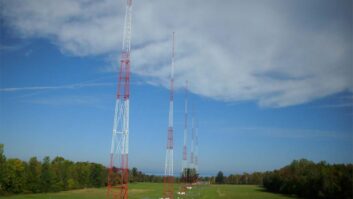
“We use GatesAir Intraplex units for the STL to Sutro Tower in the Bay Area. The STL in Seattle is via dark fiber that we light up with BroMan CWDM hardware that carries network, audio and video to the transmitter site.”
Moving the library to the cloud was a big step into uncharted territory.
“Dalet runs on a private virtualization platform on-prem. Over 20 servers in that virtualization environment were required to make it run smoothly. That became very expensive to maintain,” Alls said.
“OrangeDAM is a cloud-based solution that forces us to evolve our thinking about operations, network security and workflows. Keeping our playout on-prem requires a tight integration as content and metadata have to flow in both directions,” he said.
“BroadcastRadio has been an amazing partner in providing custom augmentations to their product as we discover various needs, both with the user interface and backend API calls.”
Tools for what KEXP had in mind are hard to find in the radio industry, Alls told Radio World.
“We had to search for vendors who could meet our requirements. When we’d try to explain to some of the bigger players in this space about what we wanted, they either looked at us dumbfounded, or tried to get us to adopt more automation.
“We are, generally speaking, anti-automation. Being human-powered is a large part of our brand identity, and so we spend a lot of time building or configuring tools for our unique purposes.”
Remote-friendly
KEXP has expanded remote broadcast access to the library so that DJs can program essentially from anywhere.
“Previously, we have one remote DJ kit we call DJ-R, where we provided a remote desktop session to a purpose-built Dalet playout workspace as well as a Wheatstone Screenbuilder mixer that allows DJs to do the manual crossfades between tracks.”
This solution has proven popular, and the programming department uses it almost daily. Sometimes this results in shows back to back having to coordinate the handoff of DJ-R between the two hosts.
“The new system will have three remote broadcast studios intended to be accessed remotely. One will be dedicated to our Bay Area programming, and the other two will be available for back-to-back handoff between DJs that are not at the main studio.”
Alls added that the station has an uncommon problem in that it plays traffic for two different markets, and potentially more.
“Since we are hand-crafted, we don’t have the luxury of automating the audio routing from a broadcast log. During a simulcast broadcast, which is 97% of the time, DJs fire a traffic break manually at the end of a song or air break, which triggers a routing change so we can send the Bay Area traffic to the right place, and keep the Seattle traffic going to all other endpoints including streams and FM,” he said.
“Since we will now have five studios — two local and three remote — from which this command can originate, we’ve had to devise a system for the DJ to ‘take traffic’ when they go on air in a studio, which gives them control of firing the two traffic logs simultaneously from the designated studio.”
InRush was instrumental in helping program the “take traffic” function on SS8 button panels in the LX-24 board.
“During a ‘breakaway’ broadcast, where a local Bay Area show is programming independently of Seattle, with its own traffic, we needed to give that studio control of its own playlist. It got complicated quickly!”
He called it another example of the complexity involved in giving humans the ability to program on the fly.
Alls said KEXP has built its brand on providing live curation with humans responding in real time to the world we inhabit.
“We’ve found that the listeners who value that connection and programming are willing to support it. It’s way more expensive and ‘inefficient’ to operate this way, but as a non-profit, we can devote resources to the technology that adds that value that people want to support. We are fortunate to have both a listener base and management that ‘gets’ it.”
This is excerpted from the free ebook “Sweet New Studios for 2026.”