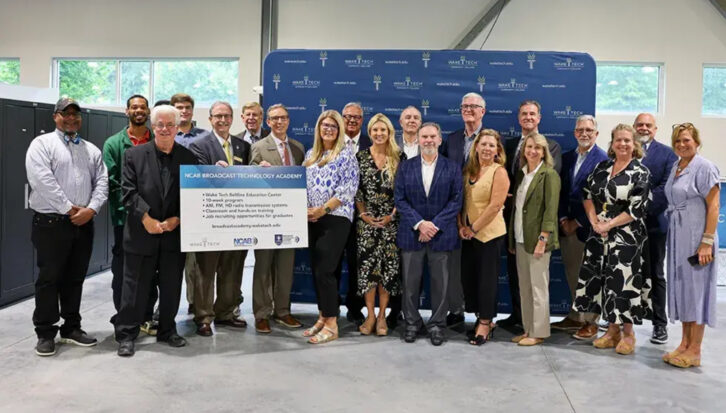
“There is an immediate need for radio frequency engineers throughout our state. The Broadcast Technology Academy is providing a direct pipeline of talented and well-trained individuals to fill that need.”
Those are the words of Mark Mendenhall, president of the North Carolina Association of Broadcasters, as reported on the website of Wake Tech Community College.
The NCAB partnered with Wake Tech to develop the 10-week academy “to prepare individuals who are technically minded, mechanically inclined or electrically inclined for careers as broadcast technicians.”
Tuition, fees and books are covered by the state association. Additional funds are available to help with living expenses and transportation.
The program provides 240 hours of instruction and bench work, eight hours per day, three days a week, for 10 weeks. The school has a lab equipped with modern Nautel solid-state AM and FM transmitters, as well as legacy CCA and Harris radio gear. TV equipment is planned.
The syllabus was written by retired engineer Jerry Brown, using the SBE Engineering Handbook as the course’s textbook; and as the program took shape, Brown also emerged as the instructor and ambassador for the academy. Guest lecturers complemented his teaching.
Students learn about AM, FM and HD radio transmission systems, including transmitters, antennas, transmission lines, remote control systems and program delivery systems.
Thirteen recently completed the program and subsequently passed the Society of Broadcast Engineers Certified Broadcast Technologist exam. They now should be able to troubleshoot and repair legacy and modern transmission systems.
I asked Jerry Brown if he had encountered any surprises during this first session.
“We found out early on that you need to do a refresher on basic physics and advanced math, such as linear algebra, geometry and an overview of calculus — foundational things when you get into antennas and electromagnetism and those sorts of things,” he said.
“We were able to adjust quickly and we’re addressing this in the course rework.”
Brown said that the program seems to be a good fit for today’s technically minded young people.
“STEM students find a field that allows them to do everything: computer science, IT, engineering, electrical, mechanical.”
And what a great model this is. I hope more state broadcast associations and technically oriented educators will emulate it.
The next academy at Wake Tech is planned for next summer. More info is at the school’s website.
The SBE recently added Wake Tech’s associate of arts and sciences degree in electronic engineering technology to its list of tertiary education programs that offer training for a career in broadcast engineering and multimedia technology.
Other schools on the list, according to the SBE website, are Bates Technical College in Tacoma, Wash.; Cayuga Community College in Auburn, N.Y.; and the AFRTS Technical Training Program at the Defense Information School in Fort Meade, Md.
The society is on the lookout for other schools to join its Certified School list, and it has a school sample curriculum to assist schools in creating a broadcast engineering degree program.
Radio World welcomes letters to the editor on this or any story. Email [email protected].