The author is with Telecommunications Law Professionals. His columns appear regularly in Radio World.
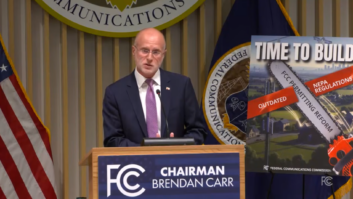
Almost everyone has heard about the controversy regarding FCC Chairman Brendan Carr’s assertion that shows like “The View,” “Jimmy Kimmel Live!” and “The Late Show” are not exempt from the “equal time” rule and that a failure to comply with the rule could trigger enforcement action.
As widely reported, the chairman’s remarks have been associated with last-minute cancellation of the appearance of Texas State Rep. James Talarico on “The Late Show With Stephen Colbert” in February.
His statement constituted an apparent change of FCC policy with respect to the “bona-fide news interview” exemption to what Carr called the “equal time” rule. The exemption has been extended to talk shows ever since it was granted to “The Tonight Show With Jay Leno.”
What is the rule?
To better comprehend this development, one must first understand that actually there is no “equal time” rule. That phrase implies that a program that interviews a candidate must grant equal time to the candidate’s opponents.
It should be called the “equal opportunities rule,” and in truth it operates quite differently.
The chairman was referring to a requirement established by Section 315(a) of the Communications Act, “Equal Opportunities.” It never uses the words “equal time.”
Here’s what it states: “If any licensee shall permit any person who is a legally qualified candidate … to use a broadcasting station, he shall afford equal opportunities to all other such candidates …”
This was addressed in the FCC’s 1978 Political Primer, “The Law of Political Broadcasting and Cablecasting.”
The commission explained that the law doesn’t use the phrase “equal time.” The provision refers to the right to obtain time in a period likely to attract approximately the same size audience as the period in which the opposing candidate appeared.
In a footnote, the commission stated that “[i]n order to avoid repetitious language, we have sometimes referred to ‘equal time’ in this primer, but we mean ‘equal opportunities’ unless otherwise indicated.”
When does the rule apply?
In addition, the FCC and federal courts have interpreted this requirement to apply only to candidates who are directly opposing each other for nomination or election. So Section 315 requires that candidates for the same office be given equal opportunities, not necessarily equal time or an appearance on the same program.
What is actually required?
Indeed, a station is not required to sell or give a candidate any particular time period, or make available exactly the same time period that was sold or given to his or her opponent.
Rather, the station must make periods that normally have comparable audiences available to competing candidates upon request; they may be in different programs or times of day. Indeed, an opportunity for 30 minutes may be equal to an opportunity for 60 minutes if the station can make the case for it.
Moreover, it’s not the station’s responsibility to reach out to opposing candidates. The onus is on the opposing candidate to request equal opportunities within seven days of the opposing candidate’s prior use, i.e., where the candidate takes part personally, either by voice or picture.
The station also is not required to notify the opposing candidate. Hence, the importance of the station’s political file.
Equal opportunities exemptions
In recognition of the need for unhindered news reporting, Section 315 of the Communications Act provides four exemptions from the equal opportunities rule.
They apply to an appearance by a legally qualified candidate on any:
- bona-fide newscast
- bona-fide news interview
- bona-fide news documentary (if the appearance of the candidate is incidental to the presentation of the subject or subjects covered by the news documentary), or
- on-the-spot coverage of bona-fide news events (including but not limited to political conventions and activities incidental thereto)
Here is where the real controversy begins.
Overturning precedent
The FCC began wrestling with how to classify talk shows under the above framework in a 1984 decision involving the “Donahue” program.
It held that certain programs or portions of them qualified as bona-fide news interviews, and were thus exempt from the equal opportunities requirement, even when they were included as part of “entertainment” programs.
The commission ruled that including less-conventional interview formats in the bona-fide news exemption was consistent with Congress’ intent to increase news coverage of the political campaign process.
It stated that “it would be unsound to rule that a program involving a unique or innovative approach to interviewing its guests somehow lacks sufficient licensee control evident in traditional news interview programs like ‘Meet the Press’ or ‘Face the Nation.’”
The FCC also stated that “the fact that other ‘Donahue’ segments may not include discussions pertaining directly to the political arena, or even to current news events, would appear immaterial.”
The commission subsequently declared that “The Tonight Show With Jay Leno” met the criteria for exemption as a bona-fide news interview: The program was regularly scheduled, its producers controlled all aspects of the program, and they asserted that decisions as to format, content and participants were based on the producers’ independent news judgment as to the participant’s newsworthiness and not motivated by partisan purposes.
The chairman’s approach
However, Chairman Carr has a different take.
His recent policy statement essentially overrules the “Tonight Show” precedent. According to The Hollywood Reporter, Carr said networks should operate under the assumption that shows like “The View,” “Jimmy Kimmel Live!” and “The Late Show” do not qualify as bona-fide news interviews and that failing to comply with the equal opportunities rule will trigger an enforcement action.
Under this interpretation, TV hosts must give similar airtime to candidates of both parties. According to Carr, the general rule is that equal time applies, although the statute says “equal opportunities.”
So now a show desiring to interview a political candidate either must file a petition for declaratory ruling to determine whether they qualify for the bona-fide news exemption or be prepared to offer equal opportunity to opposing candidates that may so request.
Guidelines
As noted, the equal opportunities rule is not necessarily a requirement to offer both candidates “equal time.”
The Communications Act only requires that broadcast stations airing an appearance by a legally qualified candidate for any public office shall afford equal opportunities to all other such candidates for that office.
This principle has been judicially affirmed in the oft-cited case United States FCC v. Summa Corp., Etc.: “The FCC itself has recognized that Section 315 refers to ‘equal opportunities,’ not equal time, and that there is thus no obligation ‘to make available exactly the same time periods, nor the periods requested by [the complaining] candidate.’ The time periods offered must only be ‘comparable as to desirability.’”
Here are some guidelines derived from past FCC rulings and policy:
What is required:
- Comparable availability
- Comparable classes of time
- Comparable opportunity to reach audience, or reasonably similar audience potential.
What is not required:
- Identical clock times
- Identical programs
- Same format or host
- Exact duplication of exposure
Those guidelines reflect the statute, the historic FCC interpretation and the so far unquestioned judicial confirmation of the rule.
However, Politico reported that Carr said TV hosts must comply with rules requiring they give similar airtime to candidates of both parties. Given the chairman’s statements about particular shows, how the current FCC might rule on an “equal opportunity” offered at a different time or on a different show and the criteria it would employ to determine what constitutes an equal “opportunity” remain to be seen.
What about radio
While the discussion has been about TV programs, Chairman Carr has clarified that the rule also applies to radio. Quoted in Politico, he has said there “wasn’t a relevant precedent … being misconstrued on the radio side.” So he didn’t see any reason to similarly press radio stations, although the same underlying rules apply. But with the mid-terms coming up, it will be interesting to see how radio shows like Sean Hannity, Mark Levin or Dana Loesch, all of whom have had Republican candidates in their shows, deal with it.
Fairness Doctrine
A final note: The equal opportunities rule should not be confused with concepts of the now-defunct Fairness Doctrine. It required that a station presenting one side of an issue give reasonable opportunity for presenting contrasting views. It did not require equal time to opposing views or present opposing views in the same program if it presented them in its overall programming. The licensee could choose the controversial issues to be discussed and the persons who would present the various views about them, provided the decisions were reasonable and made in good faith.
This column is provided for general information only and should not be relied upon as legal advice pertaining to a specific situation. Decisions should be made only after consultation with a legal professional of your choosing.