The Federal Communications Commission has adopted rules to auction 160 megahertz of spectrum in the Upper C-Band (3.98-4.14 GHz) by July 2027.
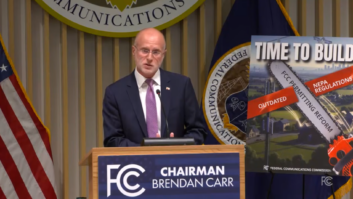
During its open meeting on Wednesday when the Report & Order was adopted, FCC Chairman Brendan Carr said that the agency is now “on track to complete an auction in less than twelve months from now.”
Speaking at the July meeting, Carr said “our decision today sets the stage for the FCC to run an auction of prime, mid-band spectrum next year — exceeding the 100 megahertz minimum established in the law.”
He highlighted that with the Lower C-Band, which the FCC freed up in 2020, the added Upper C-Band, the spectrum has been unified to create an “enormous landmass of 440 megahertz of mid-band spectrum.”
“Freeing up this spectrum drives down prices, raises speeds, and enhances competition,” Carr said. “The One Big Beautiful Bill made certain that we will put this prime, mid-band spectrum to its best use through another major FCC auction.”
As we’ve previously reported, Congress required the FCC to auction at least 100 MHz of Upper C-Band spectrum by no later than July 2027.
While the FCC originally proposed auctioning up to 180 MHz, wireless carriers and satellite incumbents pushed for vastly different outcomes.
The National Association of Broadcasters urged the commission to limit the auction to 100 MHz, warning even that amount would disrupt incumbent users.
Radio and TV stations that use satellites to pick up programming remain wary of further changes after navigating the 2020 Lower C-Band migration.
But Wireless companies praised the FCC for the Order and the agencies plans to hold more spectrum auctions in 2028.
“The auction of two ‘super bands’ of mid-band spectrum in the next two years will extend America’s wireless leadership and will deliver real results for Americans during this administration,” T-Mobile CEO Srini Gopalan said on LinkedIn.
During the vote, FCC Chair Carr and Commissioner Olivia Trusty approved the measures; Commissioner Anna Gomez approved in part and dissented in part.
The FCC Order plans to bridge the Lower C-Band and Upper C-Band to create a single, harmonized “super band” spanning 440 megahertz (3.70-4.14 GHz).
The FCC also reported that it will auction 60% more spectrum than the 100 megahertz minimum required under law, a decision that will raise tens of billions of dollars more for the U.S. Treasury to support deficit reduction and national priorities.
The FCC also stressed that the auction is on track to close by the statutory deadline of July 2027, and the FCC’s new rules ensure that the Upper C-Band can be lit up for most Americans before the end of 2030 — faster than originally expected.
The FCC described additional benefits, details and features of the Order, Order of Proposed Modification, and Order on Reconsideration adopted on July 22 as follows:
- The Impact: This plan puts America on a path towards massive gains that could result in at least $422 billion in GDP, 2.4 million new jobs, and $621 billion in consumer surplus by freeing up additional spectrum.
- The ‘Super Band’: The 2027 Upper C-band transition will ultimately result in a 440 megahertz contiguous block of spectrum for the provision of wireless services by combining the Lower C-Band (3.7-3.98 GHz) and now the Upper C-Band (3.98-4.14 GHz).
- The Auction: The 2027 Upper C-Band auction will make available 160 megahertz of valuable mid-band spectrum through the auction of 3,248 new flexible-use spectrum licenses throughout the contiguous United States. The rules allow winning bidders to commence wireless services in the Upper C-Band starting in December 2030 for the top-75 markets in the contiguous United States, and in any remaining markets starting July 2031.
- The Incumbents: The rules set forth a framework that will fairly and expeditiously transition incumbent satellite operations out of the reconfigured portion of the Upper C-band. Total incentives to satellite operators will be less in aggregate than those paid after the Lower C-Band auction, but roughly commensurate given the lower amount of spectrum being cleared.
- The Neighborhood: The new rules take steps to ensure a continued successful coexistence between wireless operations throughout the C-Band and radio altimeters in the nearby 4.2–4.4 GHz band, and establishes rebates to support the domestic aviation sector in its efforts to retrofit and upgrade the performance of these critical safety tools.
- The Coordination: The item reflects extensive input and coordination from the FCC’s federal partners, including through OMB’s OIRA and NTIA’s IRAC review processes. In particular, this effort has been closely coordinated with the FAA, which is undertaking a parallel rulemaking to greatly enhance the robustness and signal rejection capabilities of radio altimeters.
- The Incentive Payments: The item proposes that winning bidders will be responsible for transition costs and incentive payments for in-band licensees, as well as rebates for the purchase and installation of upgraded radio altimeters. This total budget is well below the low-end of expected proceeds from auctioning the 160 megahertz.
- The Process: Following the Commission’s successful Lower C-Band auction in 2020, the FCC began work last year – under its renewed auction authority and Upper C-Band auction remit pursuant to the One Big Beautiful Bill Act – to establish the framework necessary to successfully put this spectrum to more intensive use. The Commission built on an original Notice of Inquiry to adopt a Notice of Proposed Rulemaking last November, and today adopted final rules. In the next few days, Commission staff will seek comment on auction procedures before establishing the final procedures in preparation for the auction.
The initial Report and Order, Order of Proposed Modification and Order on Reconsideration is available here. The final document was not yet available.
[Do you receive the Radio World SmartBrief newsletter each weekday morning? We invite you to sign up here.]