I have written previously about broadcasters’ responsibility to prevent dangers associated with towers and transmitters, as well as the requirements for tower site signage. (See here and here.)
Because this area involves serious safety implications, the FCC’s rules are specific regarding the need to notify the public as they approach a broadcast tower.
The Antenna Structure Registration or ASR number must be posted on a perimeter fence at the point of access. Since AM radio transmitters and towers pose special risks, it is important to warn the public of the potential danger, provide a means for identifying the specific tower and its location, and prevent unauthorized access. Accordingly, AM tower sites must be fenced off from public access.
Maintenance workers who must operate near an AM tower and transmitter should be properly informed of these risks and must take appropriate precautionary safety measures. The signage requirement, that the ASR number be displayed along with danger signs, enables professionals working near an AM broadcast site to identify the specific tower and contact the FCC, which can then coordinate a reduction in broadcast power during their work. The general public, however, is unlikely to have this level of awareness and must be prevented from accessing AM tower sites.
For this reason, the FCC adopted rule § 73.49, which requires that radio towers be fenced off “to protect the general public.”
This is particularly important for AM radio towers, as the tower structure itself acts as an antenna and is typically energized with radio frequency radiation. As a result, if someone were to touch an AM tower structure, they could suffer serious burn injury. Therefore, Section 73.49 of the commission’s rules requires that antenna towers with radio frequency potential at the base, such as series-fed, folded unipole and insulated base antennas, must be enclosed by effective locked fences or other secure enclosures.
However, the rule does not require individual tower fencing if the towers are contained within a protective property fence.
The fencing rule applies only to AM stations. FM broadcast station towers, including LPFMs, are not themselves radiators; instead, the antenna mounted on the tower is the radiating element. Therefore, touching an FM-only tower structure at the base is unlikely to cause an RF burn. However, other safety concerns may lead a prudent FM licensee to fence the tower area.
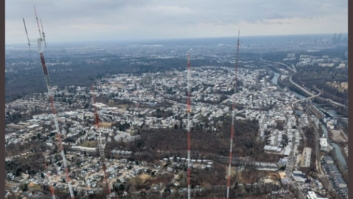
FM antennas should be installed on towers in a manner that prevents easy access to the radiating elements via climbing. Fencing may also be appropriate if it is determined that radio frequency exposure exceeds the FCC’s limits for uncontrolled, general public environments. A tragic example occurred recently in Washington, D.C., when a man, intent on suicide, climbed halfway up the 321-foot WAMU tower and jumped to his death.
Given the danger posed by exposure to AM towers with RF potential at the base, such as series-fed, folded unipole and insulated base antennas, it is critical that broadcast licensees properly fence and maintain their towers.
[Related: “Letter: Where’s the Evidence?“]
A finding that even the hasp on the gate enclosing such a structure is broken, thereby allowing easy access, can result in an FCC violation and forfeiture fine. The FCC’s 2003 AM Broadcast Station Self-Inspection Checklist states that fencing must be capable of preventing access by small children or livestock and must be designed such that gaining access to the tower would require a concerted effort. (The Society of Broadcast Engineers recently released fresh self-inspection checklists, including one for AM, available on its website.)
It is also important to remember that the FCC will hold the broadcast licensee accountable even when violations of FCC tower rules are the fault of an independent tower owner. Although the tower owner is primarily responsible for compliance with the FCC’s tower rules, the specific responsibility for fencing lies with AM broadcast licensee-tenants. AM broadcasters are solely responsible, under the FCC’s rules, for compliance with AM fencing and enclosure requirements.
The FCC has clearly stated that this fencing responsibility does not shift to the tower owner when the licensee and the owner are separate entities. In situations where required fencing is not installed before a tower is leased, the AM licensee-tenant must complete the fencing before locating its broadcast facility on the tower. See a related Radio World article on tower rule compliance here.
This column is provided for general information purposes only and should not be relied upon as legal advice pertaining to any specific factual situation. Legal decisions should be made only after proper consultation with a legal professional of your choosing.