Many radio and TV stations have, or once had, fixed-link microwave stations that relay audio from a studio to a transmitter site, or perhaps between studios.
But under Part 74 rules, errors in their licensing data could prevent new auxiliary services from signing on, or preclude effective protection for incumbent stations.
Under Part 74, fixed relays are licensed in the U.S frequency spectrum in the 950 MHz, 2.5 GHz, 7 GHz, 13 GHz and 17 GHz bands.
Their data, contained in the FCC’s Universal Licensing Service database, has been a primary focus of Howard Fine, who has been a frequency coordinator in Southern California since the early 1980s.
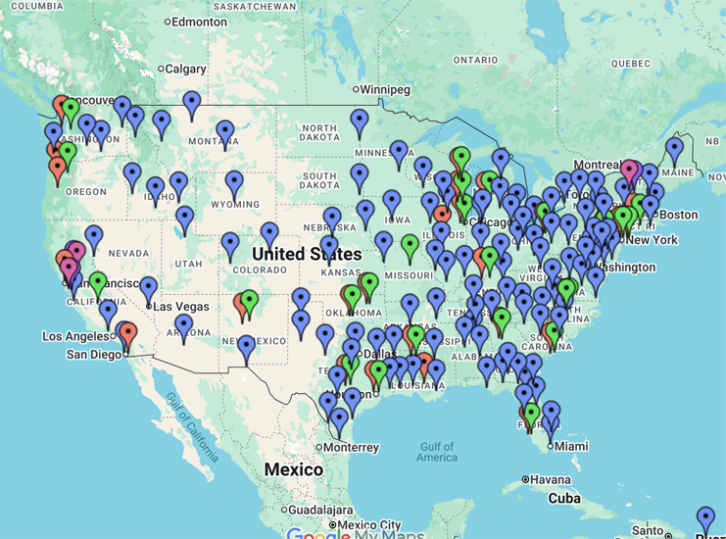
He says more than 1,200 licensees are missing receive sites on their auxiliary licenses or have incorrect technical data such as coordinates, elevation, antenna make and model and antenna receive height.
Approximately 200 TV pickup licenses out of 1,466 have no technical data on the license to protect them from non-broadcaster users coming into the band, such as satellite uplinks or Wi-Fi in the 6 GHz band.
A need for cleanup
For existing licenseholders, sufficient protection requires that accurate technical parameters be available in the FCC’s databases for use in interference calculations.
For example TV pickup licenses that have no technical data can’t be protected from other non-broadcast users coming into their band, such as satellite uplinks or Wi-Fi.
Out-of-date licenses also could prevent new services from obtaining licenses in an already crunched spectrum.
There have been several examples, Fine said, of ownership transfers that included a broadcast station’s license but not its associated Part 74 fixed-links, only for the buyer to find out afterward. “Technically they don’t even have an active microwave license,” he said.
Why the inaccuracies? Fine said they stem from a large-scale migration in 1999, when the FCC transitioned its database from Form 313 to the Universal Licensing System. A contractor posted much of the data manually into new ULS entries. Some errors are typographical, such as 23 rather than 32 seconds for coordinates.
Many broadcasters had no idea this was a problem, in part because the database transition was not well publicized.
Frequency coordinators worked to keep licenses in check. In the 1980s and ’90s, he said, “The local Broadcast Auxiliary Services frequency coordinators knew where every link was and protected them.”
Now with a new crop of broadcasters not as well-versed with rules and regulations that go back decades, there is even less impetus to fix incorrect data.
“Many stations don’t have chief engineers on staff, and so until the FCC mandates fixing it, the owners are not going to spend the money,” he said.
Part 74 licenses do not expire unless they are a non-station license, such as for an entity like Metro Traffic.
In some cases a license may reflect an expired status instead of a cancelled one.
“There are hundreds of licenses sitting there doing nothing for stations that don’t exist,” Fine said.
Another problem, Fine said, may result when a broadcast group purchases stations and moves them across states — from Dothan to Birmingham, Ala., for example.
“You look up where the Part 74 license coordinates plot on Google Earth, and it comes back to a Pizza Hut,” he said.
Ultimately, inactive licenses can prevent somebody else from getting a license.
“There are some cities where probably half of the 950 MHz licenses are going unused,” he said.
Convincing the commission
The FCC acknowledged the problem in 2003. It issued a public notice encouraging Part 74 licensees to add missing receive-end data, without a prior coordination notice, if it could demonstrate that the missing data was the result of using an early version of Form 313 that didn’t ask for this information or if the receive-end information had been previously licensed or provided in an application.
Fine has raised his concerns to the FCC several times through the Broadcast Auxiliary Services Fixed Service Committee working group of the National Spectrum Management Association.
If the commission could send letters to specific licensees, the NSMA suggested, it would expedite the process to update inaccurate information.
But the FCC never issued another notice. Fine said he has been told that the FCC feels it is a broadcaster’s responsibility to fix data, such as coordinates, on a Part 74 license.
If an entity wishes to do so, they have to pay for a prior coordination notice for frequency coordination, conduct an RFI study and file afterwards to correct the coordinates.
In a recent case, he said, a Part 74 license had its coordinates listed as 33 seconds when it should have been 3.3 seconds. A Part 101 licensee on 7.5 GHz filed to use the same tower with the correct coordinates. It cost the incumbent $15,000 to relocate the new licensee.
“The FCC told them, ‘Your licenses aren’t correct, and that’s what we go by.’”
Database duties
In the meantime, Fine does what he can to help clean up the mess.
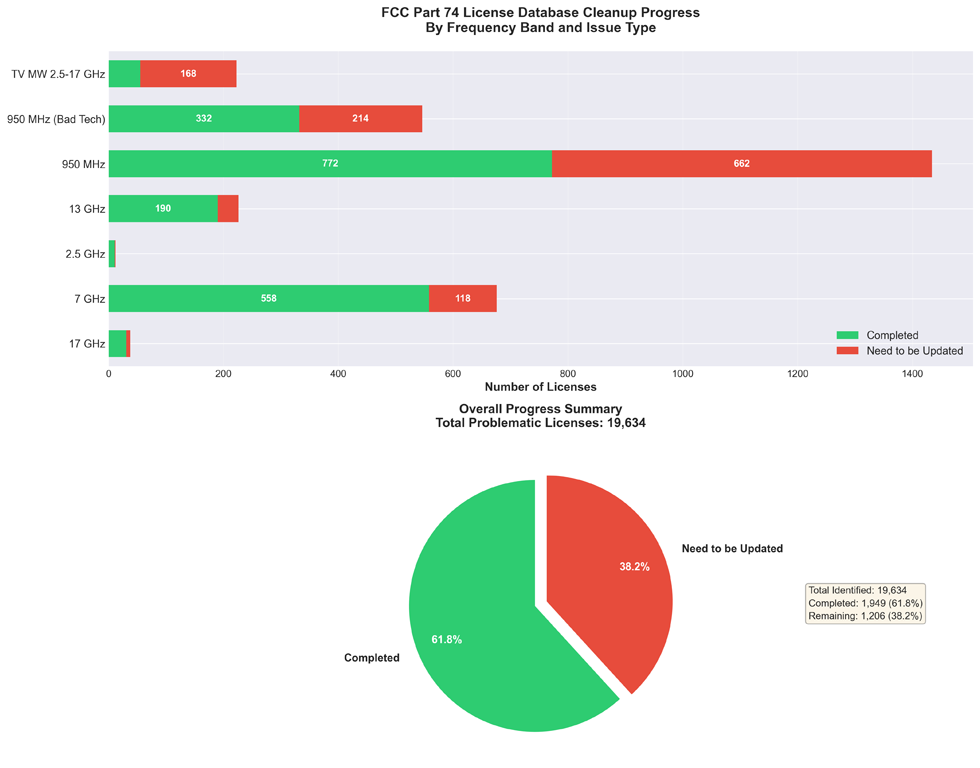
He has examined essentially all of the active Part 74 microwave licenses — approximately 18,500 of them. He has helped correct approximately 1,940 licenses.
Fine exported the FCC’s ULS data into a database of his own, and created a spreadsheet of the entries that did not have any receive sites listed.
He took the rest and identified characteristics such as incorrect coordinates. He has made use of Cavell Mertz’s site, FCCInfo.com, which will automatically flag sites that have invalid latitude or longitude entries.
Fine is passionate about the upkeep of auxiliary devices. He has served Los Angeles and surrounding areas as Part 74 Frequency Coordinator since the early ’80s, and he has functioned as on-site coordinator at venues in Los Angeles for events and NFL games.
“Sometimes, when I’m sitting at home, I start working on something, and 15,000 lines of typing later, here I am.”
He will match coordinates to recent Google Earth street-view data to verify whether any transmitting entity exists at a location. When he can, he notifies stations of discrepancies.
Broadcasters have been fined for improper Part 74 operation, including fines in Wyoming and Colorado for approximately $100,000.
Recently, he notified the new owner of a station in Colorado about fixed links that were still listed in the database but no longer being used. The owner expressed gratitude and was better prepared when the FCC visited its market.
He invites stations in similar circumstances to send him an email to check licenses.
For now, Fine preaches an internal effort to help database accuracy efforts.
“Whether it’s better understanding from the law firms in Washington or the broadcasters themselves, industry efforts from within are the most effective way to get the job done,” Fine said.
Comment on this or any story. Email [email protected] with “Letter to the Editor” in the subject field.