Credit: skodonnell/Getty Images
Archie Simpson read our discussion about using duct tape to remove a dead floodlight bulb. But what if the bulb is already broken, with the filament stem and sharp glass poking out of the socket?
As engineers, we might reach for our toolkit but Archie offers an alternative: Grab a potato!
After turning off your power, simply slice off and discard one end of the potato, then shove the rest of the tuber, cut edge down, into what’s left of the bulb. Then turn it. The bulb remains should unscrew easily.
If this doesn’t work, it may be time to just replace the fixture. The part will be inexpensive and easy to swap out. Archie used floodlight fixtures with built-in motion sensors.
He adds that you can prevent sticking by lubricating the threads of the replacement bulb slightly; however, do not use petroleum-based lubricants or flammable compounds. Instead, apply a small dab of dielectric grease to the threads of the new bulb (not to the end contact).
AutoZone sells AGS Dielectric Connector Protector.
Whups
Will Robedee is with the Center for Media at Depauw University. He attempted to order the network cable tester from Alibaba that we mentioned a while back. No luck. After filling out the order form, he got a message that he’d exceeded his order limit for this item, though he only ordered one! Apologies to anyone who encountered a similar outcome.
No, it should point THAT way!
An NPR affiliate recently experienced problems with a relatively new satellite downlink. The average Eb/No and AGC numbers were low, sometimes to the point where the receivers unlocked for extended periods.
At first the engineers thought local 5G carriers might be operating slightly out of band. They replaced the LNB and put in a new 5G filter, among other things.
But it turned out that the station’s contractor had done a substandard job of installing and aligning the dish itself. The engineers tweaked the polarization adjustment (using nothing more than the receiver Eb/No reading), which took it from 9.1 to about 13.5. They had to rotate the LNB about 30 degrees to get the system operating properly, so the alignment hadn’t even been close.
A frustrating experience after hiring what you thought was a professional company!
Before the snow blows
If you maintain an AM facility, here are some things to check at the base of each AM tower before cold weather sets in. The tip is courtesy of Larry Wilkins, technology director for the Alabama Association of Broadcasters.
At base of each AM tower is an antenna tuning unit. The ATU matches the impedance of the transmission line to the impedance of the tower, for maximum power transfer.
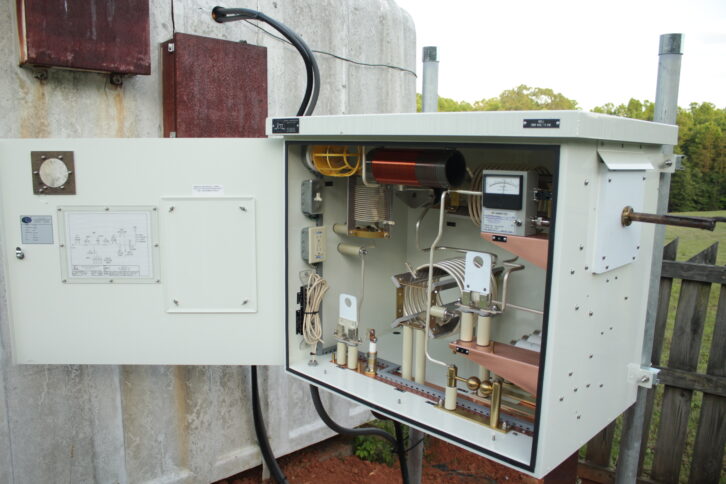
Start by visually inspecting the ATU inside and out. With the RF power off, ensure that connections are tight. Inspect components for signs of overheating or lightning damage.
You want to keep rodents, snakes and wasps out. Scatter a few moth balls in the bottom of the ATU cabinet and apply some repellant like the Mouse Magic we’ve mentioned before.
Wasp spray along the edges and eaves of the cabinet will discourage the flying critters. But the best prevention is to seal all openings. Note, insects can get in even through small empty bolt holes cut in the enclosure.
Use a light to check for holes. Most ATU cabinets have an AC outlet; plug a trouble lamp in, close the enclosure door and look for light leakage to detect holes. (Remember, turn the RF power off before doing this work.)
What is it o’clock?

Roy Baum is Topeka market engineer for Connoisseur Media; he offers a tip to pass on to your program or news director.
UClock.it is a service that lets you create a format clock directly in your browser. The software is $24 per year and you can try it for free.
Roy says they’ve been using the UClock.it software for several years in Topeka market, finding it useful for their news and agricultural network clocks.
Workbench submissions are encouraged and qualify for SBE recertification credit. Email [email protected].