A program that aired on more than 500 U.S. noncommercial radio stations in 2023 contained Emergency Alert System tones in the absence of a real emergency, according to the FCC.
American Public Media Group, the distributor of the program, agreed to a consent decree with the commission’s Enforcement Bureau on Dec. 10.
APMG, the parent of American Public Media, a creator and distributor of programming to public radio stations across the U.S., will be making a voluntary contribution of $86,400 to the U.S. Treasury Department as a result of the transmission of EAS tones during a “BBC Witness History” program on tornado chasing.
The commission’s rules forbid the use of EAS tones on the air outside actual emergencies or coordinated tests.
“Unauthorized use of the EAS tones thus presents a substantial threat to public safety,” the FCC said in its notice on the consent decree.
(Read the Enforcement Bureau’s order on the consent decree with American Public Media Group.)
Minnesota Public Radio and Southern California Public Radio are subsidiaries to APMG, which includes 46 full-power noncom stations in Minnesota, South Dakota, Iowa, Idaho, Michigan and California.
All MPR and SCPR stations aired the BBC episode in question, as did approximately 500 other noncom stations who have distribution agreements with APM, according to the commission.
The FCC noted that American Public Media is not a separate legal entity, so all agreements are entered into with MPR as the contracting party and list APM as an assumed name of MPR. That includes its distribution agreement with the BBC, for which APM has exclusive U.S. rights.
Tornado chasing
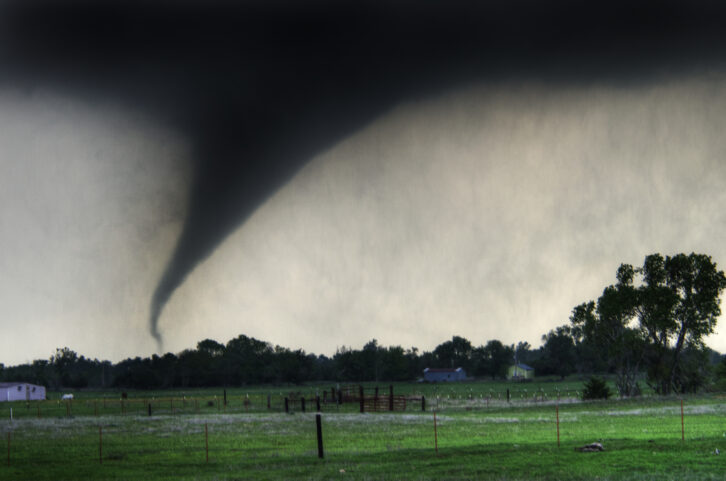
The decree is in connection with the airing of the BBC Witness History program, “Chasing the World’s Biggest Tornado,” heard on May 24, 2023. The episode centered on the EF-3 tornado that struck El Reno, Okla., in 2013, the widest tornado ever recorded.
You can hear the first EAS tone at the :22 second mark in the episode, from the BBC’s audio page.
The FCC’s Operations Center received multiple emails regarding the tones. Bureau staff confirmed that in two instances, EAS tones and subsequent NOAA weather radio tornado warning alert audio were aired, a violation of its rules.
The rules govern any of the four-part message used to activate an emergency alert. That includes the preamble and EAS header codes, the audio attention signal, the actual message and end-of-message codes.
“The commission has repeatedly warned that the use of simulated or actual EAS tones for non-authorized purposes — such as commercial or entertainment purposes — can lead to dangerous ‘alert fatigue,’” the Enforcement Bureau wrote in its notice regarding the decree.
Because those tones include data elements, the commission continued, simulated or actual tones might result in false activations, spreading misinformation.
The bureau sent a letter of inquiry to APMG in November 2023. APMG responded timely, the Enforcement Bureau noted, that December.
Second and third requests were sent in January and June 2024, which the commission said were also responded to in a timely fashion.
Compliance plan
The Enforcement Bureau agreed to resolve its investigation with the creation of the consent decree. APMG admitted by virtue of the agreement that the FCC had a fair and accurate portrayal of the facts regarding the EAS tones that were broadcast.
Within 30 days, APMG must designate a compliance officer who will oversee development of an EAS compliance plan. APMG must establish written operating procedures to ensure compliance with the EAS rules, specifically including internal policies to ensure tones or simulations are not transmitted except in an emergency or authorized test.
Within 90 days, the plan must be implemented to ensure that all covered employees follow EAS rules. That includes a training program, the commission said.
The organization will need to file a compliance report with the FCC 120 days after the effective date, and followups one and two years after.
The voluntary contribution of $86,400 to the U.S. Department of Treasury must be paid within 30 days.
[Do you receive the Radio World SmartBrief newsletter each weekday morning? We invite you to sign up here.]