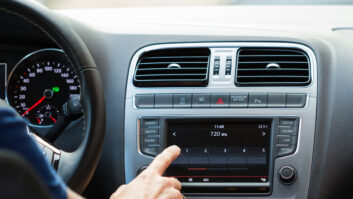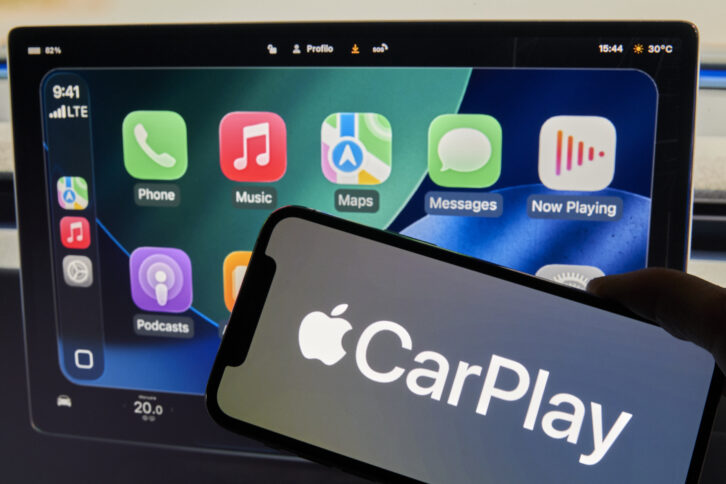
More than half of motorists rely on connections from their smartphones as their main in-car audio source.
That’s according to U.K.-based firm Futuresource Consulting, which has released the results from its Audio Tech Lifestyles 2025 survey. The study offers some interesting insights into how smartphones are shaping the future of in-car audio.
Respondents were also asked about their car audio preferences, and the survey concluded that motorists are not happy with radio being “buried” in menus.
The firm conducted the research last summer with a sample of approximately 10,000 respondents. The survey qualified only those respondents who owned a wireless speaker, smart speaker, soundbar, Hi-Fi system or separate headphones.
Its survey area included the U.S., U.K., Germany, Japan and China. The data was then filtered to include only people who travel by car.
Futuresource focused on the following listening choices: smartphone-tethered, radio — which includes AM/FM/DAB, online radio and SiriusXM, built-in streaming/native apps and CDs/other.
You can register to read the full report from Futuresource here.
Gen Z and Millenials lead shift
Approximately 51% of respondents use Bluetooth, Apple CarPlay or Android Auto as their main audio source.
Younger drivers lead this shift. Among Gen Z and Millennials — those aged 41 and under, according to the study — phone-based connections account for around 55% of listening, with CarPlay and Android Auto at 12–13%. For older drivers — those aged 58 and upward — mirroring is just 4%, with many still preferring simpler options, according to the study.
Radio remains second for in-car listening, used by approximately 26% of respondents. For those 58 and older, radio’s share climbs to around 40% of listening, while for younger drivers, it falls to around 10%.
The survey said preferences varied by nation. “In Germany and Japan, radio still dominates, though spoken word is gaining ground,” the survey said.
Music still leads at 58% of in-car streaming, but spoken-word formats are growing fast, Futuresource said. Both podcasts and audiobooks account for approximately 16% of listening.
Qualitative questions
Drivers are most satisfied when audio systems behave predictably, according to the study. “Audio should always resume in the right place after an interruption, with volume returning smoothly,” Futuresource said.
The firm said that levels should also stay consistent across music and speech to avoid sudden jumps.
Respondents expressed frustration from burying radio in deep menus, over-promising on app support or offering flashy sound modes that tire listeners on commutes.
“With regulators leaning toward physical controls for core functions, the case for tactile access to audio and climate controls is stronger than ever,” the study said.
Futuresource had specific instructions for automakers: Keep “radio fast and physical,” make voice primary in-drive with push-to-talk, and always show “continue listening” on the display when a car owner starts back up their vehicle.
Context
Across the past three ATL surveys, smartphone-tethered listening has grown from 48% in 2023 to the 51% this year. Radio declined from just below 30% to 25%. Built-in streaming edged up from slightly, while CDs continued their decline.
Futuresource Consulting said it has operated for approximately 35 years as a market research and consultancy firm.
[Do you receive the Radio World SmartBrief newsletter each weekday morning? We invite you to sign up here.]