The Federal Communications Commission has made changes to its rules that ease some restrictions on broadcasters and eliminates others.
The revisions include removing the minimum AM power increase limit and extending technical special temporary authorities up to 180 days.
The 13 adopted changes at its March open meeting are the result of a notice of proposed rulemaking in December 2024 under former Chairwoman Jessica Rosenworcel.
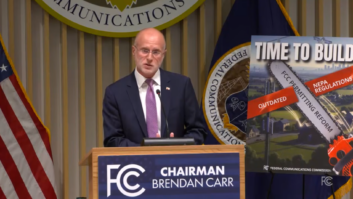
The effort to ease regulatory burdens of broadcasters appears to fit neatly into current Chairman Brendan Carr’s “delete, delete, delete” initiative.
[Related: “FCC Approves Order to Accelerate High-Speed Network Rollouts”]
While Carr celebrated the removal of approximately 1,100 rules during his time as chair, he also indicated the commission is not nearly finished with its efforts.
“On deck for 2026 is licensing and permitting reform, eliminating unnecessary paperwork and smashing technological silos that have held back innovation for decades,” Carr said in a statement.
Of the three FCC commissioners, Carr and Commissioner Olivia Trusty unanimously approved the order.
Commissioner Anna Gomez concurred and dissented in part, stating, “as I have expressed before, I am sincerely concerned about the direct final rule process the commission has been using to eliminate rules.”
The changes also remove the ten-application cap adopted for the 2021 noncom educational FM new station application filing window; and codifies the definition of an authorized station, which LPFM applicants must protect, to include both licensed and granted construction permits.
You can read the report and order here.
Rule change specifics
The FCC voted to update its rules for AM station power increases to eliminate the requirement that stations request at least a 20% increase in nominal power; and update AM station classifications to conform to current classifications used in the Class B and Class D definitions.
The commission said that the National Association of Broadcasters supported the changes and agreed they would offer increased flexibility to AM stations, helping them achieve required community of license coverage.
The commission modified sections of its rules to state that an LPFM submitting an application a filing window for a new construction permit or modification of an existing LPFM authorization must protect FM, LPFM and FM translator applications filed prior to the release of the public notice announcing the filing procedures.
It also clarified that a public notice, which simply announces an upcoming filing window, would not terminate protection requirements for prior-filed applications.
In addition, the commission said it will remove language from its rules that limit an initial STA necessitated by technical or equipment problem to a 90-day window rather than the full 180-day period permitted for STAs for other reasons.
According to the order, NAB agreed that the change reduces burdens on both applicants and FCC staff. In addition, the comments of the licensees of 10 public broadcasters concurred that their stations would greatly benefit from the extension of this STA term. They also asserted that the period is more realistic given the time it takes to procure and replace technical equipment.
The order also stipulated that moving forward, the FCC will replace references to the bureau’s legacy CDBS electronic filing system with references to its new LMS electronic filing system. The commission said that it is making the change since it no longer updates CDBS, and users are instead required to use LMS to search for and file applications and pleadings.
Here is a summary of other rule changes adopted by the commission that affect broadcasters:
Change table of assignments/allotments references
The FCC adopted the proposal in the NPRM to update inconsistent terminology in rule references to the tables governing FM and TV allotments by changing references in certain sections to correspond with the standard language used in others.
The commission noted that in its comments, REC Networks considered the proposal noncontroversial.
Elimination of the NCE FM window application cap
The commission said it will eliminate language concerning the 10-application cap on the number of applications each applicant could submit in the 2021 NCE FM filing window. The FCC acknowledged that several applications remain pending from the 2021 NCE FM window.
It will delegate authority to the Media Bureau to effectuate this change and remove section the cap “upon resolution and finality of the remaining NCE FM applications.”
Revision of the signature rule
The FCC adopted the proposal to expand the definition of who may sign an application on behalf of a corporation, a partnership and an unincorporated association to include a “duly authorized employee.”
Additionally, in light of commenters’ requests, it will codify the term “duly authorized employee,” but the bureau to interpret the term “employee” broadly, as circumstances may require to take account of all types of employees.
Local public notice requirement after acceptance for filing
The order codified the established practice concerning when applicants for new NCE FM, NCE TV or LPFM construction permits must give local public notice of their applications.
It also clarified that the NPRM did not propose any new or additional local public notice obligations on parties.
The Media Bureau will be directed to update LMS to display the date an application is “accepted for filing.”
Redesignate renewal application petition to deny rule
The commission proposed to consolidate the rules for filing petitions to deny against license renewal applications into one rule section, and it adopted the measure finding that “moving all of the petition to deny rules into section will assist licensees and members of the public in complying with the rules.”
The FCC declined codify the existing interpretation of its rules that LPFM minor change applications received on the same day will be treated as simultaneously filed and, if mutually exclusive, directed to use engineering solutions and good-faith negotiation to resolve the mutual exclusivity. It said commenters gave conflicting responses to its benefits.
It also declined to make any changes to its informal objection rule. Currently informal objections are not required to be served upon the applicant, according to the FCC, which often leads to considerable inefficiencies in the resolution of contested proceedings.
Additionally, its current informal objection rule contains no restriction on the number or type of pleadings that can be filed in response to an informal objection, and provides no pleading deadlines.
However, the FCC said disagreement among commenters on how to proceed led the commission to decide to adopt any specific changes at this time.
Comment on this or any article. Email [email protected].