After a myriad of allegations of license infractions made against two FM translators in Houston, their owner has agreed to a consent decree with the Federal Communications Commission, resulting in a voluntary contribution to the U.S. Department of Treasury.
SDK Franco operates 92.5 K223CW(FM) and 105.3 K287BQ(FM). The entity has agreed to pay $50,000 and implement a three-year compliance plan to ensure the two signals operate consistently with the FCC’s rules.
According to the commission’s account, the agreement results from infractions that ranged from the translators’ rebroadcast of unauthorized stations, originating programming from the translators themselves, premature assumption of control following a license reassignment, lengthy periods of silence and the use improper transmission equipment.
(Read the FCC’s consent decree order with SDK Franco.)
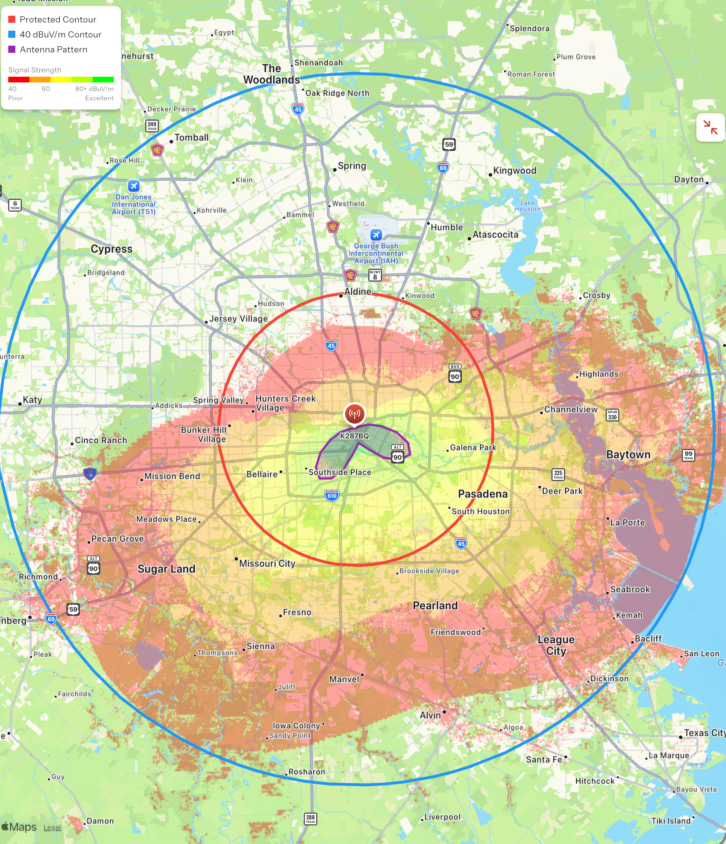
K223CW operates with 30 watts of effective radiated power and transmits from downtown Houston. It currently relays 880 KJOZ(AM), which runs a Spanish tropical format.
Previously, SDK Franco had an agreement with Gow Media to broadcast 97.5 KFNC(FM) on the translator.
From the same location, K287BQ transmits with 99 watts ERP and runs Spanish programming as “Radio Visión Latina Houston,” and FCC records show that it rebroadcasts 1540 KGBC(AM).
Sifting through
The FCC’s Media Bureau had to untangle several matters resulting from pursuit of same-channel LPFM interference allegations from 92.5 KJJG(LP), an intervening license renewal cycle and the translators’ filing of additional contested applications.
In response to multiple petitions and objections, the bureau launched an investigation in October 2022 and issued a letter of inquiry to both SDK and Centro Cristiano De Vida Eterna, which was the signals’ licensee until April 2020.
[Related: “FCC Issues Violation Notices to Two Texas FM Licensees”]
The translators were assigned to SDK followed a court-issued divorce decree ending the marriage of Hector Guevara and Sara Franco.
The letters requested information from both parties regarding their respective periods as the translators’ licensees.
In its response, according to the commission’s account, SDK acknowledged that it had rebroadcast unauthorized stations and originated programming on both translators.
K287BQ’s primary station was changed multiple times without notifying the commission, and it had also originated programming.
Meanwhile, K223CW was supposed to be paired with Houston’s KCOH(AM). But by 2017, the original licensee, Centro, notified the FCC via email that the translator was instead rebroadcasting KJOZ(AM) in Conroe.
Although the noncompliance began while Centro was still the owner, the Media Bureau argued that SDK should have been aware of the situation through ordinary diligence.
“The involvement of family members in the assignment was a further way in which SDK reasonably could be expected to have known or learned of the requirement,” the Media Bureau said. “Moreover, K223CW did not merely continue to retransmit the wrong primary station but also originated its own programming.”
The FCC said that K223CW began originating its own programming in 2020.
Ordinarily, the bureau said that K223CW’s failure to rebroadcast its paired AM station for four years would have required the licensee to either resume rebroadcasting that station or surrender the translator’s license.
However, KCOH has been silent or operating at reduced power since a helicopter struck its tower in October 2024, a crash that killed four people.
The bureau also acknowledged the adversarial divorce process through which SDK acquired the translator, which occurred after Centro had already begun rebroadcasting the wrong primary station.
Still, the FCC noted that the station is well beyond its four-year retransmission period, and any prior consent agreement with KCOH has presumably expired.
The commission also found that SDK began exercising de facto control over the stations immediately after the court issued the divorce decree, even though SDK did not obtain FCC consent to acquire the licenses until roughly two months later.
Between February and April 2020, SDK limited access to the transmitter site, changed the program format, altered the primary station and filed applications, the commission said.
It resulted in violations of restrictions on foreign broadcast ownership and cross-ownership between translator and LPFM stations, according to the commission’s account.
Finally, SDK admitted that it operated K223CW with an unauthorized nondirectional antenna rather than its authorized directional antenna between April 2020 and March 2021.
SDK argued that the nondirectional antenna was originally installed by Centro and that it was unaware of the violation at the time of the assignment. SDK also acknowledged off-air periods for both translators that exceeded 30 days without required notification.
By virtue of installing a correct antenna in March 2021, SDK said, it would have eliminated any interference to KJJG.
Ultimately, the Media Bureau determined that because SDK’s responses to KJJG’s interference complaints were “less than optimal,” the consent decree requires the licensee to establish improved procedures.
In the agreement, the FCC observed that the $50,000 voluntary payment includes $10,000 for the translator’s noncompliance with the AM Revitalization Act condition, alongside amounts attributable to SDK’s failure to notify the Media Bureau after each change to the translators’ primary stations.
Within 60 days, SDK must implement its compliance plan. The contribution, meanwhile, must be made in three installments.
[Do you receive the Radio World SmartBrief newsletter each weekday morning? We invite you to sign up here.]