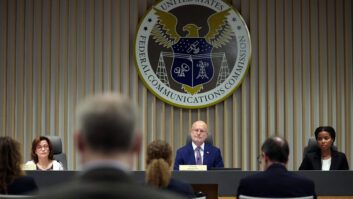
Representatives of the National Association of Broadcasters met with staff members of Commissioner Anna Gomez last week and reiterated their case for why the FCC should eliminate market caps on radio ownership, among other changes.
Gomez, a Democrat, has openly opposed further broadcast consolidation. She has said that when consolidation becomes the default solution, it often accelerates “the very decline it is supposed to address.”
FCC watchers assume that a vote to ease or remove caps would fall along party lines, with the two seated Republicans in favor. But the NAB appears not to have given up hope for a unanimous outcome.
The meeting on April 9 included NAB’s Senior VP and Deputy General Counsel Jerianne Timmerman and Chief Legal Officer Rick Kaplan. They met with Gomez’s Chief of Staff and legal advisor Deena Shetler and Policy Advisor and External Affairs Liaison Harsha Mudaliar.
The NAB representatives said local radio caps have not changed since the era before “satellite radio, streaming music services, podcasts, social media, giant digital advertising platforms, smart devices including phones, speakers and TVs, and automotive phone integration systems.”
(You can read an ex parte filing summarizing the NAB arguments.)
They presented fresh data from Edison Research’s Share of Ear report, finding that AM/FM radio’s share of time that consumers spend listening to audio sources has fallen to 32 percent, even when counting the streamed versions of those stations.
“That’s a 40 percent decline from AM/FM’s 53 percent share of time spent listening reported by Edison in its first Share of Ear reports in 2014,” NAB says.
Competition from digital audio sources, they said, continues to erode terrestrial radio’s audience share. And revenue continues to fall for broadcasters, and NAB believes FCC rules are holding them back.
They cited research from Borrell Associates that shows total ad revenues (OTA plus digital) declined over 30 percent, without accounting for inflation, from $17.4 billion in 2007 to $12.17 billion (estimated) in 2025.
They said that according to the Borrell data, “Radio stations in mid-sized and small markets earn mere fractions of the revenues garnered by stations in the top 10 markets, and often struggle to cover their basic fixed operating costs, let alone invest in improved programming, retain talented staff or hire additional staff or update equipment.”
They made the case that increased common ownership will benefit consumers in the long run. Because owners would have incentive to program stations in a market differently rather than replicate formats, “common ownership leads to a greater variety of radio programming available to consumers in local markets.”
This is an argument that critics of media consolidation have ridiculed, saying that corporatization of radio has already led the medium in the opposite direction over the past 30 years.
[Related: “Music Coalitions Say Deregulation Will Hurt Smaller Stations”]
The 2022 Quadrennial Review is pending at the FCC. Comments in Docket 22-459 can be read on the FCC’s website.
At the NAB Show in Las Vegas on Monday, Gomez is scheduled to moderate a panel on “Freedom in Today’s Media Landscape.”