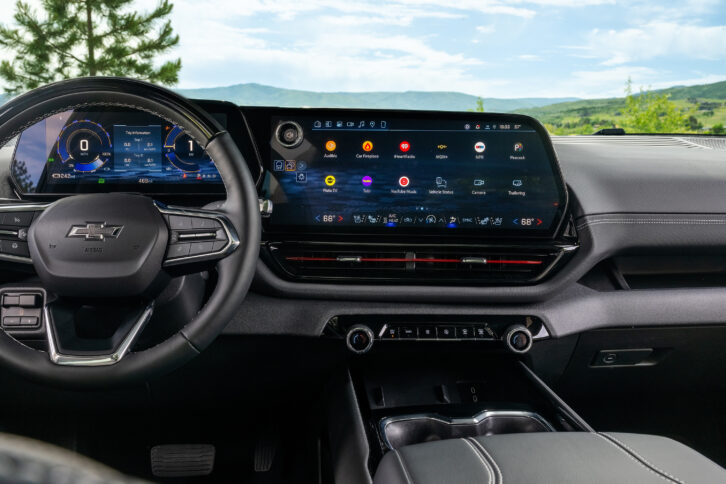
There is one sure way to catch the attention of radio broadcasters: Just mention changes to the dashboards of new vehicles.
A plan by General Motors to eventually move beyond phone projection systems — namely Apple CarPlay and Android Auto — has left broadcasters wondering what the auto industry’s next move might be.
The company’s decision to move to a proprietary platform run by GM and its tech partners will likely trigger even more changes in the in-vehicle infotainment space.
GM CEO Mary Barra confirmed the plans in a podcast interview with The Verge’s Nilay Patel in October. Apple iPhone and Android smartphone users won’t be able to use those instruments to sync with the dashboard in new GM vehicles, including gas-powered ones, possibly as soon as the 2028 model year.
GM has confirmed it will begin rolling out its own centralized computing system in some electric vehicles, beginning with the Cadillac Escalade IQ in 2028.
The automaker’s new infotainment system, based on Google’s Android Automotive OS, is expected to lay the groundwork for a more unified user experience, allow the automaker to gain access to vehicle and customer data and possibly open new revenue streams.
Tesla and Rivian also have bypassed phone apps in their vehicles.
Big GM’s plan could prove risky for broadcasters, and one major radio group has gone on the record to say it will be bad for the business.
Nic Anderson, VP of government affairs for Salem Media, wrote in the online newsletter Townhall that the move by GM to do away with third-party apps like CarPlay and Android Auto is a way to control what vehicle occupants hear.
For generations, he says, the car radio has been the great equalizer — free, local and open to all — delivering news, weather alerts and community updates instantly, no subscription or data plan required.
“But as vehicles become software platforms, automakers are rewriting the rules. They’re no longer just selling cars; they’re building digital ecosystems,” he wrote.
Anderson, who also serves as vice president of public policy for the National Religious Broadcasters, concluded: “By removing AM/FM radio and blocking third-party apps like CarPlay and Android Auto, they funnel drivers into closed environments where they alone decide what content is available. This isn’t about innovation. It’s about revenue and control.”
Typically, when platforms consolidate, Anderson said, control over content distribution increases. Algorithms replace editorial judgment. Subscription tiers determine access. Content that doesn’t serve corporate interests can become deprioritized or in the worst cases, excluded entirely, he said.
“Tesla’s FM removal isn’t an isolated decision. GM’s CarPlay elimination isn’t a technical preference. These are coordinated moves toward a future where your dashboard operates like your smartphone; except you can’t choose a different car as easily as you can switch apps,” he wrote in his post.
Terrestrial radio has long faced increased competition in the dashboard and ceded much of its dominance, but some observers say radio is now facing an increasingly unlevel playing field. The overwhelming presence of the internet is placing added pressure on OTA radio’s future in the car.
Instead of smartphone projection, GM will use an independent Google-based system with built-in Google Maps, Assistant and voice controls with Gemini embedded, similar to what the automaker uses in most of its electrified models, Barra said on the Decoder podcast.
Why did GM pull smartphone projection from EVs first? Barra said: “When you look at the fact that we have over 40 models across our portfolio, you don’t just do this and they all update. As we move forward with each new vehicle and major new vehicle launch, I think you’re going to see us consistent on that. We made a decision to prioritize our EV vehicles during this timeframe, and as we go forward, we’ll continue across the portfolio.”
As to a decision on whether gas cars will indeed lose phone projection, Barra said, “as we get to a major rollout, I think that’s the right expectation.”
In an email to Radio World, a GM spokesperson emphasized that the proposed changes do not affect any existing vehicles and that Apple CarPlay and Android Auto remain in GM vehicles for now.
In addition, GM would not confirm any specific timeline for the changes Barra spoke of on the podcast.
The spokesperson said, “As we advance toward our centralized computing platform, we’ll gradually move to a better, more deeply integrated experience — a direction the broader industry is taking as vehicles become more software-defined. This will happen over time, not overnight. We value our collaboration with Apple and Google and remain focused on delivering experiences customers love.”
GM’s next-gen centralized computing platform “supports AM/FM radio capability,” the spokesperson confirmed.
Broadcast industry observer Jerry Del Colliano, publisher of Inside Music Media, says GM’s move to retain AM/FM tuners, at least for now, is a short-term win for radio.
“The broader context of GM’s infotainment strategy heavily favors streaming, making radio a declining afterthought rather than a core feature,” Del Colliano wrote in his newsletter.
He speculated that GM could face consumer backlash following the decision about smartphones. He cited a 2023 GM Authority poll that showed 88% of surveyed buyers said the lack of CarPlay/Android Auto would be a “dealbreaker” when shopping for a new car.
Electronics industry analyst Roger Lanctot, founder of StrategiaNow, said this is a risk GM is willing to take.
Lanctot says it makes sense for GM and other car manufacturers to have some kind of control over in-vehicle application interactions.
“App-based, icon-centric interactions in the car are sub-optimal for automakers, and whenever a driver is projecting their smartphone into the dash the carmaker has no idea what they are doing,” he said.
That reality interferes with “creating safe, contextually intelligent in-cabin experiences” for drivers, he said. “It makes sense for car makers to have some kind of control over in-vehicle application interactions.”
Lanctot says for broadcast radio, the “fragmented content consumption experience in the car” is a challenge to overcome.
Industry observer and “futurologist” James Cridland says the removal of Apple CarPlay and Android Auto in GM cars is a “significant loss” for broadcasters who have invested significantly in developing apps, which offers a range of content, and not just live audio, but on-demand content as well.
Once GM removes CarPlay and Android Auto from their vehicles, he says broadcasters will be “entirely reliant” on GM providing the best user experience, and giving the prominence radio deserves in the dashboard.
“It shouldn’t be forgotten that GM only cares about selling cars. They don’t care about the radio business,” Cridland said.
In addition, much will depend on what GM uses for an app store in its proprietary infotainment system.
“If it’s their own app store, as would seem likely, then there’s nothing to stop GM from only wanting to carry, say, Audacy’s app and not iHeart’s. Or, for GM to massively promote Audacy in return for advertising, and to hide iHeart in page 3 [of the menu],” Cridland said.
The North American Broadcasters Association wrote in a statement to Radio World: “The beauty of free, over-the-air radio is that there are no paywalls or other gatekeepers standing in the way of broadcast content, which is why we think this option is important, regardless of what other information platforms car companies employ. We feel that GM must make access to AM and FM radio in the car as frictionless as possible.”
Q&A
Taking a closer look at the future of in-car listening, we asked David Layer, vice president, advanced engineering at the National Association of Broadcasters, about developments in the automotive space.
Radio World: Why is GM’s change to a centralized platform important to the radio industry?
David Layer: Automakers want more data and the ability to manage the entire in-vehicle experience. A centralized platform means the automaker controls the interface, data and user experience more directly. That makes it even more important that radio is not pushed behind layers of menus, not implemented in an inferior fashion compared to other audio services, and not replaced by subscription streaming services.
RW: How do these developments affect the relationship between broadcast radio and major tech companies in the car?
Layer: Automakers are increasingly acting like tech platforms — controlling content access, data rights and monetization of consumers’ data. That means broadcasters have to navigate relationships not only with Silicon Valley companies, but with the automakers themselves.
The car of the future should enhance radio listening, not replace it with gatekeeper models. Broadcasters were the original in-vehicle entertainment system. We want to preserve that history while working with automakers and tech partners to innovate — improving metadata, audio quality, personalization and emergency capabilities.
RW: Could GM’s move ultimately allow automakers to charge a subscription fee for access to broadcast radio? Does NAB think that is possible?
Layer: There is a real concern that a closed software ecosystem could allow automakers to package essential features behind a subscription. Consumers have already seen subscription charges for heated seats and safety alerts. We believe broadcast radio should never fall into that category.
RW: Is there an update on NAB PILOT’s Android Automotive initiative? Does the fact that GM is adopting Android Automotive better position radio in dashboards?
Layer: NAB PILOT began early work on Android Automotive because we recognized that embedded systems would drive the next phase of dashboard development. We have been working with broadcasters, tech companies and automakers on standardized ways to deliver metadata, album art, emergency alerts and interactive experiences directly to the vehicle. That work positions radio to be a prominent feature in these platforms rather than an afterthought.