The author is vice president of public policy for NRB (National Religious Broadcasters).
The FCC has adopted another significant change to the C-band that could eventually require broadcasters to modify how they receive satellite-delivered programming.
For station managers, this may sound like an issue best left to the engineering department. But if your station receives network, syndicated or other programming through a C-band satellite dish — or relies on satellite as a backup to an internet-based feed — this is a transition worth watching.

What the FCC did
The FCC recently adopted a Report and Order (GN Docket No. 25-59) that will repurpose an additional 160 megahertz of the Upper C-band for terrestrial wireless use.
Under the new framework, spectrum from 3.98 to 4.14 GHz will ultimately be made available for wireless services, while 4.14 to 4.16 GHz will serve as a guard band. Existing Fixed Satellite Service operations that remain in the band will be compressed into the remaining 4.16 to 4.2 GHz portion.
In practical terms, considerably less spectrum will remain available for the satellite services broadcasters have relied upon for decades.
Why this matters to broadcasters
C-band satellite distribution has long been an important part of the broadcasting ecosystem, carrying network and syndicated programming to stations across the country.
Distribution technology has changed considerably in recent years. Many networks and program providers now distribute programming over IP, and many stations have transitioned their primary program delivery accordingly. But satellite remains an important part of the infrastructure for some broadcasters — either as the primary means of receiving certain programming or as an important backup when internet connectivity fails. That redundancy can be particularly important during emergencies, severe weather, and other circumstances when terrestrial communications infrastructure may be disrupted.
The commission has set a Primary Transition Deadline of Dec. 30, 2030, for the top 75 PEAs and a Final Transition Deadline of June 30, 2031, for the remaining PEAs, giving broadcasters a multiyear runway to prepare. But broadcasters should not mistake that runway for a reason to ignore the issue.
What broadcasters should be doing now
Stations do not need to begin replacing satellite equipment tomorrow. They should, however, begin understanding their exposure to the coming transition:
- Identify which programming services currently arrive via C-band satellite.
- Determine whether satellite is the primary or backup delivery method for each.
- Confirm whether earth stations are on the FCC’s protected incumbent list.
- Inventory existing dishes, receivers, filters and related equipment.
- Communicate with engineers, networks, syndicators and program providers about their plans for the Upper C-band transition.
Broadcasters should also be cautious about prematurely removing equipment or making assumptions about what will, or will not, be needed under the new configuration.
How reimbursement is expected to work
The FCC’s transition framework is intended to relocate incumbent Fixed Satellite Service operations and address reasonable relocation costs associated with the transition.
Eligible earth station operators may choose, on a station-by-station basis, between reimbursement of actual reasonable relocation costs or a one-time lump-sum payment. As implementation proceeds, broadcasters should pay close attention to eligibility requirements, deadlines and procedures that could affect their facilities, including the related FCC process that will establish eligible cost categories and reimbursement amounts.
As broadcasters evaluate their options, NRB believes the transition should recognize the different technologies stations now use to receive programming. Whether a broadcaster continues relying on traditional satellite infrastructure or transitions to an IP, fiber or other distribution solution, broadcasters should not be disadvantaged simply because of the technology they determine best meets their operational needs.
Ensuring fair treatment and appropriate reimbursement for affected broadcasters will remain an important part of NRB’s advocacy as implementation moves forward.
A checklist for today
Know how your programming reaches your station. Review which services arrive via satellite and whether satellite serves as the primary delivery path or a backup. That distinction matters when evaluating how the transition could affect your operations.
Determine whether your earth station is protected. Managers, ask your engineer or satellite provider whether your earth station is on the FCC’s official list of protected “incumbent” earth stations. Registration for new or modified earth stations has been frozen since 2018, so facilities that are not already protected may not be eligible for the same relocation protections or reimbursement.
Talk with your programming providers. Ask networks, syndicators and programmers that currently deliver content by satellite what they are planning for the Upper C-band transition and whether they anticipate changes to their distribution systems. Equipment manufacturers, service providers and other vendors may also begin reaching out — if they haven’t already — with potential solutions to help broadcasters navigate the transition. Take the time to understand your options and determine which solution best fits your organization’s operational needs.
Don’t make unnecessary equipment changes yet. Before removing, replacing or substantially modifying existing C-band equipment, understand whether doing so could affect your station’s transition options or eligibility for reimbursement.
What’s next
NRB recognizes the growing demand for spectrum and the important role that spectrum policy plays in expanding next-generation wireless services. At the same time, federal spectrum policy should not come at the expense of broadcasters that have lawfully relied on C-band infrastructure to distribute and receive programming.
Broadcasters should have adequate time to transition, access equipment that reliably replaces existing capabilities, and appropriate protection from unreasonable costs resulting from a federally mandated spectrum relocation.
For now, the message to broadcasters is simple: Know how your programming reaches your station and know whether your equipment is protected.
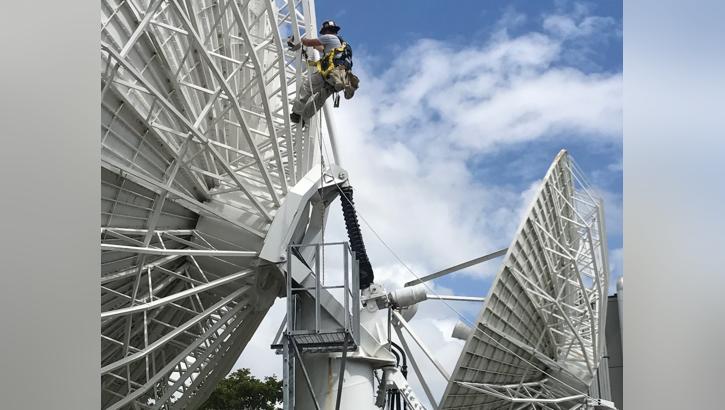
The satellite dish behind the building may not get much attention these days — but over the next several years, what happens to it could matter.
A version of this commentary appeared in the NRB members’ newsletter.