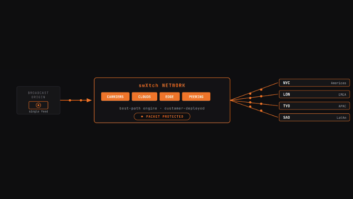
Networking solutions provider swXtch.io has introduced a software app that promises to let media organizations move audio in major AoIP formats between facilities and into the cloud over IP networks, including the public internet, without codec hardware or reconfiguring switches or routers to support multicast.
It is called groundSwXtch. Supported formats include Ravenna, AES67 and ST 2110-30.
The company says this has applications for broadcast and professional audio in live sports and remote event production, intercom connectivity between facilities, distributed audio mixing, remote production for entertainment venues, and radio workflows linking studios, newsrooms and regional bureaus.
“By carrying audio in its native, uncompressed form end to end, groundSwXtch preserves bit-identical quality while removing the encode/decode latency, hardware cost and deployment complexity that come with traditional AoIP transport,” it states.
Rather than using dedicated codec pairs to move audio, the company says, groundSwXtch carries the existing multicast AoIP streams on a facility’s network across the connecting network (WAN, 5G or public internet) through a centrally managed software overlay.
“A lightweight application on standard hardware/servers or virtual machines forms the overlay and moves native AoIP traffic across existing IP infrastructure, including over switches and routers that were never configured for multicast routing,” it states.
“Broadcasters connect studios, production centers, remote facilities and data centers into one unified fabric without touching physical network hardware, with built-in packet protection for hybrid links including SMPTE ST 2022-7 hitless failover and a single-pane view of every flow.”
The overlay shares its architecture with the company’s cloudSwXtch platform so the two can be paired to extend the same multicast fabric into the cloud. It says this gives broadcasters one hybrid network spanning on-prem and cloud environments rather than separate ground and cloud workflows.
groundSwXtch transports AoIP streams natively in their original format, with no compression or transcoding.
CEO Brent Yate said, “If audio already exists as native AoIP and we provide an IP network that can transport it reliably, removing that encode-and-decode layer simplifies infrastructure, lowers costs and preserves the integrity of the original signal.”
It plans to demo it to IBC attendees via appointment in meeting room 5.MR13 (Hall 5).