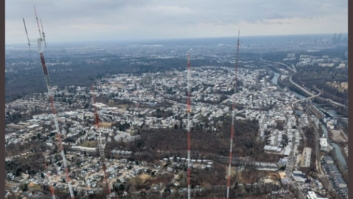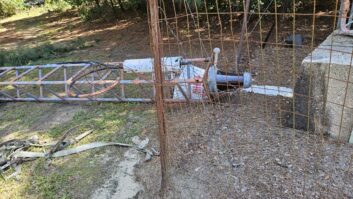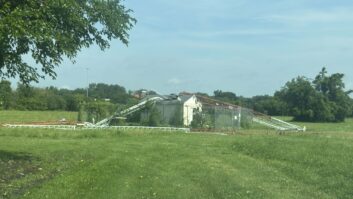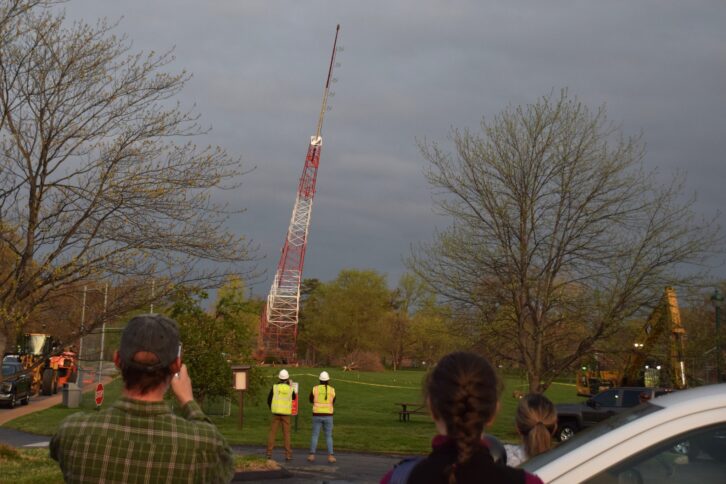
It came tumbling downward on an early spring Friday morning, with a swift thump.
A crowd gathered at Concordia Seminary, a Lutheran seminary in Clayton, Mo., to watch a radio tower that had stood since 1948 fall to the ground.
The radio history at Concordia goes back much further. KFUO(AM) can trace its roots back to 1927 on the campus.

Three years earlier, the station that holds the title of the longest continually running religious radio station in the U.S. took to the airwaves from a seminary on South Jefferson Ave. in St. Louis.
In fact, KFUO’s original broadcasting license predates the existence of the FCC itself — it was issued by the U.S. Department of Commerce and signed by then-Secretary of Commerce Herbert Hoover, years before his presidency.

Crews from St. Louis-area TV stations captured the collapse, garnering a fleeting moment in the news cycle, as these types of things often do.
For the Lutheran Church—Missouri Synod, the owner and operator of 850 KFUO, it was a bittersweet moment.
On one hand, a century of broadcast history officially concluded at the seminary.
A handful of listeners, Gary Duncan, KFUO’s executive director, told Radio World, reached out and reminisced about the station’s history there.
But the AM signal had already moved from Concordia’s campus two years prior.
A far more emotional moment, Duncan said, came in 2013, when the station moved from its studios, which were also at the seminary, to the Lutheran Church of Missouri’s international center in Kirkwood.
“All along the way,” Duncan, who has been KFUO’s executive director since 2015 and joined the station’s staff in 1993, explained, “we’ve operated with the mindset that you’ve got to close a door to open another and proceed.”
The station believes its move, centered around LCMS’ purchase of a second AM signal across the Mississippi River in Illinois, has it well positioned to serve metropolitan St. Louis going forward.
Starting a search
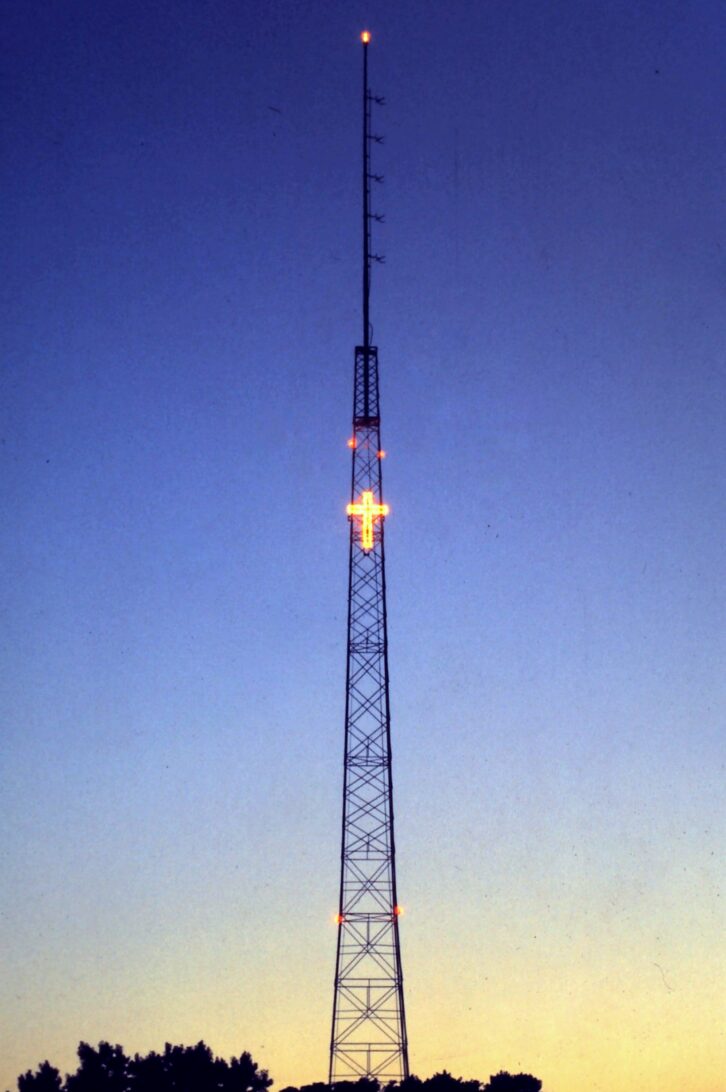
In September 2022, as part of Concordia Seminary’s redevelopment, its staff approached LCMS and asked if it would remove the KFUO tower from its campus.
For Duncan, it was time to begin the search for new land.
“I knew Illinois was an option,” he said of across the Mississippi River. “There’s also many more locations west of St. Louis with open property.”
But untapped sites carry unknowns, both in terms of their environment and how they would nestle into 850 AM’s licensed parameters.
KFUO is a “limited time” facility — more on what that means below — and it had been running at 5 kW, non-directionally from the Clayton site, so LCMS sought technical parameters that would result in a similar coverage footprint.
One month after Concordia’s request, Relevant Radio placed KXFN(AM) 1380, licensed to St. Louis and which maintained separate daytime and nighttime sites, up for sale, along with an associated 105.3 FM translator.
“We studied it, and concluded that it made a lot more economic sense as opposed to if we had purchased land and installed a tower from scratch,” Duncan said.
For $570,000, according to the FCC filing, LCMS made the October 2022 purchase of KXFN and its associated broadcast sites, which consisted of a three-tower daytime site, northeast of St. Louis, and a four-tower KXFN nighttime site, located in Dupo, Ill.
While the daytime site had been prone to flooding — most recently during the significant floods of 2019 — the nighttime site proved suitable for LCMS.
The consulting firm, Cavell, Mertz & Associates (now a division of Capitol Airspace Group), had already been helping LCMS with FM translator-related studies, so LCMS called on the group to assist.
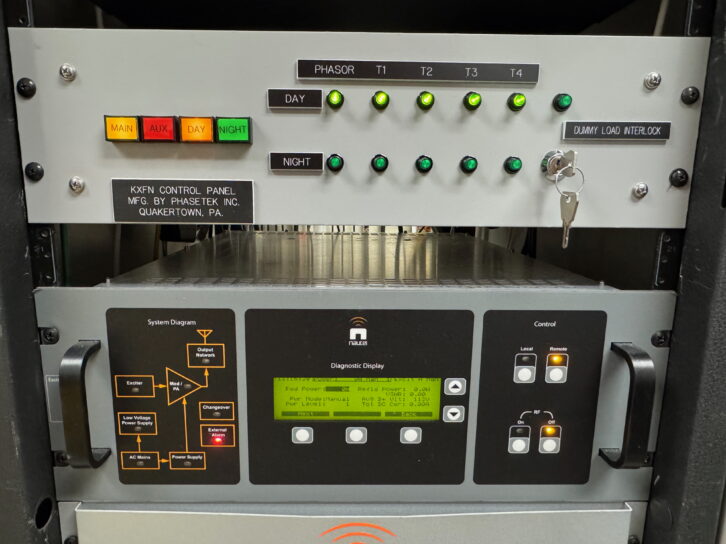
AM RF and design expert Gary Cavell led consulting efforts for LCMS and was quick to credit Kurt Gorman of Phasetek for his role in diplex network and phasor design, construction and installation to support both KFUO and KXFN.
“Not only did he design the replacement RF systems for the combined operations, but he also personally showed up, assisted with the installation, and tuned the new diplex,” Cavell said.
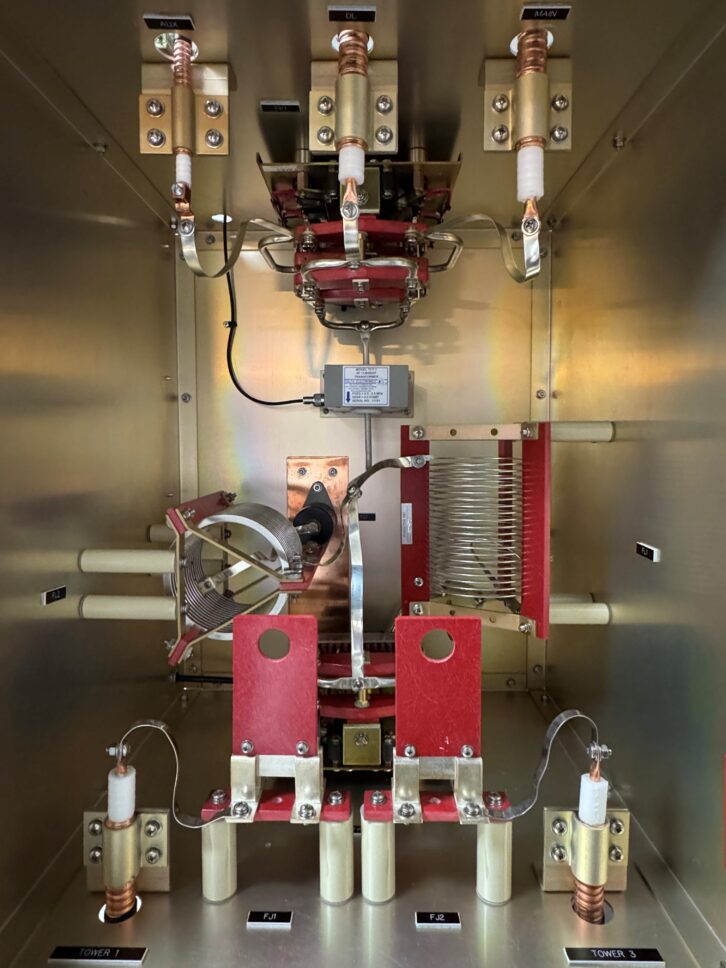
Cavell’s firm utilizes a standard set of considerations when evaluating the feasibility of proposed diplex operations such as this one, and he said that the Dupo site
proved not to be extraordinarily difficult to tackle.
For example: “Are the frequencies too close or too far apart to work with? Are the ground system lengths and tower heights compatible? You examine that, and also look at the FCC rules aspect, while also considering the station’s coverage goals,” Cavell explained.
Designing the site at Dupo
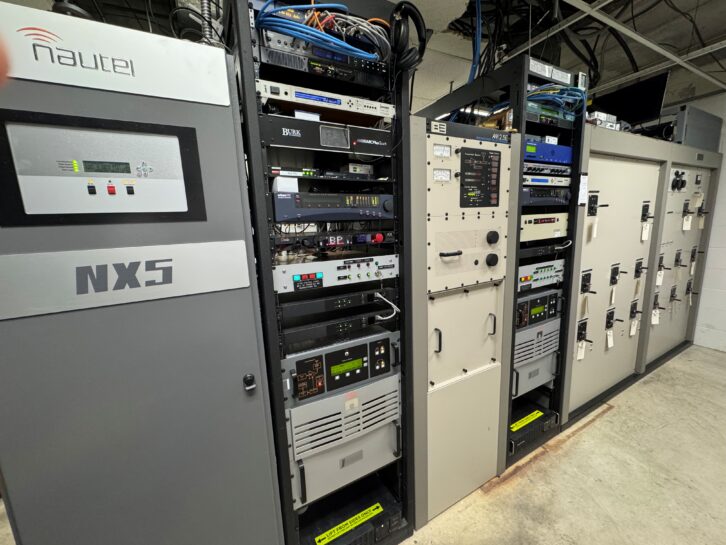
The KXFN site purchase was also an opportunity, Cavell explained, to replace the older tuning units and phasers with systems of a more modern design, and new equipment was installed for both stations.
Despite the straightforward diplexing setup, the cleanup and construction, which included support from a local contract-based engineer, required a team effort.
New electrical, control, ethernet cables and RF lines were installed to each tower via both horizontal trenching and hand digging.
All four tower ground screens took days of work to properly repair and re-shape the screens and braise all connections, the team said.
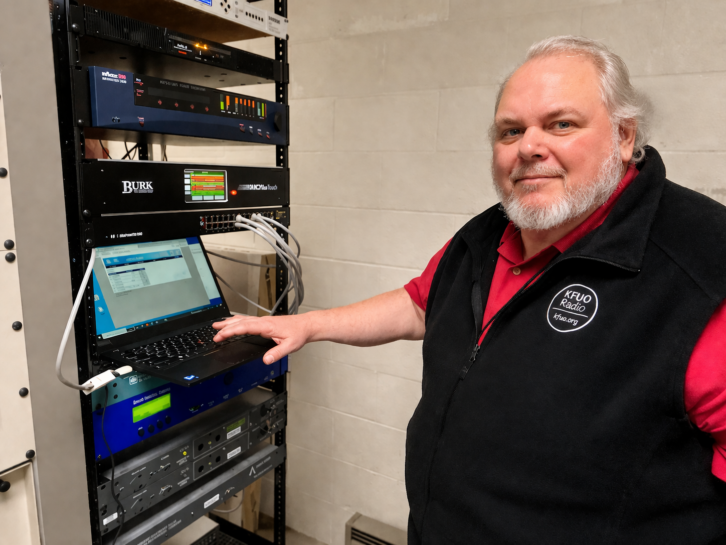
The transmitter building and doghouse received a new paint job, new door seals, pest control and landscaping. LCMS converted tower lighting, meanwhile, from incandescent to LED.
Cavell’s firm produced prospective coverage patterns for Duncan and LCMS, and they chose one that worked best with KFUO’s coverage.
Cavell noted that the towers’ heights, at just under 400 feet above ground level, translated into suitable efficiency at the KFUO frequency of 850 kHz.
While it is on the east side of the river, the new signal will provide nearly the same coverage as Concordia, Cavell said, with improved audio processing equipment.
The ground system in place at Dupo, Cavell explained to us, was newer and in much better shape than the considerably older system at the former Concordia site, which had the effect of slightly improving coverage over what would have been possible from the aged system at the original site, even with KFUO at a slightly lower power level — 3.8 kW at Dupo, versus its 5 kW at Concordia Seminary.
The overhaul of the nighttime site also eliminated KXFN’s need for a separate daytime site.

KXFN uses all four towers at the site, but KFUO only uses one. A second tower, Cavell explained, is designated as its emergency tower, wired as a backup should something happen to the primary tower.
LCMS is considering using the now inactive daytime site as a backup location for both KFUO and KXFN.
“We have belts and suspenders and safety pins,” Cavell said of the redundancy in place.
Aside from the proliferation of ants in the tower doghouses — a job best served for the pest control crew — the team capably tackled the remaining obstacles, and in testing, reported expected coverage from both signals.
For LCMS, while the overall project is a significant investment, adding the backup was not that much of an added expense.
KFUO now operates with 3.8 kW from the Illinois diplexed site, running its program schedule of Lutheran teachings, music and the Lutheran Hour, a long-running program that originated at KFUO.
KXFN, meanwhile, runs religious music and hymns.
Moving day
Duncan shared with us a remarkable clip from the archives — KFUO had featured it on the air in 2024 to celebrate 100 years of broadcasting.
On March 29, 1941, a date dubbed “Radio Moving Day,” nearly 800 stations across North America changed dial positions as part of the North American Regional Broadcasting Agreement.
It was during this shuffle that KFUO landed on its long-held 850 AM frequency.
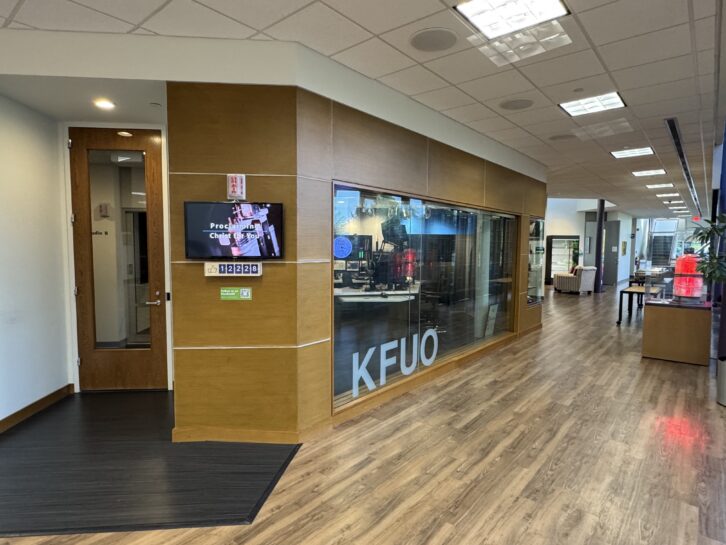
Today, the 850 AM signal is heard on three FM translators, which hits home particularly for Duncan. LCMS was the longtime owner/operator of 99.1, formerly KFUO(FM), which ran a non-secular Classical music format. The FM signal dates back to 1948.
The synod sold KFUO(FM) to Gateway Creative Broadcasting in 2010, which now operates it as a Contemporary Christian format as “Joy 99.”
Up until November 2022, Gateway Creative had maintained the Concordia one-tower site as a backup for 99.1.
Ever since LCMS sold the signal, Duncan had a vision in mind.
“My goal was to get back on the FM,” he said.
Cavell helped Duncan upgrade KFUO’s existing 92.7 translator, which LCMS was granted a construction permit for in 2018, to 200 watts ERP, and it serves the St. Louis Westplex from a site west of Saint Charles.

KFUO added 104.5 K283CI(FM) from Burt Kaufman’s 104 License LLC in 2023, placing an FM signal along N. Tucker Blvd. right in downtown St. Louis, while 105.3 K287BY(FM), from near Crestwood, serves the south side of the city.
Together, with the 850 AM signal, Duncan estimated a population of approximately 2 million people is served.
Naturally, LCMS does plenty of streaming and podcasting. Duncan said that it had nearly 2 million podcast programs downloaded last year.
“But I always look at the radio stations as the foundation of our worldwide ministry,” Duncan said.
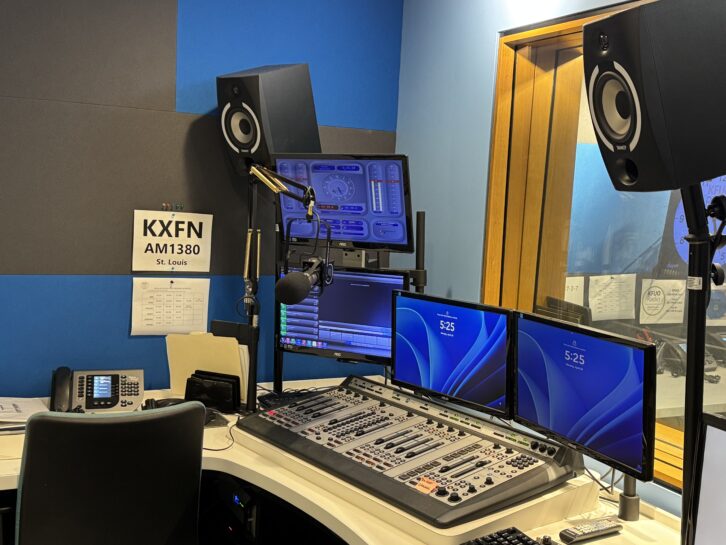
Today, the station boasts a modern layout that includes three production studios, a broadcast studio and a separate space dedicated to podcasting. While watching the Concordia Seminary tower come down was bittersweet, Duncan believes LCMS is primed for the future.
“The tower served its purpose,” Duncan explained. “but now, we’ve moved onto something better that we can reach more people with, and I’d like to think serves as a model for other AM broadcasters.”
Limited time only
KFUO is one of a handful of AM stations nationwide that is classified as a “Limited Time” facility. Certain Class B AM stations, according to FCC rules, that were on the air before Nov. 30, 1959, and that share a frequency with a clear channel Class A station, can operate with longer hours than regular daytime-only stations.
Stations west of a Class A station may operate until local sunset, while stations east of a Class A station must sign off at the Class A station’s local sunset time.
Because of this rule, KFUO is authorized to operate beyond normal local daytime hours and does not have to sign off until sunset in Denver to protect 50 kW KOA(AM).