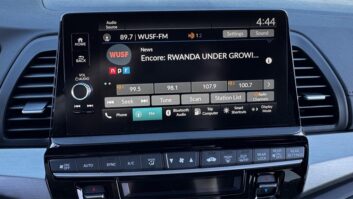
When Radio One moved WBT’s programming to its Class C 107.9 FM signal last December, on Jan. 8, the 50,000-watt AM signal at 1110 kHz was replaced with an automated program loop and an instrumental bed.
It occasionally directs listeners to switch frequencies and has remained that way ever since. Now, the future of WBT(AM)’s historic transmission site, which dates back to 1928, is in doubt.
For Johnny Caudle, who has around 30 years of experience in radio and more than two decades in public safety communications, the shift hit home. As a result, he’s spearheading a campaign to save WBT’s transmitter site in south Charlotte — regardless of whether or not it stays on the air from there.
Hitting home
Growing up outside Charlotte, Caudle told us that stations like WBT were a constant presence. Having worked at WBT in the early 2000s, along with other roles across the Carolinas in on-air, production and programming, he said his push to preserve the site is personal.
“Listening to those stations every day helped spark my interest in broadcasting at an early age,” Caudle said. His own time at WBT offered him a deeper appreciation for what the station has meant to generations of listeners.

He said that Audacy’s decision to end WCBS(AM)’s all-news programming in New York was already etched in his mind, as 880 AM — now WHSQ — puts a stout signal into the Carolinas at night.
“This felt like another piece of radio history was fading away,” he said.
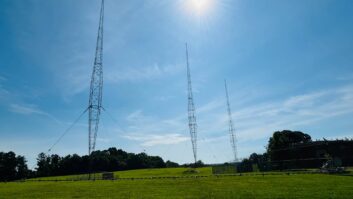
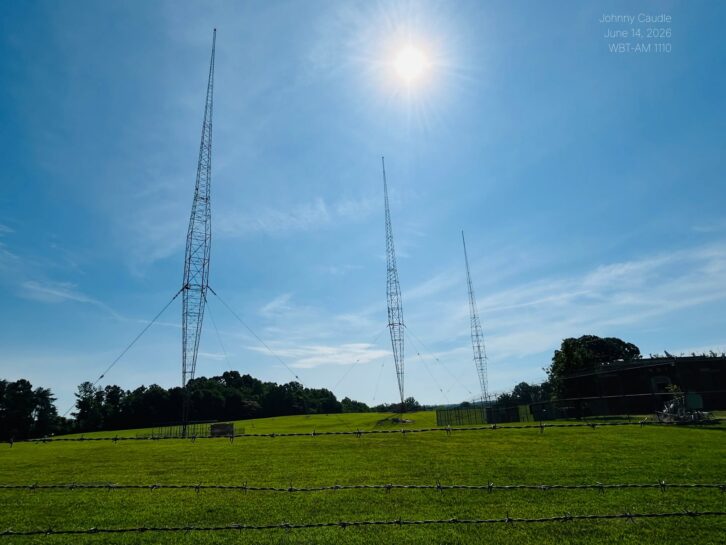
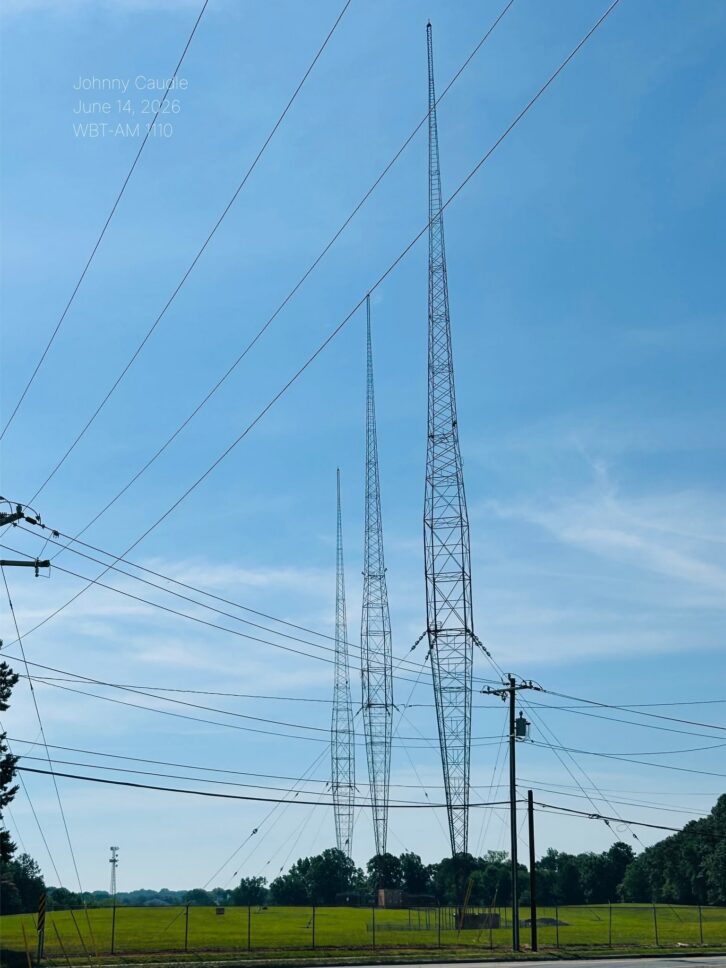
From a business standpoint, Caudle said he understands why Radio One prioritized its 100,000-watt FM signal. The programming itself is not his primary concern. But he feels the transmitter site, which features three rare Blaw-Knox towers, means much more.
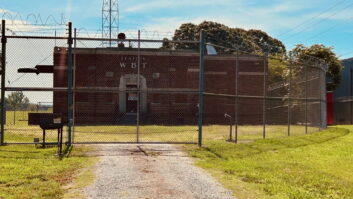
The site’s future was cast into doubt when real estate firm JLL listed the 19.04-acre property at 9201 Nations Ford Road in south Charlotte as a “garden multifamily development opportunity,” putting the land up for commercial purchase.
The property is tied to two radio groups.
Dating back to the 2016 sale of WBT(AM) from Beasley Broadcast Group to Entercom, Radio One — which ultimately acquired WBT — owns the equipment and buildings, while Beasley retains the underlying land, according to Lance Venta of RadioInsight.
Caudle believes the facility is a piece of Carolina history and deserves a fight.
“Once a place like that is gone, it is gone forever,” he said.
Radio World has reached out to Radio One for further comment on the site’s future.
Seat at the table
Caudle launched an online petition at change.org on July 1 to rally support for conserving the broadcast site.
He admitted the advocacy effort was out of his comfort zone but felt compelled to act so he wouldn’t regret seeing the site disappear without anyone asking if it could be saved.
He is thrilled the petition recently surpassed 1,000 supporters and is now aiming for 1,500.
It’s also opened doors. Caudle recently received an invitation to meet with representatives from Radio One and Beasley Media Group to discuss potential options for the site.
The drive has also drawn personal stories from listeners, broadcasters, engineers, historians and families who remember turning to WBT during weather events and breaking news.
“I’ve been told petitions don’t work, that this effort won’t be successful, and that I should just sit down and be quiet,” Caudle said. “Maybe they’re right. But that doesn’t mean it isn’t worth the effort.”
His ideal outcome is saving all three towers and the transmitter building, though he acknowledges that preservation often requires compromise.
“There are no villains in this story,” he said. “This effort has never been about stopping progress. It has always been about asking if there is a way to preserve a meaningful part of a place that played such an important role in Carolina broadcasting history.”
Stewart Gray, director of the Charlotte-Mecklenburg Historic Landmarks Commission, told WCNC(TV) the building has “true historic value.”
Gray first learned about the site from Caudle and he hopes to speak to a future buyer to explore the benefits of preservation.
Restoring and repurposing historic landmarks for commercial use can come with tax incentives, Gray said, pointing to the 150,000-square-foot Optimist Hall as an example of successful reuse.
A slice of history
The site itself dates back to the late 1920s.
As usual, we find the appropriate Scott Fybush “Site of the Week” profile, where in 2013 he astutely noted the station traces its roots to 1920 and became licensed as WBT in 1922.
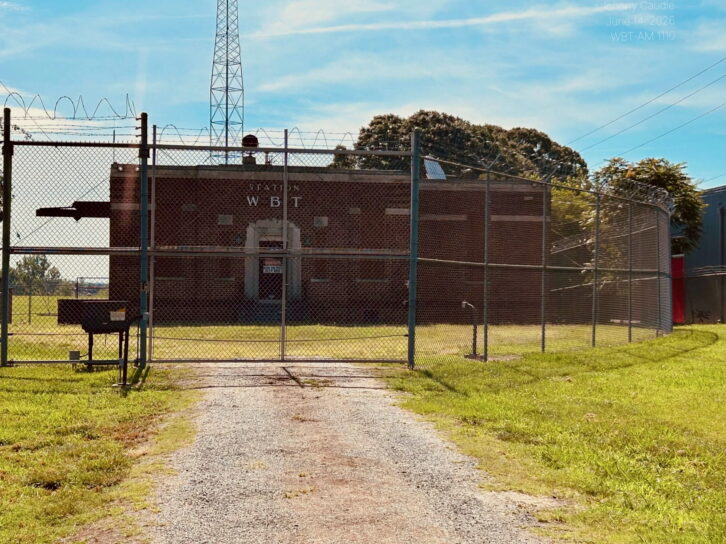
C.C. Coddington bought the station in 1926. Two years later, he increased power to 5,000 watts from farmland he owned on Nations Farm Road. The current red-brick building dates back to 1929 and was expanded in 1932 when the original RCA 5A transmitter was joined by an RCA 50B.
A 428-foot Blaw-Knox diamond-shaped tower went up in 1934 after the station, then on 1080 kHz, raised its power to 50,000 watts. Following the NARBA frequency shift in 1941, WBT moved to its longtime home at 1110 kHz, according to Fybush. It added two more Blaw-Knox towers in 1946 to create a directional array protecting KFAB in Omaha, Neb.
When high winds from Hurricane Hugo struck the site in 1989, Fybush noted the two outer towers — including the 1934 original — were destroyed. Exact replicas were later built to restore the array.
Beyond local broadcasting, the facility has played an important role in national defense.
As we reported in 2011, the federal government built a subterranean backup facility beneath the 1929 building following the Cuban Missile Crisis.
Decades later, WBT was designated as a Primary Entry Point station under the IPAWS network, resulting in upgraded above-ground emergency infrastructure installed in 2010 to ensure presidential and public warnings could broadcast during major national crises.
Radio World welcomes letters to the editor on this or any story. Email [email protected].