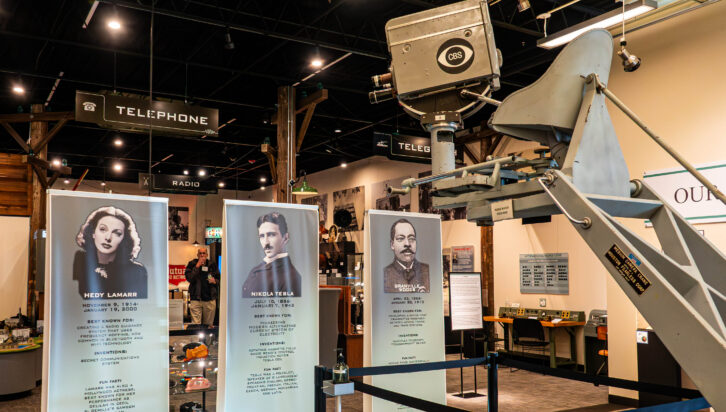
There is a good way to look back into the history of broadcasting and how we communicate. I do that by visiting the Pavek Museum of Electronic Communication in St. Louis Park, Minn.
It’s on the West side of the Twin Cities, about 17 miles from MSP Airport. The Pavek was declared the Museum of Wonderful Wireless at its grand opening in 1988. Much has changed in this 12,000-square-foot facility even since I wrote about it here a few years ago.
Of special interest for me recently was the opening in February of a traveling exhibit about Edwin Howard Armstrong (1890–1954), titled “Unseen Signals.”
Armstrong was a U.S. Army Signal Corps officer in World War I, working on ways to improve military communications. That included going up in a surveillance airplane to pass messages to a ground station.
Armstrong improved regenerative receivers of the day with superregeneration to improve sensitivity and ease of use. The scheme used feedback to amplify RF and was just one more step into making radios work better. Then there were patent battles which I won’t go into here, but they weren’t pretty.
As a patriot, he allowed the U.S. government free use of his patents to help the war effort during World War Two.

Historian Alexander Magoun, Ph.D., from Princeton, N.J., was at the Pavek Museum to tell attendees the story of this famous man. He’s shown in Fig. 1.
Of note is that Armstrong invented the superheterodyne receiver in 1923. Receivers of this type convert incoming signals to an intermediate frequency, often 455 kHz or 10.7 MHz, then amplify it before detection. With six tubes, this innovative design vastly improved receiver sensitivity and selectivity.

Fig. 2 shows one of the original hand-built receivers from back then. We still use this technology today.
Ten years later, Armstrong took frequency modulation from theory to practice in what we now know as FM radio, sometimes referred to as wide-band FM. Rather than 5 kHz, it is 75 kHz FM deviation that is required to give good audio performance. Original FMs were in the 42 to 50 MHz range. Some two dozen stations were heard in the eastern part of the U.S. on the Yankee Radio Network using this new and innovative FM technology in the 1930s. My father, Charles B. Persons, built one of those FMs for the Arrowhead Radio Network in Duluth, Minn.
It was evident that FM is technically superior. In its infinite wisdom, the FCC moved the band to its current 88 to 108 MHz after World War II.
When you look back at Fig. 1, you will see a model of Armstrong’s famous transmission tower in Alpine, N.J. That 400-foot tower still stands as a testament to this man. I have a lot of respect for Edwin Howard Armstrong as an inventor and innovator. The exhibit details his life but, at this writing, was scheduled to close in late August.

The Pavek Museum has a large collection of receivers as well as radio and television broadcasting equipment. That includes a 250-watt Western Electric AM transmitter that I helped donate years ago (Fig. 3). It came from KBRF Radio in Fergus Falls, Minn.

Next to it are century-old receivers. Also, as you would expect, there are vintage microphones, a few with legendary call letters (Fig. 4).
There are guided tours, but I prefer to analyze each display in detail at my own pace. As in many museums, recognizable equipment that I used as a young man is now on display as museum pieces!

The Pavek is home to the Minnesota Broadcasters Hall of Fame display (Fig. 5). Names and stories of exceptional Midwest broadcasters are remembered. That includes a few engineers.

Visitors can even attempt to play music on the theremin, an electronic musical instrument that changes sound as a musician’s hands are moved near two conductors (Fig. 6). Invented in 1920 by Leon Theremin, it amazed audiences in the 1920s and ’30s.

Of particular interest to many is a rare original Magnetophon tape recorder that was brought to this country from Germany just after World War II (Fig. 7).
It was vastly superior to wire recorders, which you can see on the left in the photo. The technology was copied and improved by Ampex and others to be a standard way of recording and playing audio for over 70 years. Later came audio cassettes, reel-to-reel and cartridge tapes.

The Man From Mars Radio Hat is a curiosity with two tubes, a rotatable loop antenna and volume control (Fig. 8). AM radio, of course, from the early 1950s.

You don’t find junk at the Pavek. Most items have been meticulously restored. The display window that I find comforting is Nipper the dog listening to a radio on what appears to be a clear winter night in the 1930s (Fig. 9).

Then there is a radio on a bicycle from 1956 that has four tubes and a battery pack under the seat. A switch selects one of three AM stations (Fig. 10). I had one similar to that as a kid!
Field trips from local schools tour the Pavek on a regular basis. Students follow scripts and then innovate to create radio and television shows to the chagrin of their friends. More than a museum, Pavek has regular classes on Saturdays where adults are taught how radios work and how to repair them. Multimeters and soldering irons are among the tools.
Then there are annual events such as Havoc at the Pavek: Haunted Manor around Halloween. Participants scavenger hunt in STEM (Science, Technology, Engineering and Mathematics) adventures through the history of communications. Events include plays, much like how radio was done in the 1930s and ’40s. They are often voiced by retired local broadcast personalities, to the delight of crowds.

I am a proud sponsor of the Pavek Museum because it tells the story of electronic communications so well. It takes at least two hours for each visit. Find out more at the Pavek Museum website.
Mark Persons, WØMH is an SBE Life Member, CPBE, CBNT, AMD. He is retired after more than 60 years in radio broadcast engineering, including 44 years in business. He started by turning the dials of broadcast transmitters at age 11 and stays active by mentoring four radio broadcast engineers. Mark and his wife Paula were inducted into the Minnesota Broadcasters Hall of Fame in 2024. Their website is MWPersons.com.
[Do you receive the Radio World SmartBrief newsletter each weekday morning? We invite you to sign up here.]