Nick’s Signal Spot is a new feature in which Nick Langan explores RF signals, propagation, new equipment and related endeavors.
In just the last year, Radio World has covered several different software-defined radio platforms.
Our James Careless recently profiled how KiwiSDR, WebSDR and OpenWebRX are bringing shortwave stations into your own home via remote receivers.
Meanwhile, for FM broadcast hobbyists like myself, there is the growing FMDX.org webserver project — a network I’m proud to participate in as a host.
If you’re new to the world of SDRs, however, the pace of development can be understandably dizzying. Where do you even begin?
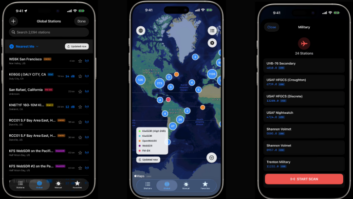
We recently discovered a new mobile app that attempts to bridge this divide. Developed by Mark Garrison Jr., the Echo app brings four popular SDR platforms to your Apple iPhone or iPad. Garrison Jr.’s motivation for building the app is something I can appreciate and I’ve loved using it so far.
You can download Echo for free on iOS here, and I asked him some questions about the project in my latest Signal Spot.
Walkie-talkie childhood

Garrison Jr., a 27-year-old pharmacy technician in Texas, has been a radio hobbyist since childhood.
Despite being firmly in the Gen-Z demographic, he owned a walkie-talkie long before he had a cell phone. “I used to love helping my father test long-range reception with his homemade antennas, seeing if I could hear him all the way from the town grocery store,” Garrison Jr. told us.
That experience planted the seed, but as he grew older, his biggest hurdle was the barrier to entry created by the cost of traditional equipment.
Eventually, he and his father discovered SDRs. Garrison Jr. was amazed that a small laptop, a $25 USB dongle and a magnetic antenna with an application like SDRTrunk could replicate the performance of a $1,000 digital scanner.
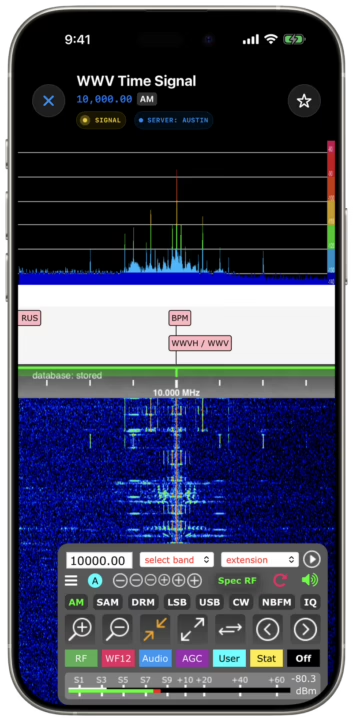
It sparked a question: Could he harness the power of existing SDR networks and develop a mobile solution, something akin to many of the scanner apps that exist, but truly designed for a smartphone?
“I wanted something made for iOS that felt like ‘Apple quality’,” he said.
Garrison Jr. wrote Echo in Apple’s native Swift language to ensure a similar experience across iOS, iPadOS and macOS.
While development began last June as a personal project, he quickly realized there was a demand for a polished client that aggregated KiwiSDR, OpenWebRX, WebSDR and FMDX.org servers.
He was also careful to respect the community’s roots, speaking directly with KiwiSDR creator John Seamons and OpenWebRX developer Jakob Ketterl to ensure proper attribution.
The community’s response was, well, swift: A crowdfunding effort funded his Apple Developer license within ten minutes. After a two-month TestFlight beta with 200 users, Echo officially launched for iOS on March 31.
The iOS version is also available in the European Union. An Android version, he said, is also in development.
How it works
The beauty of Echo is that it doesn’t reinvent the wheel. There are so many SDR servers publicly available. A thoughtfully designed interface that can more easily bring them to you would go a long way. And that’s what I’ve found Echo is in my own use.
Echo can automatically match you with the nearest SDR server via location permissions or allow for manual selection.
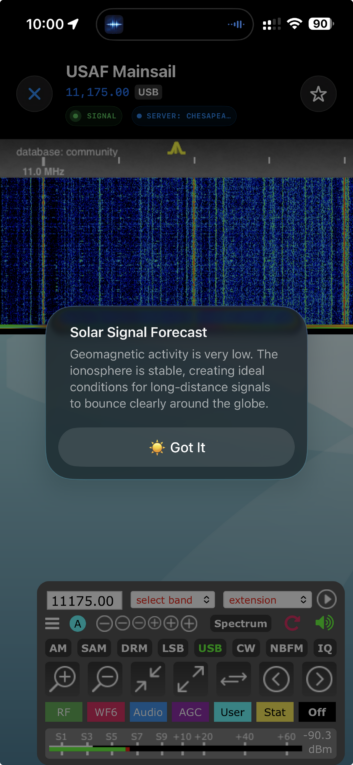
Depending on your target — such as an FM broadcast station — Echo switches you to the appropriate platform.
When I asked Garrison Jr. what sets Echo apart, he highlighted these five areas:
-
The “smart scan” experience: Located in the main station tab, the feature allows users to cycle through categories like amateur radio frequencies, public safety and military bands. He said that of the user feedback he’s garnered so far, military bands have been the most popular.
-
On-demand flexibility: While the scanner mode is a highlight, Garrison Jr. also wanted Echo to mimic a true tuner. At any point, users can break out of a scan to focus on a specific frequency. This includes access to a “hot list” of popular selections.
-
Interactive map: “Users can filter by SDR type, physical distance or signal-to-noise ratio to ensure the best audio quality,” Garrison Jr. explained, which includes whether you want to hear something locally or from another country.
-
A smart manual tuner: Echo detects kHz vs. MHz and routes FM requests to the nearest FMDX.org server. “I’m particularly proud of how it handles server complexities,” Garrison said. “If a server doesn’t support a specific frequency, the app helps the user find a server that does.”
-
Global database: Echo uses a categorized database of over 11,000 frequencies. The list is constantly growing, Garrison Jr. said, covering everything from standard FM and amateur radio to spy-thwarting “numbers stations.”
Echo has already seen quite a few user-fueled modifications. Garrison Jr. recently added Apple VoiceOver support for blind and low-vision users. The project has an active Discord community that he encourages new users to join.
What a time to be alive
I’ve said this before and the Echo app is a reminder — there’s never been a better time to engage in the hobby of radio, whether it’s long-distance (DX) signal hunting or scanning.
There are smart, young people like Garrison Jr. that are catching the bug and using software development skills to aid our endeavors!
For me, I can’t wait to use Echo to aid my DX this upcoming E-Skip and tropospheric ducting listening this season.
[Read the Signal Spot from Nick Langan for More DX-Related Stories]