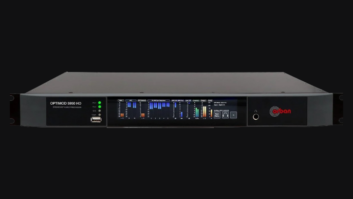
Orban has introduced the MXneo limiter, earning a “Best of Show” Award from Radio World at the 2026 IBC convention.
To explore the topic, Orban has sponsored this interview by Radio World Editor in Chief Paul McLane.
Radio World: Let’s start with your roles at Orban.
Robert Sack: I’m a technical support engineer at Orban, working closely with our product development team on ongoing product improvements. In addition to providing technical support to our customers, I’m involved in product testing, particularly when it comes to firmware updates. My background is in broadcasting: Before joining Orban, I worked for a company that supplied studio equipment and provided broadcast engineering services.
Peter van Beusekom: I am senior product engineer here. It is a dynamic job because I have to deal with customers as well as our sales and engineering departments. I have been passionate about audio processing since my early youth. Later, having already spent time modifying existing analog audio processors — and as a long-time fan and promoter of Orban — I joined the company as a customer support engineer employee in 2004.
RW: What is MXneo? Is it a standalone product?
Sack: MXneo is an evolution of our proven MX Limiting algorithm, which we introduced in 2016 for our flagship FM processors. It reduces audible distortion that could occur with MX on certain types of program material.
Van Beusekom: It is not a standalone product. MXneo is a new feature available as a free software update for our OPTIMOD 5950 and OPTIMOD 5950 HD processors, and it will come standard on all new units of these models. Since these models already include our standard MX technology, the enhancement can be installed in the field.
RW: Let’s go back in time. Why was Orban’s current MX Limiting technology important?
Sack: Orban’s original MX Limiting technology represented a major leap forward in the program density and loudness achievable on FM, with relatively few artifacts. It also made it possible to transmit substantially more high-frequency energy over FM, with particular emphasis on preserving the punch of the music.
Van Beusekom: It represents yet another major milestone in our long history of innovation.
When Bob Orban first started working on the original MX Limiting technology for FM back in 2008, the goal was to drastically reduce distortion while boosting transient punch and high-frequency power compared to the FM-channel peak limiter in the OPTIMOD-FM 8500.
The main goal was to help analog FM broadcasts compete with digital media in terms of cleanliness, punch, and open high frequencies.
The foundation for this goes even further back. In 1977, Orban was the very first company to patent and commercialize a psychoacoustic model to estimate and control audible clipping distortion in the OPTIMOD-AM 9000A.
Decades later, Bob came up with a new, far more sophisticated psychoacoustic model — one that shares similarities with audio codec technology — to completely redefine FM limiting. This breakthrough, introduced in the 8600 and 8600Si, became our standard MX technology.
During one of our very first head-to-head shootouts for a classical radio station, the stakes couldn’t have been higher. The panel of decisionmakers had one critical mission: finding a processor that could maintain pristine sonic consistency while keeping audible distortion completely under control, as the OPTIMOD 8400 did.
They put our OPTIMOD 8600, running in MX five-band style mode, to the ultimate test against their trusty OPTIMOD 8400 and the toughest competition on the market.
As the critical composition played, the room fell silent — followed by wide eyes and looks of pure disbelief.
One of the top decisionmakers turned to me and said: “Peter, it is clean now. No audible distortion, and the sound color remains completely untouched.”
When our processor was stacked up against the competition, the choice wasn’t just clear — it was unmistakable.
And I thought, “Yes! This is another incredible achievement from Bob and his R&D team.”
RW: What prompted the company to work on improving MX Limiting?
Van Beusekom: The development of MXneo was driven by the desire to further improve our proven MX Legacy algorithm.
Instead of resting on our laurels, we wanted to see how much further we could push MX technology, as certain types of audio material could still produce audible distortion in the upper midrange and at high frequencies.
To give users greater control over the balance between brightness and distortion, MXneo introduces a new feature: HF Distortion Control. Like the existing Distortion Control, this new setting adjusts several internal parameters, allowing you to fine-tune the sound to your preference.
Years ago, we overhauled the hard bass clipper in the pre-limiter section, introducing a new algorithm that enabled more aggressive bass clipping without generating objectionable distortion in the upper mid-bass frequency range. For MXneo, we took a closer look at this component and refined its operation even further.
In MXneo, the Bass Pre-Limiter operates over a wider bandwidth than in MX Legacy. This allows more bass energy to be processed, resulting in greater gain reduction and improved control over the bass level entering the stages following the Bass Pre-Limiter.
Sack: We noticed that when our classic MX algorithm encountered specific type of intense material, it could occasionally produce upper-midrange distortion when MX was driven hard with certain program material. As Peter mentioned, we were already working on improvements to MX. We were able to reproduce those issues internally, which made us all the more determined to improve the algorithm.
We had not received any complaints about objectionable high-frequency distortion, but we addressed this on our own initiative: During our intensive internal listening sessions, we noticed that MX also struggled to cleanly handle tracks with strong high-frequency harmonic content relative to their upper-midrange energy.
RW: Orban has said that this upgrade retains the “punch” and loudness performance of MX with “substantial improvements” in distortion behavior. How does it accomplish that?
Van Beusekom: The core of our MX technology is advanced and flexible, so we did not have to reinvent the wheel for this. Robert and I were able to gather the missing elements and address the issues we had encountered; Robert worked this out for Bob and for our DSP Engineer Ralph Swartz to create the substantial improvements.
Sack: Our MX limiter consists of several stages that share the work of increasing program density while introducing as few artifacts as possible. In MXneo, we have adjusted how the limiting work is distributed among these stages to reduce distortion in the upper midrange.
It is also important to understand that one of MX’s priorities was to transmit as much high-frequency energy as possible over FM. The tradeoff was that, depending on the material, high-frequency distortion could become audible to varying degrees. MXneo now also masks this distortion psychoacoustically, and the degree of masking is fully adjustable using the new “HF Distortion Control” parameter.
RW: How important is distortion behavior in broadcast processing today — would anyone truly notice, given the way consumers listen to radio now?
Van Beusekom: It is certainly significant; consider FM radio, for example, which still offers an unbeatable advantage for in-car use — accounting for over 80% of the total time spent listening to ad-supported audio in vehicles. Even in modern, connected vehicles, it remains the preferred choice over streaming platforms, while also ensuring free access for a broad audience.
Audio quality and in-car radio technology have improved significantly in recent years. Many modern aftermarket car radios and factory-installed infotainment systems use powerful DSP chips to help compensate for the acoustically challenging environment of a vehicle’s interior. Examples include time alignment, which compensates for the different distances between the speakers and the listener’s ears, as well as active crossovers.
Sack: Of course, we asked ourselves the same question. The answer is simple, but not clear-cut: “It depends.” It depends very much on the spectral content of the material and on how much distortion is already present in the source.
Distortion is not inherently undesirable. Some music actually relies on it for its character; just think of the electric guitars in rock music. But our aim is to cover everything “from Bach to rock.” In other words, our processors need to handle the full range of program material to a professional standard. That is why we developed MXneo as the next evolution of MX.
RW: Why is this improvement important for contemporary material such as pop, rock and similar formats?
Sack: As I mentioned, we want to offer the best possible audio processing for a wide range of content, whether that is rock, pop, classical music or speech programming. For rock and similar formats, our original MX algorithm is very likely to deliver excellent results. Much of that music already contains a substantial amount of distortion, so the emphasis is on delivering its punch and high-frequency brilliance on air.
Even in these formats, however, and especially in pop music, there are songs or passages in which added distortion can become very noticeable. Those are precisely the situations MXneo addresses, delivering cleaner results.
Van Beusekom: With demanding pop, rock and other contemporary material, MXneo reduces audible midrange distortion and improves high-frequency performance while preserving the loudness and punch that define MX Limiting.
RW: Orban also highlights MXneo for reducing audible high-frequency distortion. What kind of content has strong high-frequency harmonics relative to its upper-midrange energy?
Van Beusekom: The important point is that a song doesn’t necessarily need to sound extremely bright overall. The issue can arise when high-frequency harmonics are strong relative to the upper-midrange content, making distortion introduced by aggressive limiting more noticeable.
Sack: There is a particularly revealing example of a track that can really put FM audio processors to the test in this respect: Kelly Clarkson’s “Because of You.”
In the intro, she hums over a piano accompaniment. Her voice is rich in harmonics, giving it a very close, intimate sound. At the same time, there is relatively little energy in the upper midrange.
That combination is crucial: if there were more energy in the upper midrange, the associated harmonics would help mask the distortion generated at high frequencies. In this example, the absence of that masking effect makes the resulting high-frequency distortion particularly easy to hear.
RW: In MXneo, users can “shape the trade-off” between distortion, loudness, punch and HF energy. How does this differ from your past algorithm?
Sack: Setting up broadcast audio processors always involves a number of trade-offs, many of which arise in its final limiting stages. That applies to every manufacturer, because we all work within the same physical constraints.
The main objective in FM, at least in countries without specific limits on multiplex power (ITU-R BS.412), is quite clear: increase program density to achieve the highest possible loudness without exceeding the permitted peak frequency deviation. That is a challenge we all share.
The art lies in achieving that density while keeping artifacts to a minimum and preserving the essential sonic characteristics of the source material. Your question already identifies the main trade-offs. Customers can use the settings to strike the balance that best reflects their priorities.
A key difference with MXneo is that all of the changes we have described are adjustable. If a customer wants MXneo to sound exactly like the original MX, that is readily achievable. If the priority is to transmit as much high-frequency energy as possible over FM, accepting potential high-frequency distortion while reducing audible midrange distortion, that is equally possible.
Van Beusekom: In FM processing, there is a direct trade-off between loudness, brightness and distortion. Within a given limiter design, improving one aspect generally involves compromises in one or both of the others. Thanks to Orban’s psychoacoustically optimized designs, this is less true of Orban processors than of others.
MXneo builds on the original MX algorithm by giving users greater control over these trade-offs and more freedom to shape the final sound to their preferences. This allows them to find the balance between loudness, clarity, punch, and brightness that best suits their application.
RW: The Classical Music Mode seems like an important iteration of this. How is it different?
Van Beusekom: The Classical Music Mode in MXneo takes a significant step forward in preserving the natural dynamics and tonal detail of classical recordings. Unlike conventional limiting modes that prioritize loudness and impact, it is designed to retain the subtle nuances, dynamic contrasts, and natural transients that are essential to classical music, while ensuring transparent and controlled level management.
Sack: When we talk about classical music on the radio, we need to look more closely at what a station is trying to achieve.
Some stations present classical music as an entertainment format, offering a direct alternative to rock, pop, and similar formats. The emphasis is on entertainment or background listening. It is reasonable to assume that listeners will be tuning in under much the same conditions as they would to a contemporary hit radio (CHR) station. Ideally, there should be no noticeable drop in loudness when they switch from a CHR station to a classical station with this approach. The aim is also to reduce classical music’s often wide dynamic range to a minimum.
MXneo is ideally suited to this approach. Even without using Classical Music Mode, it can provide the required program density while keeping distortion to a minimum.
Other stations aim to broadcast classical music as faithfully as possible, making only modest adjustments to its dynamic range to suit FM transmission. Here, the focus is on the music itself, on giving listeners a deeper understanding of it, or on exploring musical works and their historical context. With an attentive, discerning audience, the processing goal is to avoid introducing distortion altogether.
This is where our Classical Music Mode comes into play. To minimize distortion even with demanding material that has high peaks, such as classical piano recordings, it disables all stages within the MX limiter that could potentially introduce distortion. A final look-ahead limiter then handles most of the peak limiting required for FM.
RW: In which products is MXneo offered? Will it be offered in others?
Sack: MXneo is initially available as a free software update for our OPTIMOD 5950 HD and OPTIMOD 5950 processors. We are already working on new products in which MXneo will also play a role.