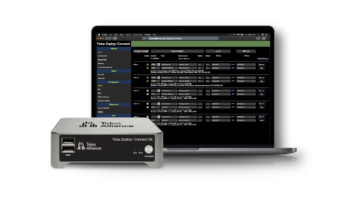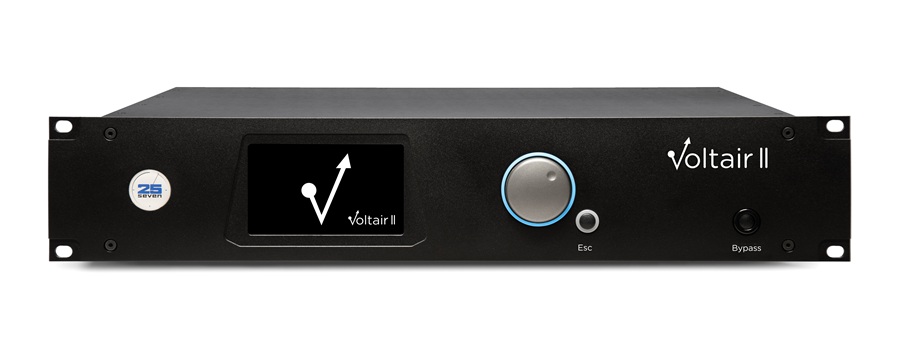
Telos Alliance has introduced a new version of its Voltair watermark monitor and processor, the box that made such an industry ruckus more than a decade ago.
I spoke with Marty Sacks, executive VP of Strategic Partnerships about the Voltair II. Our Q&A follows.
First some background:
The original Voltair caused a deal of controversy after it launched with a degree of secrecy on hundreds of stations in late 2014, and then blew up publicly the following spring. Its target clients were FM stations in markets where Nielsen’s PPM system was in use.
As Telos put it at the time, “Voltair won’t increase your actual listenership, but it will help you be more confident that listeners to your station participating in the watermark-based ratings process are correctly measured.”
Radio engineers speculated about which stations had acquired one and about how much of a lift it might provide in Nielsen PPM ratings. The assumption was that if a processor could help produce even small improvements in ratings performance, it could mean significant difference in revenue, especially in the largest markets.
The industry discussion put a spotlight on debates over whether certain radio formats encoded as well in the PPM process as others, and whether programmers could “game” the system by adopting certain programming tricks with their audio.
Things got testy for a while.
One Nielsen official said the box produced an unlevel playing field. “Nielsen’s measurement … is a level playing field, as it’s defined today. Nobody should be interfering with that.”
Around the same time Telos CEO Frank Foti addressed the controversy defending its approach in a client memo titled “Nielsen Schmielsen!”
Nielsen soon announced that it planned to introduce enhancements that would “negate the need” for Voltair. This turned out to be the eCBET coding enhancement to make PPM codes stronger and more robust and to improve code detection in challenging acoustic environments.
Telos responded by saying broadcasters using Voltair were still reporting a significant ratings advantage.
After that the public controversy settled down. Within a couple of years Telos had sold more than 1,000 of the Voltairs; it later discontinued production when market demand had been met and other production priorities mounted.
Now Telos has begun shipping Voltair II. Here’s my conversation with Marty Sacks.
Radio World: You told me that Voltair II is essentially three units in one.

Marty Sacks: Yes. First, Voltair units in the field have been serving faithfully for 10 or 11 years, and now some of them have started to need repair or replacement. Our customers have expressed concern here about availability, since they consider the unit critical infrastructure.
Meanwhile, we’ve been working behind the scenes for some time to solve an additional problem that our customers are experiencing, which is that some material is harder to encode.
Spoken-word and contemporary urban music formats seem to be most affected. One of the companies that brought this to our attention has a stable of talk programming, and they believe they have a higher level of listenership than is what is credited in the surveys.
So we developed an algorithm that we call Pascal. I can’t tell you details about how it works, but it basically looks at the energy in certain parts of the audio spectrum and enhances it to address the problem.
And third, you may recall that Telos produced a limited run of a legacy product called the TVC-15 Watermark Analyzer and Monitor. You’d use it to detect, monitor and analyze how well each element in your programming supports watermarking; and stations with a Voltair could pair it to a TVC-15 to automatically adjust enhancement levels in real time.
Why is that important? Because some users took the Voltair and turned the knob all the way up and just left it there, which means that artifacts can be heard in some cases. People can get upset about that, which I can understand. So the TVC-15 was like an AGC for the Voltair, and could help manage the trade-offs between robust encoding and artifact issues.
Now we’ve come out with the Voltair II, which has been tested in several markets including Los Angeles, Chicago, Boston, Dallas and Columbus.
It’s the first time in some years that customers can actually buy a Voltair. It went out of production after the big adoption cycle, and we sold later units piecemeal. Some users have had to remove them and had no way to replace them.
The Voltair II includes the tried-and-true Voltair that everybody is familiar with.
It also incorporates the TVC-15 — that AGC functionality — so that the enhancement level of the Voltair can be adjusted in real time based on the qualities of the audio.
And the third function is the Pascal algorithm that helps with harder-to-encode material.
It’s the first time that we’ve packaged all this into one box.
This is for stations that want to get the best possible results from their encoding, and those that want help with certain kinds of voices and music.
We’ve said for years that every meter counts. We want to give people a tool to really squeeze the washrag dry if they want, as well as to support those who need another unit when, say, they’re creating an extra stream.
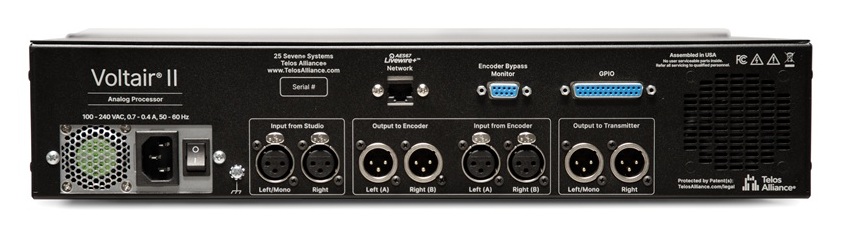
RW: Is it shipping?
Sacks: Yes. We have them on the shelf. And it’s in the same form factor, two rack units high, analog and AES versions — pull the old one out, put the new one in. It has the same connectors, the same pin-out on the DB connector.
I will say that the immediate supply is limited. We’re facing the same issue that a lot of others are facing because of the AI data center explosion — it’s harder these days to get servers and to get memory. There may be a bit of a delay once we sell out the first production run.
RW: What does it cost?
Sacks: It’s $19,500. We want to be good corporate stewards at a time when many broadcasters are struggling so we based it on the original Voltair price from 12 years ago and adjusted it for inflation.
RW: And it’s sold direct from the factory.
Sacks: Correct. And only to U.S. stations.
RW: What kind of benefit should users expect on the ratings side?
Sacks: This is not like when the original Voltair hit, when users saw a significant pop because it made such a difference. It’s less dramatic; but nonetheless there are improvements.
And we’re not looking to tweak Nielsen or throw stones. We’re not using their trademarks or their data. We can’t promote specific results. We have customers telling us what they think is happening. But our testers and our analysts have estimated a 1-1/2 to 2% improvement at the low end, to 4 or 5% at the high end, in terms of overall improvement on certain kinds of program material. It’s a case of “your mileage may vary.”
RW: Is Voltair II available as software?
Sacks: It’s not, for various reasons, which is ironic for a company that prides itself in making a product available how you want it. But we need it in hardware due to the time tolerances involved and how it works with the hardware encoder.
Also we know there are folks doing their Nielsen PPM encoding inside an audio processor, including our own Omnia .9. They will need to move back to a hardware encoder to use the Voltair II.
But we believe the vast majority of broadcasters in PPM markets use hardware encoders.
RW: How many of the originals did you sell?
Sacks: More than 1,000. We went from zero to hero in 18 months to two years. We don’t expect that kind of an uplift. But we want people to know what’s going on. The product webpage is up at www.telosalliance.com.