A longtime member of the Radio World extended family wrote to me last month as the House of Representatives was preparing to consider the AM Radio for Every Vehicle Act.
“I am watching the progress of this and hoping for the best,” he said.
“I wanted to share a few concerns I think are pivotal. First, putting AM back in the car does not guarantee decent reception or fidelity. If AM on a car radio sounded like *** before, where is the motivation for manufacturers to improve the radio’s design? If a decent sound is not there, neither are the listeners,” he wrote.
“Also, why are we still employing NRSC for AM? Take away that brick-wall frequency limit and add back in that (almost) octave we lost 30 years ago. With smaller AMs folding and leaving the dial, I wonder if that bothersome 10 kHz interference whistle is still an issue.”
[Related: “Can the AM Radio Car Mandate Beat the Congressional Clock?”]
Our friend also believes that AM station owners have to step up.
“The government is giving them a lifeline here. Check the fidelity and clarity of EAS rebroadcasts, get someone out to the antenna site to cut down the overgrowth, tighten down those bolts and check the tower paint. And when disaster DOES hit, the station cannot still be on autopilot, rebroadcasting the FM side.”
And on the topic of EAS, he notes that AI-based speech is an order of magnitude ahead of where it was only a few years ago.
“It plainly is time to replace ‘Perfect Paul’ with a clear, articulate near-human voice that commands attention.”
He concludes: “I have invested close to 50 years in this career and am not ready to walk away. I am just hoping that when/if the act is passed, it does not become a case of, ‘Okay, we won! Now what?’”
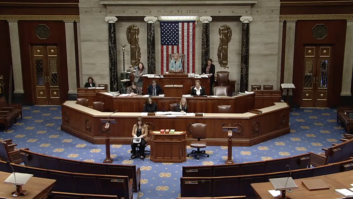
The House subsequently approved the bill, as we have reported.
But with Congress now going home until the mid-terms and then coming back to a crowded calendar, it’s unclear how quickly or whether the Senate will act. If it does not by the end of the year, the legislative process will have to start over.
In September, Nic Anderson, vice president of public policy at the NRB, told members in a blog post: “This is not just an AM story. It is a radio story and a broadcast media story with stakes that reach well beyond the dashboard.
“Congress is not simply deciding whether AM radio stays in cars,” he continued. “It is deciding whether free, local, over-the-air broadcasting will retain its place on the automobile dashboard or be quietly engineered out — one cost-cutting decision at a time.”
AM of course plays an important role for Christian broadcasters. But as Anderson noted, AM is important beyond questions of programming format. When severe weather or natural disasters strike and power and cellular networks fail, AM stations equipped with backup power can continue carrying emergency warnings and lifesaving information.
He noted the Senate will have to pass identical text, or approve its own, after which the chambers would have to resolve any differences before it could go to the White House. President Trump has expressed support for it.
If the bill becomes law, I hope the industry will consider the comments from our colleague above. If passed, the question indeed should be, “Now what?”
Radio World welcomes letters to the editor on this or any story. Email [email protected].