credit:
Getty Images/Carol Yepes
The author is technical consultant for Norsk Localradioforbund in Norway.
I’d like to offer a short response to recent commentaries by John Caracciolo and Jerry Del Colliano. I’m writing from a European local radio perspective, following two weeks of travel in the United States and observations of how radio is positioned in today’s in-car and digital audio environment.
As a technical consultant for Norwegian local radio stations, my work involves helping stations adapt to changes in technology, listening habits and distribution. That is why I read the commentaries with great interest.
Both identify important parts of the challenge facing American radio. Financial pressure, debt and ownership strategy clearly matter. But after two weeks of travel in the United States, and based both on conversations and my own observations, I am not convinced that balance-sheet pressure alone explains the broader position the industry now finds itself in.

From my perspective, American radio is also facing a structural challenge in a fragmented audio market. Mainstream music radio no longer competes only with other radio stations. It competes with streaming services, podcasts, social media platforms and a growing range of digital options in the car that might replace radio.
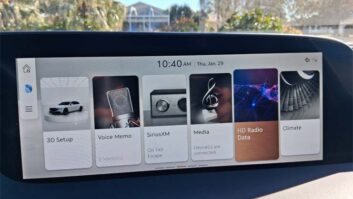
In that environment, relevance alone is not enough. Radio also must be easy to find, easy to access and clearly prominent in the listener experience. What struck me in some U.S. rental cars was that radio did not always feel like the natural first choice. Over time, that matters and affects business.
The increasingly difficult position of AM radio is part of the same picture. Even if Congress supports AM’s continued presence in vehicles, that alone is unlikely to resolve the deeper issue.
The real challenge is fragmentation, combined with the growing influence of technology platforms over listening habits and dashboard access.
This is where a European perspective may be useful.
In Europe, broadcasters, regulators and technology partners have at least tried to respond more collectively. There has been greater emphasis on hybrid radio, metadata, dashboard prominence, platform access and cooperation through initiatives such as Radioplayer.
Europe has not solved everything, but there is a clearer recognition that radio must actively defend its position in the connected car rather than assume it will remain secure on its own.
What stands out to me is not that U.S. radio is under pressure. That is understandable. What stands out is that the response still appears relatively fragmented at a time when broader cooperation may be increasingly necessary.
So, while debt and strategy are clearly part of the story, they are not the whole story. The current difficulties in American radio may also reflect a slower or less coordinated response to a more fundamental shift in the audio market. A stronger focus on digital advertising and AI may be part of the answer, but it is unlikely to be enough on its own.
From a European point of view, this may be a moment for American radio to think not only about financial restructuring, but also about stronger cooperation in the fight for visibility, prominence and ease of access in the car. That may also be a reason to look more closely at collaborative models such as Radioplayer.
Radio still has significant strengths. But in a market shaped by fragmentation and platform competition, those strengths may need to be defended more actively and more collectively than before.
The author assists local radio stations with technological solutions and technical challenges. The Norwegian Local Radio Association, or Norsk Localradioforbund, is a member-based organization for local radio stations in Norway. To learn more about it, visit www.lokalradio.no and click on the English button in the top menu.