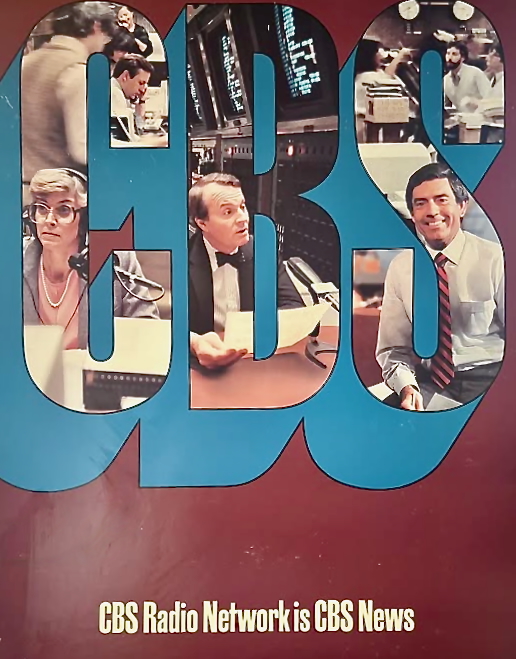
CBS News Radio leaves in its wake an era of broadcasting never to be repeated.
Nearly a century of voices, reporting and features that, based on the outpouring of feelings we’ve seen this month following its shutdown, meant so much to the radio industry and those who follow it.
The shuttering of the news division prompted a wave of reflection among former staff, including veteran correspondent Judy Muller, who remarked to former CBS Radio Engineer Henry Lenz that she never expected to outlive CBS News Radio.
Now, Lenz, who spent almost 40 years with the network making sure the likes of Walter Cronkite, Charles Osgood, Douglas Edwards, Charles Kuralt, Mike Wallace and Dan Rather sounded at their best, is now sharing some of the moments he helped bring to the airwaves.
He launched “Still Rolling,” a Substack dedicated to his memories of CBS News Radio’s golden era.
For years, colleagues and friends urged Lenz, 75, to write a book about his decades at the network.
“But that’s not what I wanted to do,” he remembered saying. “I wanted to tell the story my way.”
Finally, after talking with several friends who are producers in the industry, Lenz began crafting episodes, with around a dozen online at his Substack.
They include audio clips, pictures and several documents never revealed to the public before — such as Cronkite’s 1976 audio tribute to a retiring colleague. Plus, there are Lenz’s own memories through his writing.
Campus to Cronkite
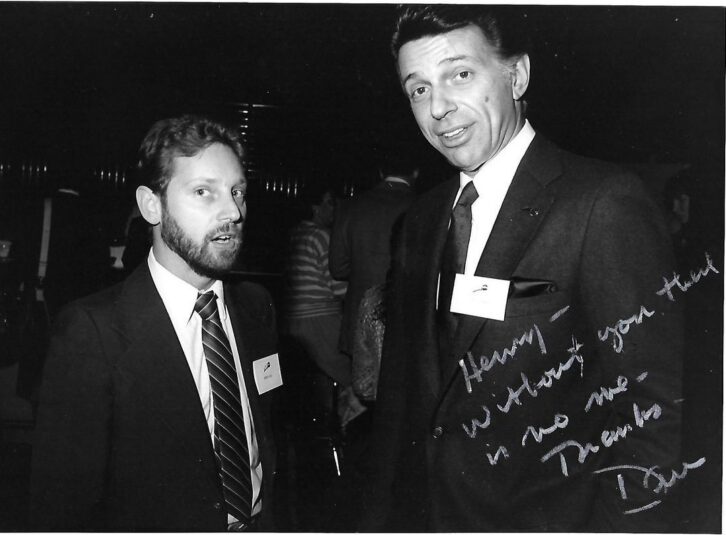
It all started for Lenz during his youth in New York City, where he grew up listening to legendary voices like Dan Ingram on WABC.
He later attended Hobart and William Smith Colleges in Geneva, N.Y, eventually rising to become the news director of the campus radio station, WEOS.
“This was during the late 1960s with quite a bit going on,” Lenz said, reminiscing that his college years coincided with historic events such as the Vietnam War, the moon landing and major civil rights protests.
Following graduation, Lenz accepted a full-time volunteer position at WNYC(AM/FM) in New York.
Working 40 hours a week, his duties ranged from handling remote broadcasts to setting up microphones at Lincoln Center and city council meetings.
After Lenz earned his first class radio telephone license from the Federal Communications Commission in 1973, he asked WNYC Director of Engineering Henry Wei for a staff position. Wei had other plans for Lenz.
Wei had an impressive radio background of his own. He orchestrated WNYC’s coverage at the 1939 New York World’s Fair — WNYC had a broadcasting studio there — and Wei was also Mayor Fiorello La Guardia’s engineer as he read aloud comic strips on the air during a 1944 newspaper strike.
He was an influence to many, including longtime New York engineer Richard Ross, who we profiled after his passing.
Wei was close friends with Bud Arnow, the engineering director for CBS Radio. Arnow frequently relied on WNYC for young talent. Two other technicians, Andrew Vallon and Gary Scherer, also came via the pipeline.
The connection landed Lenz a job at CBS Radio in 1973. The first assignment of his career was Walter Cronkite’s daily radio commentary.
“How do you top that?” Lenz said.
Fittingly, Lenz also would engineer Cronkite’s final radio hourly newscast in 1999, when President Bill Clinton’s impeachment was voted on in the U.S. Senate.
Fitting of a Peabody

When Lenz’s CBS Radio career began, a technician was present for every newscast. Over the next four decades, Lenz became a preferred engineer for the network’s top talent, receiving specific assignment requests from prominent broadcasters like Osgood and Rather.
In 1985, Lenz’s work as a technical director for “The Number Man — Bach at 300,” alongside senior producer Norm Morris on an Osgood-hosted Newsmark documentary, earned the network a Peabody Award. You can hear the episode on Lenz’s Substack.
Lenz credited Morris as an early mentor who helped elevate his profile within the company. In a memo to future CBS News President Van Gordon Sauter, Morris once wrote of Lenz: “Keep an eye on this guy, he’s going places.”
“I was enthusiastic, and I think it helped get me noticed,” Lenz said.
Osgood, Morris and Lenz also received a second Peabody Award for another Newsmark documentary, “Where in the World Are We?”
Lenz also spent nine years mixing the acclaimed “CBS Radio Mystery Theater” after he began as a sound effects technician. “The primary engineer was not in the IBEW, and the union required that a member should be present,” he recalled.
When that engineer, Fred Himes, suddenly left CBS, Marlin Swing, the assistant director, suggested to legendary producer and radio pioneer Himan Brown that Lenz run the program’s board. He’d go on to mix the show for the next seven years, totaling around 1,400 episodes.
“Hi Brown directed Orson Welles in the 1930s and me in the 1970s,” Lenz remarked.
In control at Candlestick
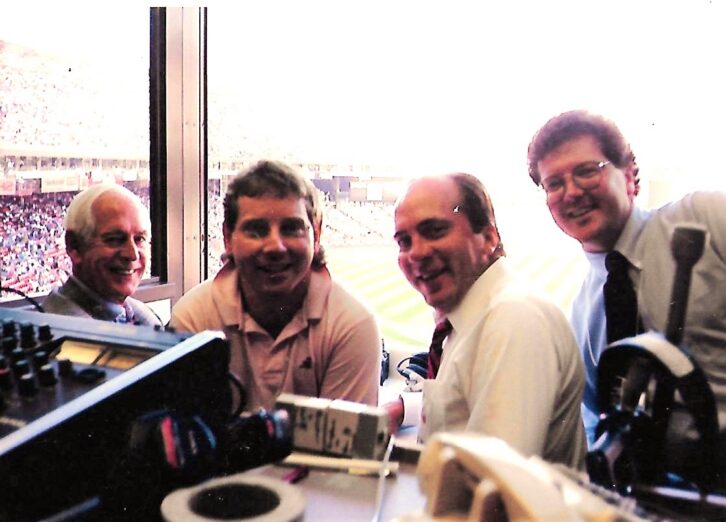
Lenz’s sports assignments took him to major events worldwide, including the Masters and the Super Bowl. He worked with Vin Scully on four different World Series broadcasts. Sportscaster Win Elliot, Lenz said, was a father figure to him.
“Win taught all the engineers at CBS Radio to take chances when going live and dare to be great,” Lenz said.
Perhaps his most harrowing assignment occurred during the 1989 Loma Prieta earthquake, which struck just before Game 3 of the World Series at San Francisco’s Candlestick Park.
When the disaster knocked out the network’s satellite uplink, Lenz discovered that 11 of the broadcast booth’s 12 backup phone lines had gone dead.
Using the remaining live telephone line, Lenz coordinated with the New York master control studio to interrupt a prerecorded pregame show, handed the phone receiver to announcer Jack Buck and told him he was live on the air.
CBS Radio remained broadcasting while major television networks scrambled to get back online.
A moment in time
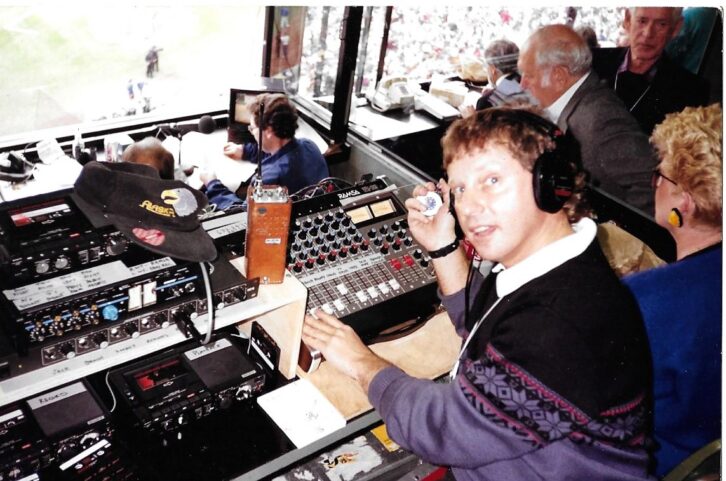
When Lenz retired in 2012, technological advancements and shifting union jurisdictions had fundamentally changed the industry. The 55-engineer department had dwindled to just eight.
“By the time I finished, I had the most seniority in radio,” Lenz said.
Now retired, he has stayed involved in video production — including for his alma mater — but the announcement by Paramount Global to close CBS News Radio in March convinced Lenz that it was time to preserve the division’s legacy.
Recent “Still Rolling” installments include the opening of a rare, three-hour broadcast hosted by Cronkite detailing the network’s first 50 years, as well as a retrospective on the production behind the CBS Radio Mystery Theater.
Lenz has about 20 additional episodes prepared for the pipeline and plans to publish new entries weekly.
He realizes that, no matter what happens going forward, we will never again hear the combination of voices, journalists and engineers that all came together during CBS Radio’s heyday. It is why Lenz is honored to share his memories with the world.
“CBS Radio’s legacy is as important to the 20th century as the transcontinental railroad was to the 19th century,” Lenz, still rolling, told us.
Radio World welcomes letters to the editor on this or any story. Email [email protected].