The author chairs the Digital Radio Mondiale Consortium.
Things are moving fast for the DRM all-frequency-band digital broadcasting standard.
Following the DRM General Assembly in Jakarta in May, the DRM Consortium used IBC 2026 in Amsterdam to announce new steps and products.
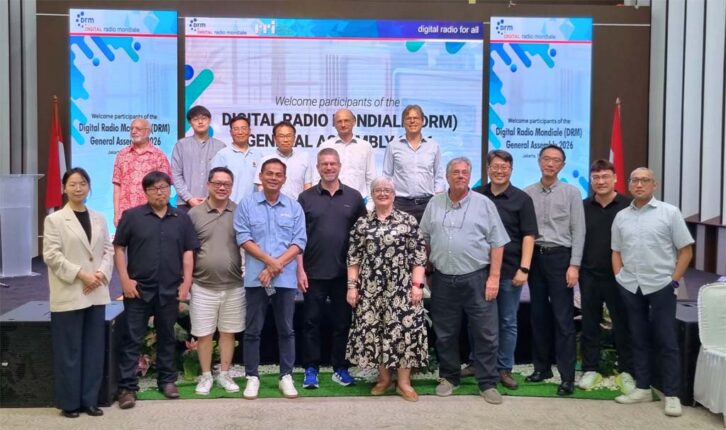
The consortium had partnered in the spring with leading broadcaster and DRM member Radio Republik Indonesia (RRI) to hold our annual meeting for the first time on the Asia-Pacific continent, where DRM is the prevalent digital broadcasting standard.
At IBC, it used a global virtual meeting and then two live events to focus on four main areas:
- the launch of new receivers and receiver solutions, many of which support multiple standards,
- the geographic advancement of DRM, also fuelled by its special benefits like Emergency Warning Functionality (EWF) and e-learning,
- the technical support for the implementation of the standard and the receiver manufacturing,
- the announcement of the cooperation with UNESCO on a distance learning project.
Across continents
DRM remains the prevalent digital broadcasting standard across the largest continent, Asia-Pacific.
In 2023, Indonesia, a nation of 280 million people and 17,500 islands, took the decision to adopt the DRM standard to digitize radio services in the AM and FM bands (VHF Band II), as well as VHF Band III (174–202 MHz), accompanied by DAB+ (upper part of VHF Band III, 202–230 MHz).
The Ministry of Communication and Digital Affairs, known as Komdigi, published its regulation on transmitter services in 2024.
RRI’s DRM services in the FM band are already on-air from nine sites throughout the country. A regulation on receivers is being worked on by Komdigi.
After the recent natural disasters, the DRM consortium renewed its efforts and cooperation to show that DRM alone can offer an emergency warning system that can alert populations at a distance of hundreds and thousands of kilometers when a disaster like the recent four simultaneous volcano eruptions occurs.
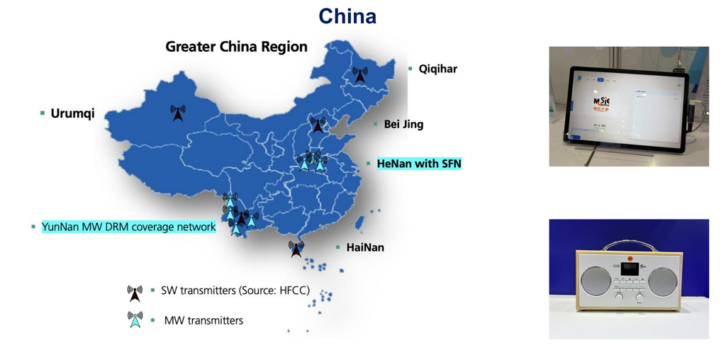
Other big Asian countries, including China, home to 1.4 billion people, are making big strides after the adoption of DRM alongside native CDR as part of the national standard.
A year ago, the official document for the national Chinese DRM standard in MF and HF Band became public. China’s adoption of DRM is largely driven by interest in its Emergency Warning Functionality (EWF).
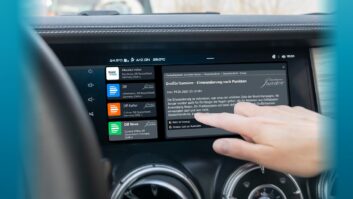
The importance of in-vehicle emergency broadcasting reception is also borne by current work to make it a national standard across the industry. The government is very close to officially mandating analog radio in all new cars, with the plan to go to digital later.
Chinese official partners and DRM members jointly are testing an end-to-end Journaline-based solution enabling geofencing capabilities.
India remains a huge DRM country, with 37 high-power MW transmitters on-air, about 900+ million people served by DRM digital radio signals in full-digital configuration, and more than 13 million cars on Indian roads with built-in DRM receivers, at no extra cost. India also has strong DRM development and manufacturing facilities.
A decision by the Indian government about the digitization of the FM band — where private stations have 40% coverage, and together with the public broadcaster about 74% — is still eagerly awaited by all the stakeholders. The consortium is advocating the “one standard for one country” approach, with DRM in VHF Band II being easy to implement on all platforms, including mobiles phones.
DRM developments in these three big Asian countries are joined by Pakistan and Nepal adopting DRM only, too. Other countries in the region like Malaysia, Thailand and Vietnam are weighing their national options.
Then there are the first countries to have adopted dual open standards — DRM and DAB+ — in Indonesia and South Africa.
They have had a ripple effect. Thus, Papua New Guinea is also interested in the dual approach adopted by Indonesia. The African continent has in principle adopted the dual solution and is watching what is happening in South Africa and Nigeria, big movers on that continent.
New DRM and multi-standard receiver solutions
IBC 2026 was the place for DRM to focus on receivers even more than during the General Assembly.
The variety of car, standalone and mobile/personal devices with DRM that were introduced at IBC was richer than ever, based on chipsets and modules launched by companies like CML Micro, NXP, Skyworks, Optm and Inntot, and using an updated user-friendly Fraunhofer IIS ContentServer Technology R8.
Companies like Solar Grove Solutions, together with Alongside Tech, based in the U.S. have launched a portable receiver, the N88, which is already getting positive feedback from users. This will be available for orders in October.
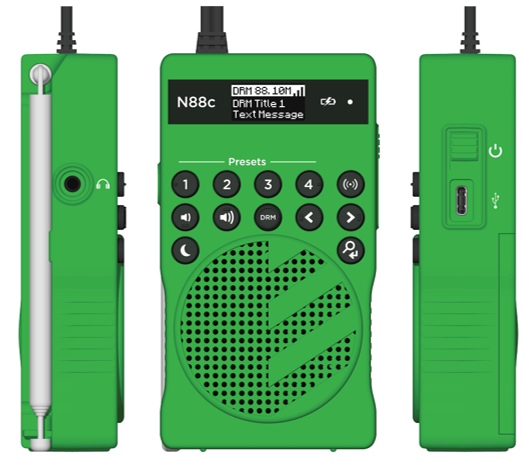
A lot of new models support multiple standards. These new receivers, demonstrated at IBC by DRM, are a new, significant development for the mass uptake of digital radio.
Elements Innovation (Korea) powered by RF2Digital technology has launched a dual-standard desktop receiver under the brand name BKS, Model ES006, with three versions already.
One version offers reception of broadcasts in both the DRM in the AM bands / CDR / analog SW/AM/FM / RDS. The CDR standard is aimed at the Chinese market.
Another version offers reception of broadcasts with DRM in all frequency bands / DAB+ / analog SW/AM/FM. This would serve South Africa, other African and European countries.
And for the first time ever, there is a version with DRM in VHF Band III and DAB+. This receiver version is aimed at countries like Indonesia considering the rollout of both DRM ( in all VHF bands) and DAB+.
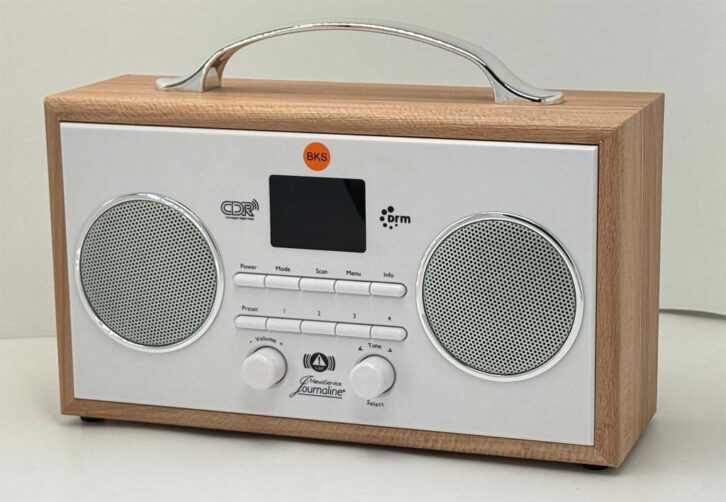
BKS’s Model ES006 dual-standard receiver is available in two versions: DRM/CDR and DRM/DAB+.
Starwaves (Switzerland) is also offering a DRM-DAB+ blaster but also a DRM classic receiver with Wi-Fi hotspot covering DRM-AM and DRM-FM as well as DRM Band III /DAB+.
A new SoftRadio App for Android, DRM-DAB+, joins the DRM-only App from Starwaves, and they are all available from established app stores.
A series of versatile multi-standard receivers also was introduced by NewGlee of China.
A software solution offered by Inntot (India) was also introduced as cost-effective and high-performance, an alternative to digital radio chips powering 2.4 million of the about 13.2 million cars with DRM receivers in India.
A DRM radio in my ear
CML was at IBC demonstrating its groundbreaking solution that delivers much-desired digital radio in mobile phones, or rather in mobile/cellular accessories such as headphones or earbuds.
CML Micro took an innovative approach called “radio without radio” to how listeners can get their preferred audio and multimedia in DRM.
In this new approach, the wireless neckband of a headphone acts as the natural antenna. Promoted by CML, the DRM1000 tuner chip captures and processes the DRM broadcast signal natively and makes it available via wireless Bluetooth to the DRM companion app running on the mobile phone.
The same concept applies to popular earbuds. The charging cases of the earbuds contain the small DRM chip, which acts as the DRM receiver.
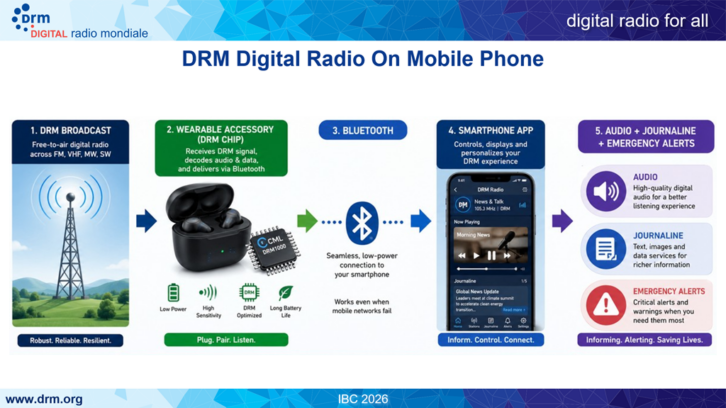
CML Micro thus demonstrated how headphones or earbuds can become receivers while the mobile user’s screen can be used as the remote control of this new radio.
This software radio is sophisticated enough to ensure that DRM Emergency Warning is delivered to all “smart” devices, as Journaline and read services are also available in this innovative solution developed by CML Micro.
The demonstration was also on display at the Fraunhofer booth at IBC 2026. It showed how a smartphone connects via Bluetooth to the DRM1000 module, with a companion app making the full range of DRM features, including Journaline, directly available on the smartphone.
For more on products and solutions for cars, mobiles and standalone receivers please see products.drm.org
Better and faster
DRM is making big strides geographically and technologically.
While the qualities and features of the DRM standard remain unchanged, there are always new developments; see Version 6 of the DRM Handbook, available as a free PDF download at handbook.drm.org, or the soon-to-be-unveiled DRM “members-only” area. It will include an MDI library with a collection of MDI files and the Fraunhofer DRM xHE-AAC Audio Conformance Library, a set of DRM MDI files to test DRM xHE-AAC decoders.
DRM members are pioneers of digital radio innovation. DRM is harnessing AI for education, reaching people where no data plan can be accessed or electricity switched on, saving lives when mobile towers are down. Streaming, Direct to Mobile (D2M) and AI are out there. At IBC DRM also announced a new project in conjunction with UNESCO to demonstrate the capability of DRM to deliver distance learning and emergency warning over short and wide distances.
At IBC DRM members have shown how they have met, in a short time, the challenge of offering transmitters, content servers, exciters, modulators and receivers for all bands, so that the regulators and administrators can now confidently recommend and introduce digital, open radio for use in cars, mobiles and in the home. DRM is a standard for these times that leaves nobody behind.
[Do you receive the Radio World SmartBrief newsletter each weekday morning? We invite you to sign up here.]