Radio World’s “Guest Commentaries” section provides a platform for industry thought leaders and other readers to share their perspective on radio news, technological trends and more. If you’d like to contribute a commentary, or reply to an already published piece, send a submission to [email protected].
The author is an award-winning transmedia storyteller, producer, director, writer, sound designer and owner of SueMedia Productions, a full-service audio production company.
In his recent opinion piece on the Radio World website titled “What’s Next for Public Radio,” Jerry Del Colliano dismissed the federal government’s role in supporting public media, framing it as “getting out of the rescue business.”

As someone who has seen firsthand what public radio means to communities, I find this view shortsighted and uneducated about a century and more of service.
Congress, in the 1920s, recognized the need for public media with the establishment of educational radio stations by universities, which initially gave rural communities access to educational programming.
The Public Broadcasting Act of 1967 officially established public broadcasting as a system, creating the Corporation for Public Broadcasting.
Public radio has strived to ensure fair access to the airwaves, a principle that those steeped solely in commercial broadcasting may undervalue.
Del Colliano’s suggestion that licenses should be sold off “for pennies” to groups like the Educational Media Foundation — operator of massive national Christian music networks such as K-Love and Air1 — would gut local service, especially in rural and underserved areas. These are precisely the communities that most rely on independent, fact-based reporting about local and state government, issues like climate change and emergency event coverage.
Republicans have been seeking to do away with CPB funding almost from the start. But in 1995 even Speaker Newt Gingrich’s proposal did not include a cold turkey zeroing out of all funding.
Rather, he proposed putting CPB funding on a three- to five-year glide path to zero, with federal funding diminishing yearly, to give the system some amount of time to plan, adjust and plot a new way forward. That plan failed because reasonable Republicans were persuaded not to back it.
What has just occurred is in keeping with the increasing cruelty and violence we see being done every day, all over America, by the policies being enacted by this Congress and the present administration.
The White House has labeled public media “politically biased” and “an unnecessary expense.” Backed by “free market” rhetoric, conservatives have decided that NPR and PBS are the problem, not their own unpopular policies.
As PRX Chief Operating Officer Jason Saldanha explained, network-level entities like NPR, PBS and PRX may be able to adapt to funding cuts with more resilience than small stations: “The funding cuts don’t affect us in exactly the same way they will affect stations, especially community radio.”
For these local stations, the consequences could be fatal. NPR President/CEO Katherine Maher has already warned that as many as 80 NPR stations may close in the next year.
Public radio is public safety
For communities like those in California’s Humboldt and Mendocino counties, public media is more than daily news and entertainment — it’s a lifeline.
The area’s public radio station, Redwood Community Radio, commonly known as KMUD, has broadcast wildfire evacuation notices, flood alerts and road closure updates for decades.
In 2019, Humboldt County awarded the station two generator grants — funded by a public safety sales tax measure — to keep transmissions going during emergencies.
It’s worth noting that even Michelle Bushnell, one of Humboldt’s Republican conservative county supervisors, uses KMUD’s airwaves weekly to connect with her constituents, something commercial stations in the area, many of which are automated, simply will not or cannot do. This is local democracy in action.
Domino effect of defunding
Subsequent to the publication of Del Colliano’s article, CPB announced it would begin shutting down in late 2025. CPB supports technical infrastructure, music and streaming licensing fees and original programming. KMUD expects its budget to shrink by 25% or more without CPB support, threatening rural weather alerts and emergency communications there, as well.
This is not just about news and information. Mississippi Public Broadcasting is eliminating its 24/7 children’s streaming channel, which has educated generations before they entered school, serving public media’s original mission. CPB grants have also funded food, history, music and cultural shows — programming that won’t survive without federal support.
A century of public service at risk
The U.S. has supported public media for generations, which is in line with most democracies around the world. While economic and political pressures affect public broadcasters globally, it is typically authoritarian governments — not democracies — that deliberately silence independent stations.
In “The Engineered Silence of Public Media,” anthropologist James B. Greenberg notes: “When public data is doctored, when independent media is filtered, and when education is recast as propaganda … ignorance is internalized — not as absence, but as truth.”
Across the United States, in communities large and small alike, public media overwhelmingly carries the broadcast mantle for democratic participation in the form of call-in shows, town halls and public affairs roundtables.
These are civic rituals that bind citizens to one another, reminding people that despite our differences, voices matter, dialogue matters, civic engagement matters. Without them, people can become isolated consumers of chaos, not participants in something shared.
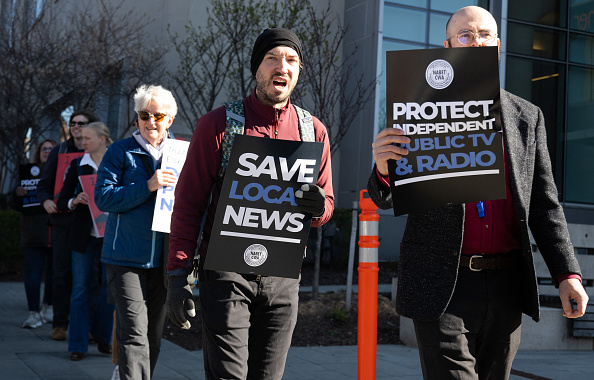
The reality on the ground
Del Colliano derides on-air fundraising as “whining” and tells stations to simply boost underwriting.
But KMUD — which broadcasts to primarily rural communities and whose territory spreads out over 10,000 square miles of rugged terrain and vast forests — already raises 75% of its income through underwriting, listener donations and community engagement. Simply suggesting that more underwriting can easily replace the federal support stations receive doesn’t consider the stations’ local economies.
It also doesn’t consider that federal support serves and, yes, even protects the public.
What’s truly tragic and infuriating is that CPB’s 2025 budget is $535 million, approximately 0.0076% of the total budget of the U.S. government, or $1.57 for every man, woman and child in the country. With so much talk about waste, fraud and abuse in government spending, one would be hard pressed to find taxpayer money that is better or more efficiently spent.
If the U.S. government truly “gets out of the rescue business” for public media, it will also be walking away from rescuing people in times of disaster, cutting off rural communities from emergency information and silencing diverse voices in the process.
In this moment of democratic fragility, we must recognize that public media is not a luxury — it is infrastructure for truth, safety and participation. If stations like KMUD survive, it will be because communities understand that and somehow figure out a way to rally to keep them alive.