The author is retired from the Research Department of Swedish Radio in Stockholm.
Decisions across Europe — including Sweden, Finland, Switzerland and the U.K. — to maintain FM broadcasting for the foreseeable future reaffirm that the FM band remains the most resilient communication channel during crises and national emergencies.

The marketing of the updated Radio Data System standard (RDS 2.0 / IEC 62106) has historically overemphasized graphics and station logos. Technically, however, the single most critical advantage of RDS 2.0 is a significantly increased data rate, which enables ultra-fast, dynamic updating of Alternative Frequency (AF) lists.
This effectively eliminates audio blackouts, scanning delays and “data starvation” during transmitter handovers in mountainous terrain, valleys and sparsely populated regions.
To guarantee uninterrupted Emergency Warning System (EWS / VMA) broadcasts to vehicles in transit, broadcast network operators, regulatory authorities and civil contingency agencies should advocate for the activation of RDS 2.0 in transmission networks and its inclusion in future automotive reception software specifications.
Data bottlenecks in legacy RDS
In the original RDS standard (IEC 62106-1), data is transmitted at a low rate of 1,187.5 bps (approximately 11.4 data groups per second).
When a vehicle travels through complex topography — such as mountain ranges, deep valleys or dense forests — signal levels from surrounding transmitters fluctuate rapidly. Legacy receivers encounter two severe operational limits:
Data Starvation: To execute a seamless handover, a receiver must first acquire and validate the transmitter’s AF list. In legacy RDS, cycling through a complete AF list takes several seconds. If signal degradation or multipath interference causes dropped data blocks, the radio becomes “blind” to available alternative frequencies.
Audio Muting and Scanning Artifacts: When signal strength drops precipitously before an updated AF list is received, the radio is forced to perform a blind frequency search or manual scan, resulting in pops, prolonged silence or improper frequency locks.
Technical solution
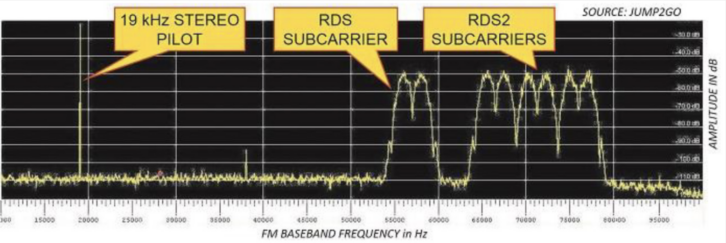
RDS 2.0 introduces three additional subcarriers (10, 11 and 12, with Subcarrier 13 as an option) alongside the legacy 57 kHz subcarrier (Subcarrier 1).
- [Subcarrier 1: 57 kHz] Legacy RDS (1.2 kbps), backward compatibility
- [Subcarrier 10: 66.5 kHz]
- [Subcarrier 11: 71.25 kHz] RDS 2.0 Extension (Up to 4.8 – 9.6 kbps)
- [Subcarrier 12: 76 kHz]
The key technical advantages for mobile reception are:
Parallel AF Transmission at Higher Data Rates: The expanded bandwidth allows full AF lists and regional transmitter matrices to be broadcast four to eight times more frequently. The receiver constantly maintains an up-to-date, localized frequency map in memory.
Seamless Handover: When combined with modern dual-tuner automotive architectures — where Tuner B continuously scans background frequencies using AF data while Tuner A outputs the audio — RDS 2.0 enables completely imperceptible handovers without micro-pauses or mute sequences.
Resilience to Multipath and Shadowing: Because data packets are repeated at a much higher frequency, a brief window of clear reception (e.g., passing over a hill crest) is sufficient for the tuner to fetch the entire current transmitter table.
Civil protection and national defense
In scenarios where IP-based networks (cellular, fiber) fail due to power outages, cyber threats, network congestion or physical sabotage, terrestrial FM remains the primary independent infrastructure for emergency broadcasts.
Emergency Warnings to Vehicles in Transit: During evacuations or crisis movements, citizens rely on continuous information via car radios without needing manual tuning or experiencing loss of signal between broadcast zones.
Coverage in Remote Areas: In regions where distances between main and repeater transmitters are vast (such as northern Scandinavia or the Alpine valleys of Central Europe), RDS 2.0 provides the necessary technical headroom to maintain stable reception.
Action plan
To bring this issue back to the forefront of industry discussions, a three-step implementation model is proposed to resolve the “chicken and egg” dilemma:
Transmission Side (Network Operators): Enable RDS 2.0 support on MPX signals during scheduled encoder updates at primary transmitter sites. The implementation barrier is low, as modern encoders often support this standard via simple firmware or software license upgrades.
Regulatory & Emergency Authorities (EBU / Civil Contingencies Agencies): Define uninterrupted coverage and seamless transmitter handover for Emergency Warning Systems as a core metric for national broadcast resilience.
Automotive & Receiver Side (SDR & OEMs): Demonstrate active RDS 2.0 transmissions to drive automotive adoption. Because modern vehicle infotainment systems rely heavily on Software Defined Radio (SDR) architectures, hardware modifications are unnecessary — enabling RDS 2.0 subcarrier processing can be achieved entirely through software and firmware updates.
[Read More Guest Commentaries]