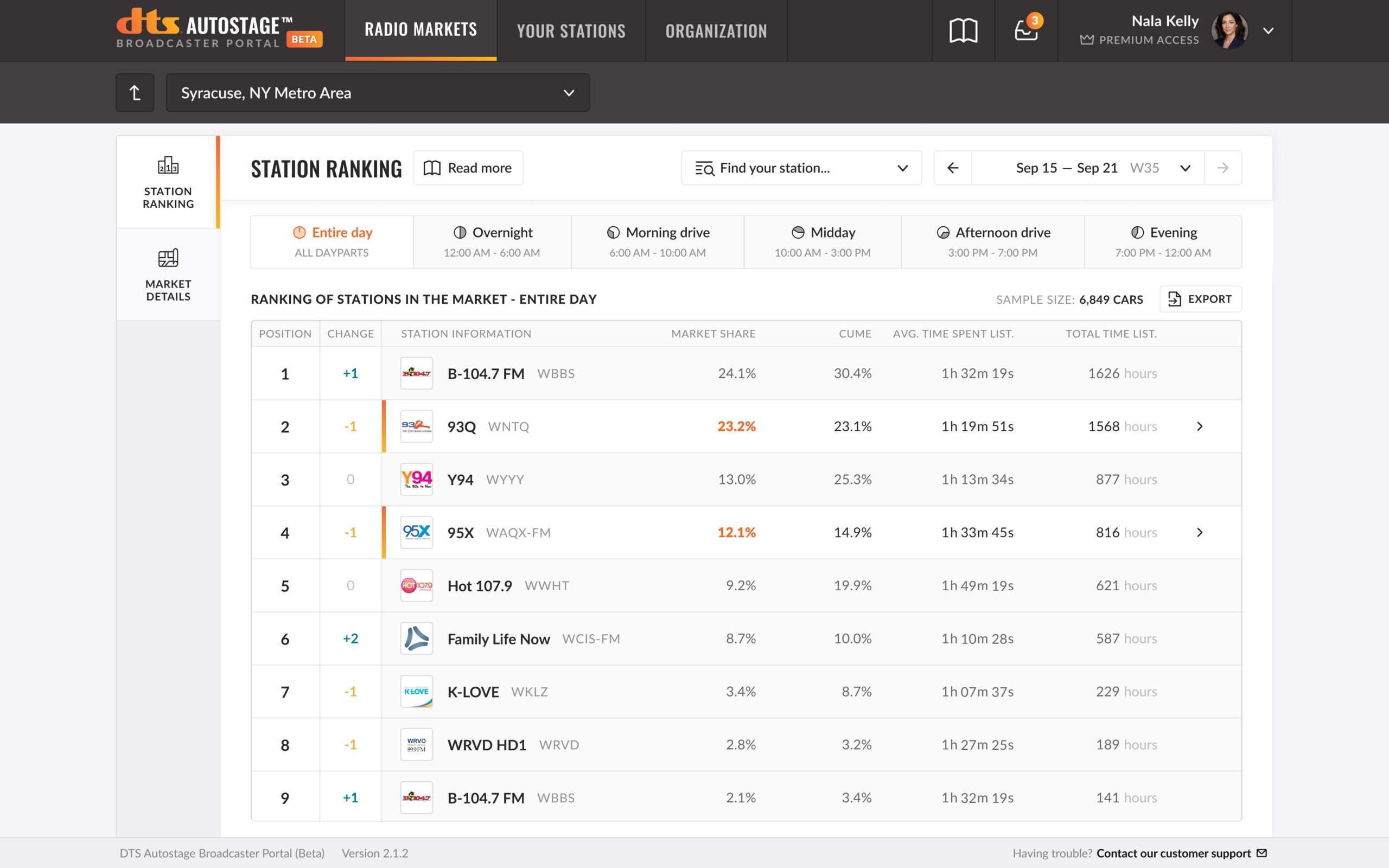
The DTS AutoStage Broadcaster Portal is now available in 550 U.S. markets, and Xperi continues to promote its platform to be a key source of in-car analytics for the radio broadcast industry.
Separately Nielsen last week encouraged broadcasters to tap the brakes a bit on their use of in-car analytics. Without citing Xperi specifically, it said such platforms have “a huge blind spot” and that stations should do a “rigorous review” of in-car data sets.
Details
With the NAB Show New York about to open, Xperi announced that it added 246 markets and that the expansion has added 1 million vehicles to the portal’s measurement service, for a total of 7.7 million.
It said the platform’s feature set now includes weekday and weekend station rankings and enhanced reports for Premium tier users.
According to Joe D’Angelo, Xperi’s SVP of commercial strategy and partnerships, the expansion will be a boon to broadcasters in smaller markets.
“A station in a smaller town of 20,000 people can now see its audience data with the same clarity as a station in New York or Los Angeles,” he said in the release.
Xperi listed examples such as Grand Junction, Colo.; Altoona, Pa.; Ithaca, N.Y.; and Key West, Fla. It said that “many” of the markets “were previously radio ‘data deserts’: stations that have been without audience measurement for years.”
“Each new market receives data from at least 1,600 vehicles,” Xperi said.
“Of the new markets, the South, led by North Carolina and Texas with 17 each, is benefiting from the greatest coverage expansion. In the Midwest, Ohio’s overall coverage has more than doubled, while Wyoming has access to the portal’s radio audience measurement for the rst time in Cheyenne.”
According to Xperi it now publishes radio data in more than double the number of markets of other audience measurement services. The standard tier is free to stations.
Companies now using the premium tier include Cumulus Media, Zoellner Media Group and Seven Mountains Media.
Xperi quoted Kristin Cantrell, owner of Seven Mountains Media, saying her company combines aggregated in-car listening from connected vehicles with its streaming data. She cited the platform’s listening heat maps as particularly valuable to sellers.
The decision by Cumulus to jump into the deep end with DTS AutoStage, announced in July, came as the media company has been grappling with Nielsen in a high-stakes legal battle.
A different take
Nielsen ratings are the widely accepted reference for radio measurement in the United States.
In public discussions about dashboard analytics, neither Nielsen nor Xperi usually mentions the other by name. But in its recently released piece about audio, Nielsen wrote that “in-car data on its own reveals what a head unit was tuned to, not who was listening.”
Nielsen notes that it measures radio, podcasts and streaming audio together, from local stations to national networks. It argues that in-car systems “ typically can’t tell a driver from a passenger, count the people in the car or verify their demographics, and it reflects only the vehicles that report it, often newer models with data sharing turned on.”
It said millions of vehicles on the road are not captured by in-car data, including “older vehicles, delivery vans, professional services vehicles, semi trucks, cabs … the list goes on and on. This is a huge blind spot.”
Nielsen makes the pitch that its large data sets are about “verified human behavior from proportional, census-informed panels, so added scale brings added precision instead of added bias.”
It challenged readers to do a “rigorous review” of in-car data sets.