(Editor’s Note: The following account is adapted from a WNYC Archives oral history interview with WNYC Chief Engineer Steve Shultis, conducted by WNYC reporter Amy Eddings on Dec. 9, 2002. Today, Shultis is New York Public Radio’s chief technology officer.)
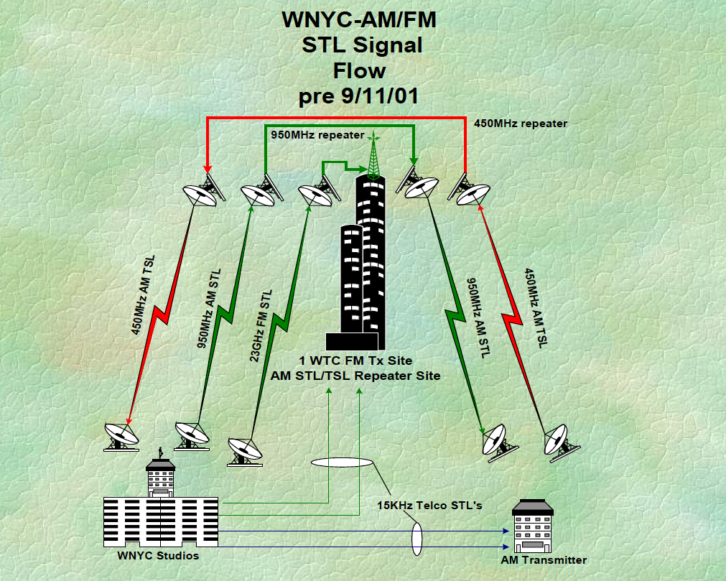
When World Trade Center Tower 1 was struck on the morning of Sept. 11, 2001, New York Public Radio’s WNYC lost its primary FM transmission facility in Room 11049 on the 110th floor, its rooftop master antenna mast and its microwave studio-to-transmitter links.
WNYC(FM) was one of four FM stations broadcasting from the WTC — sharing space with Columbia University’s WKCR(FM), then-Clear Channel’s WKTU(FM) and Spanish-language WPAT(FM).
For WNYC Chief Engineer Steve Shultis and his engineering team, the FM transmitter was lost, but quick thinking kept WNYC’s 820 AM signal, from its Kearny, N.J., transmitter site, on the air almost throughout, while phenomenal outreach in a time of need from the broadcast community at large helped return 93.9 FM to the airwaves.
Sept. 11, 8:50 a.m.
Shultis had worked overnight at the World Trade Center transmitter site on Sept. 10 tweaking audio processing back to a receiver at 1 Centre Street, where WNYC’s studios were located. Having slept late as a result, he emerged from the subway at Brooklyn Bridge and Centre Street around 9:15 a.m., unaware of what had occurred.
“First of all, I saw one person just kind of screaming and running into the train,” Shultis recalled to Eddings. “And I thought, ‘Well, just another day in New York.'”
Stepping onto the street, he saw crowds staring up at the burning towers and realized something was wrong. “I just asked somebody who I was standing next to,” Shultis said. “And this guy said, ‘It’s terrorists, man! It’s terrorists!'”
While FM 93.9 went silent, WNYC Engineer George Edwards switched the WNYC(AM) STL at the studios from microwave to a leased 15 kHz Telco radio circuit. That change restored AM 820 transmission, keeping news coverage on the air through the morning and afternoon.
Sept. 11, 9:30 a.m.
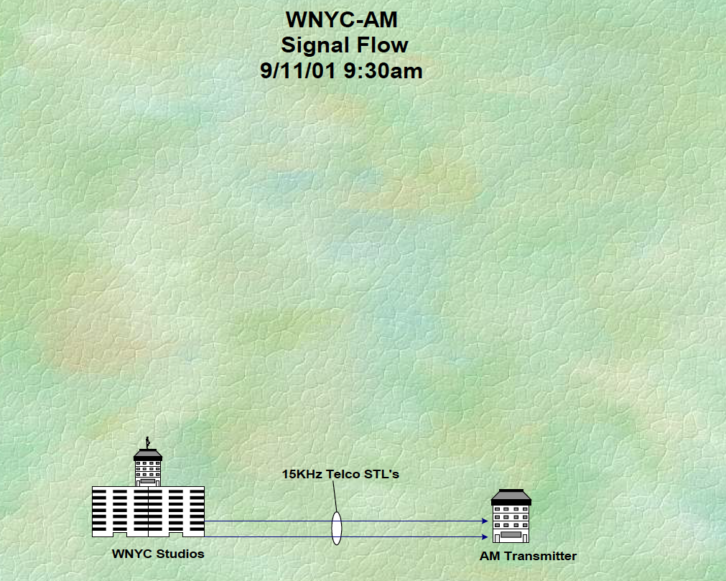
Inside 1 Centre Street, Vice President of Administration Mitch Heskel urged staff to evacuate. Announcer Mark Hilan interrupted regular programming to broadcast that the Pentagon had been hit. Before leaving Control Room 2, Shultis called the NPR System Technical Center in Washington, D.C., on satellite channel Sat 01, telling them WNYC was evacuating and asking them to keep news audio feeding the NYC line.
Shultis and the staff walked down 25 flights of stairs to the street.
“And I’ll never forget this part,” Shultis recalled to Eddings. “I walked down with Mark Hilan and Karen Burdick, one of our maintenance engineers. And we were, you know, we were just talking it through, going downstairs, and we got downstairs into the, onto the street. And of course, it was just mobbed. And we all kind of just lost each other immediately. And at that point, I thought, ‘All right. Everybody’s out.’ And I started walking uptown. And I ran into some of the morning news people. Brian Lehrer was there and a few other people.”
Standing on the street near Worth Street, Shultis suggested walking up to the NPR New York Bureau in Midtown. Shortly after coming onto the street in front of the Municipal Building, Tower 2 collapsed, sending a dust cloud rolling up Park Row toward City Hall. Shultis ran, realizing one tower was down and the second would likely follow.
He headed over to Lafayette Street, where station drivers brought him the WNYC van with the engine running. Shultis turned on the van radio and was surprised to hear Hilan broadcasting on AM 820 — Hilan had snuck back up into the evacuated building to resume on-air coverage.
Shultis began driving north slowly through the crowds fleeing Lower Manhattan, hearing the roar of Tower 1 collapsing behind him as he turned onto Canal Street. His goal was to make it to the Kearny site across the Hudson River.
Sept. 11, midday
Heading north out of Lower Manhattan with cell networks jammed, Shultis found traffic moving reasonably well on the West Side. He spotted a pay phone in the West 50s with a manageable line. He pulled over, waited 10 minutes and called home to check in with his wife.
“Yeah, that was, that was the hardest part, to try to get through to her,” Shultis said. “Because I knew she didn’t know … Her sister came down from Albany right after she heard that, because, you know, she expected the worst and stuff. But, as it turned out, I was okay.”
Learning over the radio that the George Washington Bridge and tunnels were closed, Shultis continued up to 125th Street, aiming for the Henry Hudson Parkway to cross farther north at the Tappan Zee Bridge. But around 140th Street, traffic ground to a complete halt.
There’d be no way Shultis could cross the Hudson.
His cell phone connection briefly reestablished, allowing him to place a call to contract engineer Richard Koziol in New Jersey. After confirming Koziol was safe — he also served as transmitter engineer for WKCR at 1 World Trade Center — Shultis learned Koziol had already contacted Harris Corporation in Quincy, Ill.
Together over the phone, they finalized an order for three 1 kW FM transmitters, audio processors and cabling, arranging for a non-stop delivery truck to come via Indiana for ERI antennas en route to Manhattan.
Shultis headed to the NPR New York Bureau in Midtown, where engineer John Keefe and bureau staff were converting an 8×10-foot reporter’s office into an emergency studio.
“By the time I got there, they had a room all picked out,” Shultis recalled. “The bureau had given us a room, and then we started running wire … We started, you know, beg, borrowing equipment from the bureau. They would give us stuff, because we basically left One Centre Street with nothing.”
Sept. 11, 7 p.m.
While news staff broadcast from Midtown, AM 820 stayed on the air via the leased line through the afternoon. At 7 p.m., 7 World Trade Center collapsed, destroying the telecommunications hub at Verizon’s West Street Central Office and severing WNYC’s leased telephone lines.
“That’s how we stayed on the air until Tower Seven, Building Seven fell that night,” Shultis explained. “That basically took out the whole West Street telephone central office. And then we lost that umbilical cord to get to Jersey.”
Losing that connection had been an ongoing concern for Shultis throughout the morning. “I had figured that would be gone already,” he recalled. “That’s why I was trying so hard to get to New Jersey. But we were able to stay on that for a while.”
Sept. 12, 12:30 a.m.
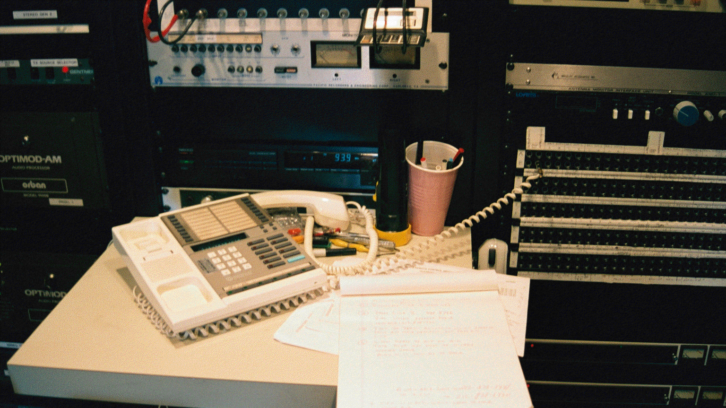
Without a standard telephone audio codec available at the Kearny AM site, Koziol set up a workaround. He took a standard telephone, unscrewed the earpiece, attached alligator clips to the earpiece leads and plugged a patch cord into the Optimod audio processor input.
“And we established a very low fidelity audio link via the telephone hybrid at the bureau through this earpiece at the transmitter site,” Shultis explained. By placing a standard dial-up phone call from Midtown to the transmitter room, WNYC restored AM 820 overnight. Koziol configured a low-tech auto-answer trick on the line so the phone would reconnect if dropped.
Sept. 12, 2 p.m.
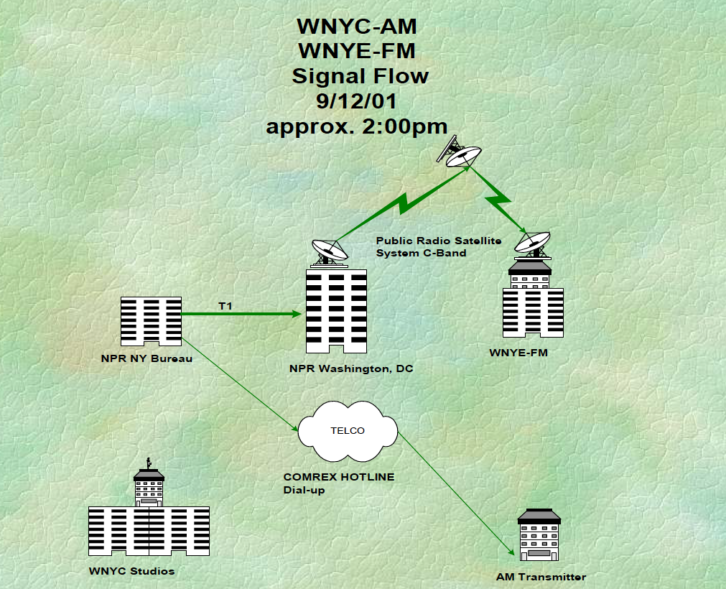
To replace the telephone earpiece connection, engineers sourced hardware locally. RadioVision Christiana Chief Engineer Peter Polanco went to a facility in Paterson to retrieve a Comrex Hotline codec, but ran into an obstacle.
“We had changed the locks on it, so he never had a new key,” Shultis recalled. “So he showed up there alone, with no key. So I instructed him to break the window of the transmitter room. I said, ‘Just break the window. Get in. And install the codec.’ And that’s what he did on the 12th. And that basically saved us from this whole, just regular handset, dial-up set dropping off the air.”
WQXR(FM) Chief Engineer Rodney Belezaire supplied a matching unit for the Midtown studio, and by 2 p.m., broadcast audio was running over dial-up POTS lines.
91.5 WNYE(FM) offered its frequency to simulcast WNYC, routing audio through NPR in Washington via fiber and satellite. WKCR provided studio facilities and telephone hunt-lines so hosts Lehrer and Leonard Lopate could take live call-in shows, wired by WNYC engineers James Williamson and Ed Haber. WAXQ(FM) Chief Engineer John Lyons donated transmitter space, ISDN lines and tie-lines at the Empire State Building.
Meanwhile, Harris sent its truck from Quincy, with 1 kW FM transmitters, stopping in Indiana for the ERI antennas while coax cable was shipped from Connecticut.
“Well, I think this comes back to the whole tradition of broadcasters, throughout history and with amateur radio,” Shultis remarked to Eddings. “It’s a very traditional broadcasting type of mentality. And we couldn’t have done it without any of these guys. And so many people came forward. People I didn’t even know at that point.”
Sept. 14, 4 p.m.
Following a Wednesday logistics meeting at ABC Television to coordinate getting emergency gear into Manhattan, DSI RF Systems escorted the Harris transmission equipment into the city under a staged FEMA caravan from the Meadowlands.
“Everything had to do with just getting the FM back on the air,” Shultis explained. “So, whether it was attending a FEMA meeting, you know, that was a priority. If that meeting happened at some point, that was a milestone step to get FM back on the air. So whatever was a milestone step, I had to do it. Then in the FEMA meeting, you do it — you get your name in the hat, so you get your stuff in the thing.”
Equipment was unloaded on the 82nd floor of the Empire State Building. To supply an audio feed, Lyons ran an ISDN line from his 83rd-floor room out a window, where Shultis reached out an 82nd-floor window to catch the wire.
When an initial backup antenna lead proved unusable, engineers moved the transmitter up to the combiner room to feed the 1965 Alford Master Antenna on the 102nd and 103rd floors.
Sept. 16, 2 p.m.
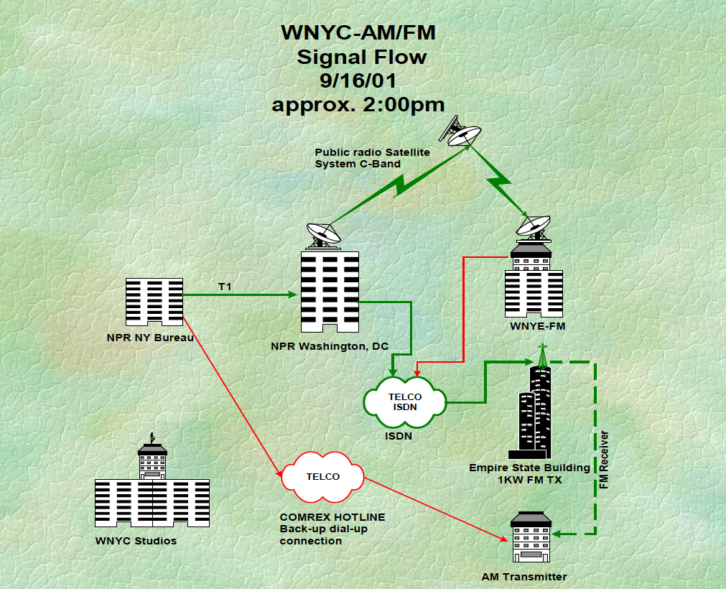
By Sunday afternoon, WNYC was broadcasting at 500 watts from the Empire State Building, limited by a single available 15-amp circuit breaker.
“It’s an excellent-to-good range over the five boroughs,” Shultis told Eddings. “There’s not a lot of power to get in, deep into the urban canyons of the streets of Manhattan. And certainly it doesn’t get into the fringe areas of full power that a full-power station could reach.”
An off-air FM receiver at Kearny picked up the 93.9 FM signal to feed the AM transmitter. An electrician combined two breakers a week later to increase transmitter output to 1,000 watts.
Dec. 3, 2001
WNYC’s downtown studios reopened on Sept. 30.
On Oct. 24, engineers restored a microwave link to Kearny despite having no clear line of sight between the buildings.
“We were really cheating the system,” Shultis said, explaining how they turned off the digital feed and manually angled the dish until they picked up a workable analog signal.
On Dec. 3, a dedicated T1 circuit was installed at the Empire State Building, allowing engineers to hang up the ISDN phone call that had been running continuously as an STL since Sept. 16.
April 1, 2002
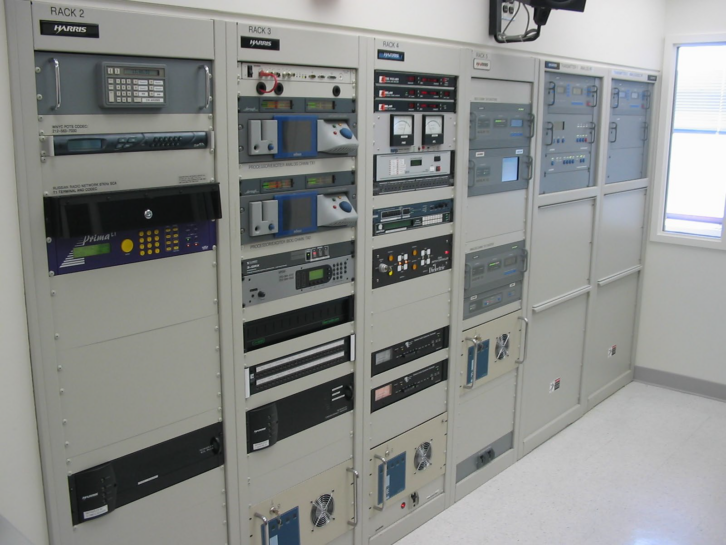
On April 1, 2002, WNYC restored full-power FM transmission from a new primary site at 4 Times Square. Throughout 2002 and 2003, Shultis designed a redundant “self-healing loop” STL architecture — combining 5.8 GHz spread-spectrum microwave, physical T1s, ISDN and POTS backups across 4 Times Square, the Empire State Building and master control.
“They very quickly decided that we have to have two full-power sites now,” Shultis recalled of the decision to construct dual facilities. “Creating stability was the priority, because everything was unstable. Whatever step we could take to increase stability was the goal.”
(Credit: Material adapted from the WNYC Archives oral history collection, featuring an interview with Steve Shultis conducted by Amy Eddings on Dec. 9, 2002. Used with permission.)
Radio World welcomes letters to the editor on this or any story. Email [email protected].