Here is a sampling from recent letters to the editor. Read more Radio World reader letters.
Should We Log Tower Light Observations?
Regarding Gregg Skall’s article “What to Know About Your Station Log” in the May 20 issue:
I have spent most of the last 25 years conducting ABIP inspections in New England and Florida. Before that I was a station owner, chief engineer/operator and director of engineering for 50+ years.
Gregg states that regular observations of tower lights must be logged. I agree 100% that this is an incredibly smart practice. However I cannot find in the regs that the actual logging of these observations is required.
FCC rule 47 CFR § 17.47 requires that these observations be made (unless there is an alarm system in use) but does not explicitly state that they must be written down in a station log. Moreover, 73.1820 talks about the logging of lights that have been extinguished or are not functioning properly, but it is silent regarding making an entry when everything is functioning correctly.
Logging regular observations is prudent, especially if there should ever be a problem such as a plane strike. However I fail to see where making these entries has been codified into the rules.
Robert A Shotwell
Former owner
Spectrum Investigative Services Inc.
Author Gregg Skall responds: Bob Shotwell is correct. The article’s wording was not intended to suggest that logging of regular observations is required; it’s not. However, if you observe extinguished or malfunctioning is observed, the log must state the nature of the problem, the date and time of extinguishment or improper operation, and the date, time and nature of adjustments, repairs or replacements.
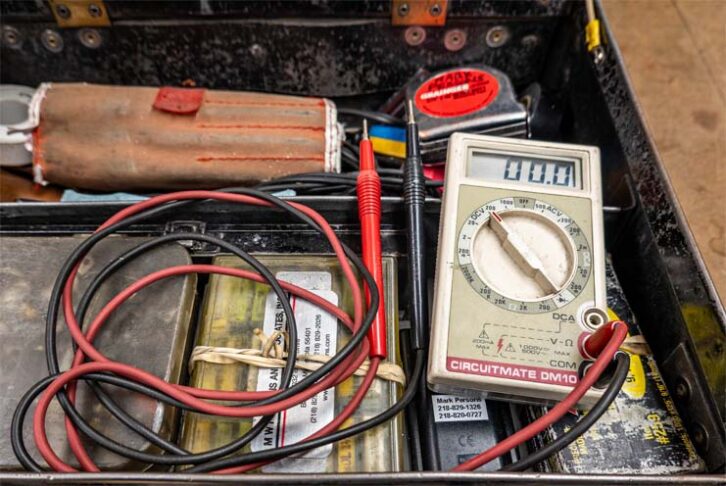
I’ll take the VOM
Hi Mark Persons: My preferred type of multimeter (“Here’s Something I Can’t Live Without”) is still the analog VOM or volt-ohm-milliammeter.
Sometimes waiting for the digital voltmeter or digital multimeter to lock up can cause one to lose a significant event. The meter sweep of the VOM can show the transient of interest that has a rise or decay time much faster than the DMM can provide a solution (voltage or current indication) for.
One such usage is tracking down ringer failures on analog phone lines — yeah, those still exist in my world. From there you can determine if the signal occurrence is OK or requires further investigation.
I do also carry a DMM, but my digital world at work requires I use a VOM to analyze things in the analog domain.
73,
Kevin K Asato
KC6POB
Plain talk is best
I agree that flooding the general manager with technobabble is not the best idea (“Technobabble Doesn’t Help Your Cause,” April 22 issue).
One thing that I quickly learned to do is a show-and-tell in the GM’s office with the remains of the recent expensive repair. I’d bring in the failed part to show him what we’d just spent thousands of dollars fixing.
Bill Ruck
San Francisco