John Bisset is away this month.
Crawford Broadcasting has been using Enberg BA-6 annunciator panels in its control rooms for many years, to alert operators of conditions like silence, ringing phones or that someone is at the door.
They are simple and effective, but today they look dated and rely on night-light bulbs as the primary indicators. Not a great fit in an AoIP control room.
Now Crawford is experimenting with a modern replacement developed by Director of Engineering Cris Alexander and his colleague Stephen Poole.
These employ a Raspberry Pi-4 as the “brains” and a 27-inch LCD monitor with HDMI input for the display. They’ve assembled three or four of them so far.
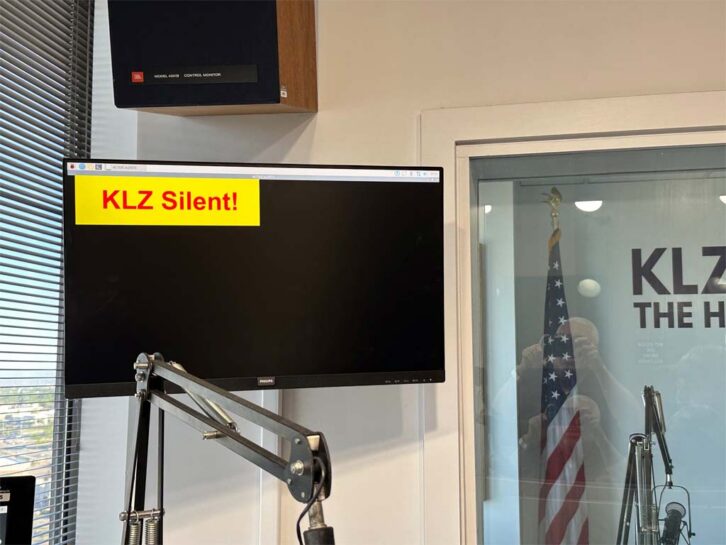
The photo demonstrates an on-screen message that would be displayed if the receiver monitoring the air signal of KLZ(AM) control room went silent.
“We initially set things up in our production units with four inputs from Wheatstone logic outputs,” Cris wrote in the company’s Local Oscillator newsletter.
“Those LIOs are cross-connected in software with silence detection from off-air monitor receivers, and if one goes silent for more than a few seconds, a graphic is displayed on the screen indicating, for example, ‘KLZ Silent.’”
All four stations are monitored, and silence on any of those stations will be reported on the displays in all the studios.
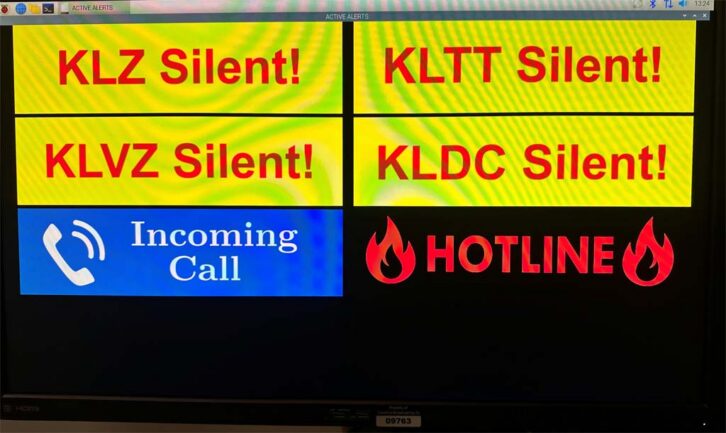
Three of Crawford’s stations in Denver employ Telos Hx6 on-air phone systems connected to incoming lines set up to feed analog ports in an Avaya IP Office 8 phone system. Ringing talk lines or hotlines are detected by analog ring detectors, the closures from which are connected to the Pi annunciator display systems.
But KLZ employs a Telos VXs virtual on-air phone system, and with that system, there is no “ring voltage” to detect.
The VXs does, however, allow configuration of general-purpose outputs (GPOs) through the Livewire network.
What if you’re a Wheatnet facility? There’s no way to make a Livewire GPO from the virtual phone system “talk” to the Wheatnet infrastructure. Or is there?
Cris has previously obtained a used Axia GPIO node. He and his daughter and Crawford colleague Amanda Hopp set it up on the bench, and she figured out the IP address of the unit.
“Once we had that, we were able to set a new IP address to one on the Wheatstone AoIP network and plug it in there. Then I went into the configuration of the VXs and set up a couple of GPOs, one for the three lines in the hunt group and one for the hotline, mapping them to two different closures on the Axia GPIO node. We ran a quick test, and it worked!”
From there it was a simple matter of making a physical connection between those Axia node closures and logic port inputs on a Wheatstone blade, creating LIO sources for them in Navigator, creating LIO destinations on the KLZ control room blade, and cross-connecting them. They had to add two more wires to the general-purpose input (GPI) cable for the display Pi, and that was it.
When any of the lines in the KLZ on-air hunt group ring, an “Incoming Call” graphic pops up on the display. When the hotline rings, a flaming “Hotline” graphic appears.
Cris said this solution was simple and effective for an environment where you can’t have an audible ring.
Crawford’s team has also manufactured and installed SNMP-enabled antenna switch controllers and an SNMP-enabled HVAC controller using Pi-4s. They also have been working on a Pi-based SNMP interface for older auxiliary transmitters that don’t have web connectivity.
And now Cris is wondering how hard it would be to add SNMP functionality to the studio annunciator board display Raspberry Pi’s. “Just think of all the stuff we could monitor and cause to light up on that display!”
What’s up there?
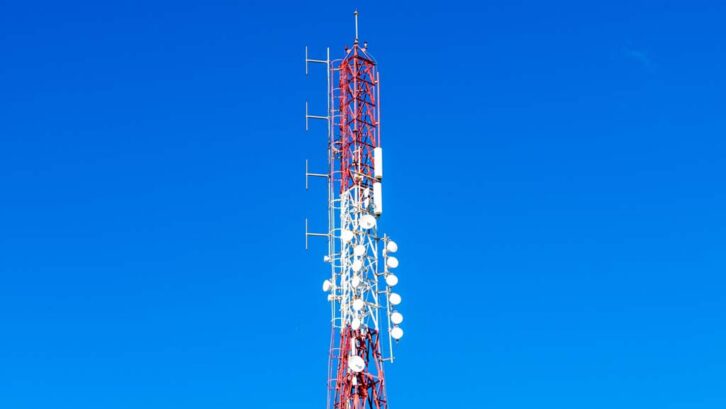
Larry Wilkins of the Alabama Broadcasters Association reminds us that after a tower is built to support a transmission antenna, additional equipment can accumulate on the structure over time.
“Without accurate records, you may eventually lose track of everything installed on the tower,” he wrote in the association’s engineering newsletter.
Larry recommends that you keep on file a tower drawing that shows the height and location of these additions. The drawing should include the level of various lights, side markers and beacons; the length of the antenna, if top-mounted, above the structure top plate; and the height of STL gear, rental equipment, ENG, two-way antennas etc.
“Create a separate data sheet for each item that lists its purpose, transmission line type and the tower leg where the item and line are mounted,” Larry writes.
“Heights may be measured from either ground level or the tower base, and the site’s ground elevation above sea level should also be noted.”
Tips please! Your ideas are what make Workbench go, and they qualify for SBE recertification credit. Email [email protected].