Radio World has been featuring memories from readers and industry professionals about their experiences on Sept. 11, 2001, which was 25 years ago this week. Here are two more.
Fotios Padazopulos
He had planned to go to New York City that day by taking the PATH train from Newark, N.J., a line that terminated under the twin towers, but Fotios Padazopulos opted to stay home.
He was on a phone call with his car insurance firm when a company representative told him that a Wall Street skyscraper had been hit by an airplane.
“I went to the bedroom of my North Arlington apartment, from where I had looked at the two skyscrapers for a long time. I saw the smoke and dust in the upper floors of the first building that had gotten hit.”
Padazopulos dressed and went to an area that offered a better view of the skyscrapers. Others had already gathered.
“I heard one of the fellows saying the second skyscraper was hit. I turned my head and saw the cloud of smoke and dust in that building too. A minute later a patrolman stopped his car and told us with tears in his eyes that the White House got hit. We froze. One of the fellows said, ‘We’ve got to carpet bomb them.’”
He went back home. “There was only Channel 9 on, as it transmitted from New Jersey. All the other channels were off,” he recalled.
“I wondered if the CBS antenna engineer whom I had spoken to the year before was alive. I turned the radio on and I heard that it was not the White House that had been hit, it was the Pentagon. I called the North Arlington Police Departement and told the sergeant on duty to advise the patrolmen to be careful with what they told the public because people became alarmed.”
[Related: The Six Broadcast Engineers Who Lost Their Lives on 9/11]
He described the days that followed as “an eerie feeling, life was not as we knew it any more.”
Padazopulos had a friend who worked in one of the towers. For days he didn’t know if the friend had survived.
“A week later he called me to tell me his ordeal. He’d been in a meeting in one of the towers and 15 minutes before the attack they decided to move to an adjacent building,” he related.
“When the first tower got hit, they came down 60 floors and ran out but the cloud from the explosion was already expanding more rapidly than humans could run. He managed to run northward and found some clear air.”
Richard Factor
Richard Factor was CEO of Eventide Inc. in 2001. He was working in his office in New Jersey, about five miles from the George Washington Bridge, when he first heard about the attacks.
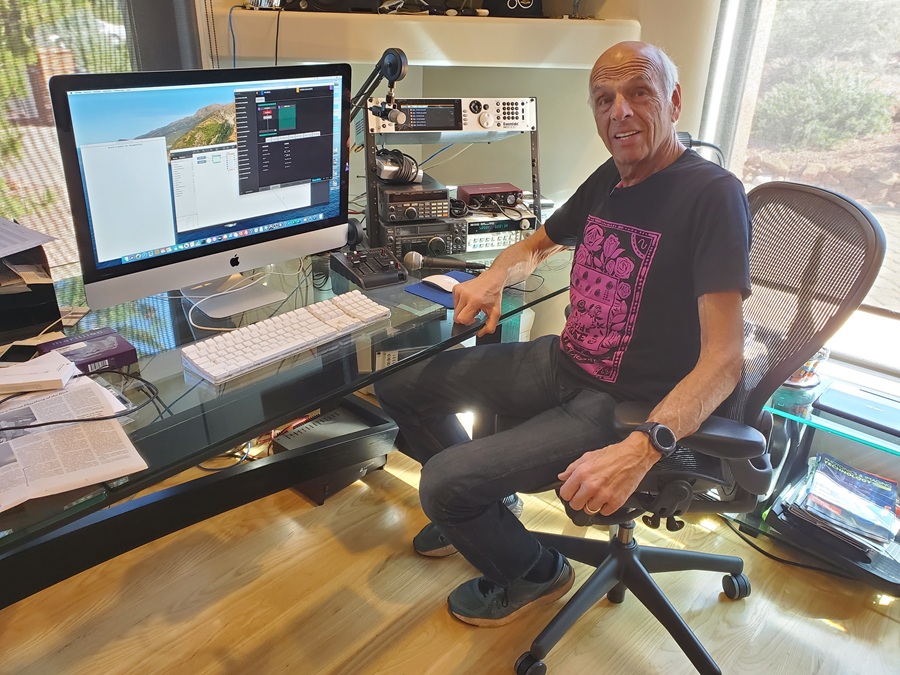
“My initial concern (correct) that it was a terrorist attack and bigger concern (incorrect) that it could have been inconceivably worse.”
He watched the event on TV and went around the plant trying to reassure everyone.
“I explained that wind would blow the smoke and pollution away from New Jersey. At that time I was still concerned about radiation.”
He remembers staying unproductively very late that night.
[Related: Memories of 9/11 in the Washington, D.C., Area]
“I called a local hospital to see if they wanted any blood, which I must have realized would have been unneeded. I finally drove home on an almost empty Route 80 West. All the very light traffic going east had red emergency lights.”
In addition to radio hardware, Eventide made aircraft navigation moving maps.
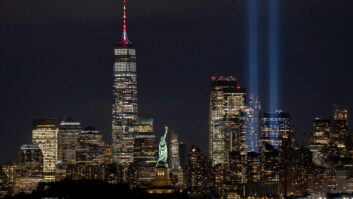
“I would often demonstrate them by flying from New Jersey south along the Hudson, doing a 180 around the Statue of Liberty, and flying back north practically in the shadow of the Twin Towers. They were BIG, and I knew what kind of airplane it would take to do that much damage,” he said.
“Broadcasters did a great job that day.”
Factor wrote about his experience in a blog post in 2006 that you can read here.
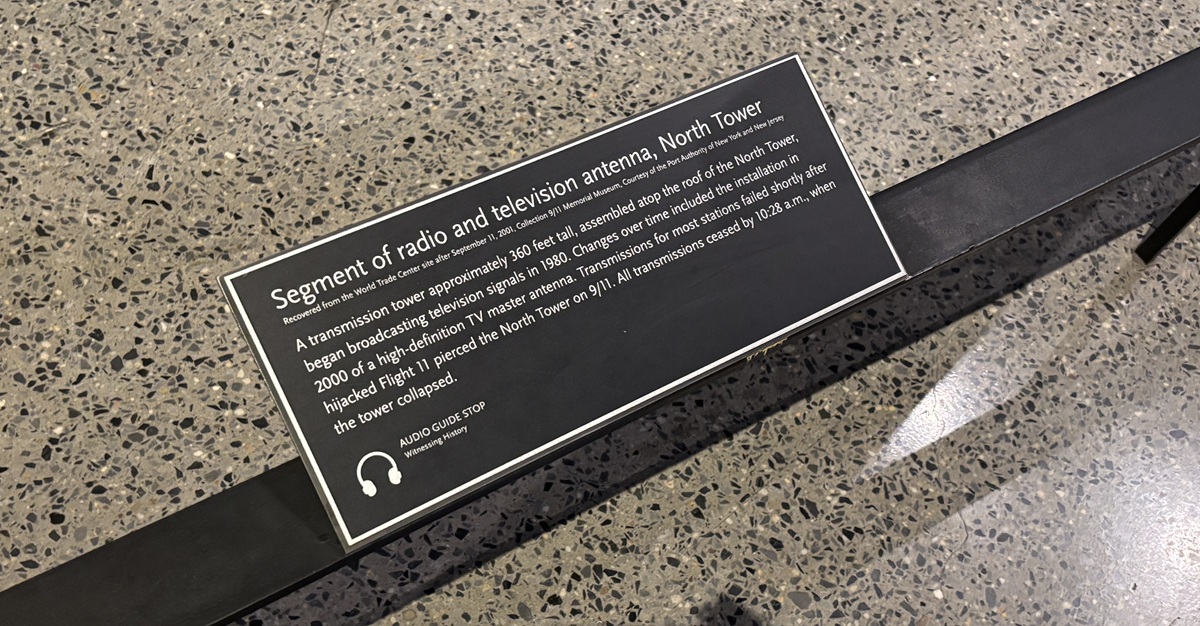
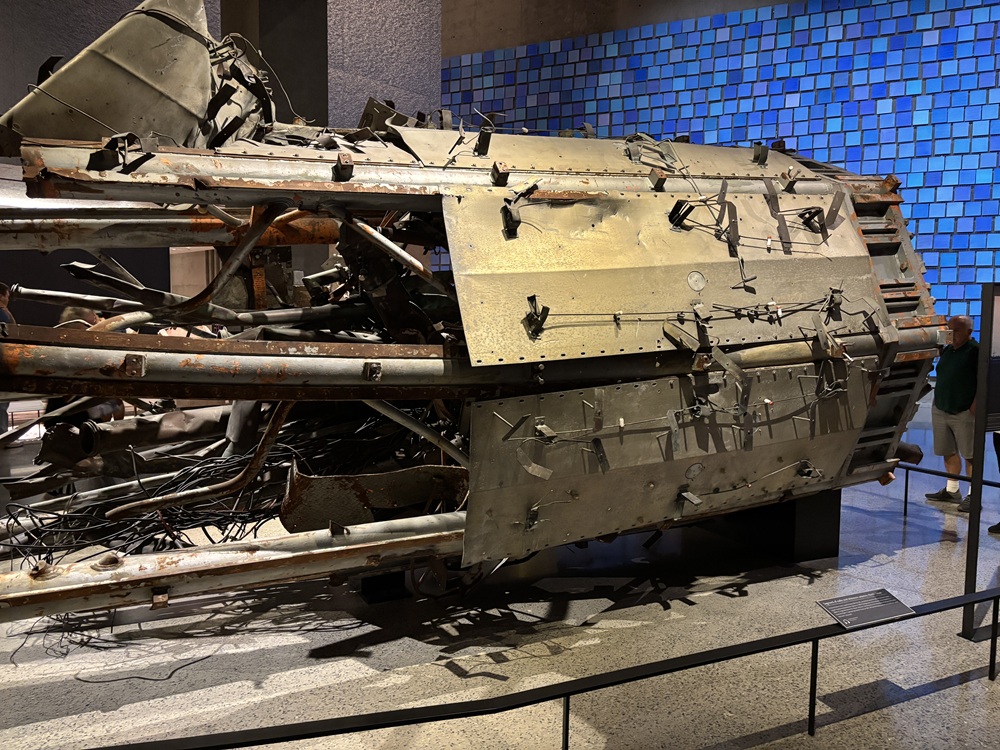
The photo below shows the sign that accompanies the image at the top of this story. Click image to enlarge.