Maybe you’ve had the experience: Your station is having a new antenna installed. The old one is too damaged to be reused, so the rigger removes the brackets and hauls them away or just leaves them on the ground.
Frequent contributor Frank Hertel of Hertel Engineering tells us that his friend Jeff Oestreich showed up at Frank’s shop one day with brackets manufactured by ERI. You can see in the first photo how beefy they are. Such workmanship doesn’t belong in a scrap yard!
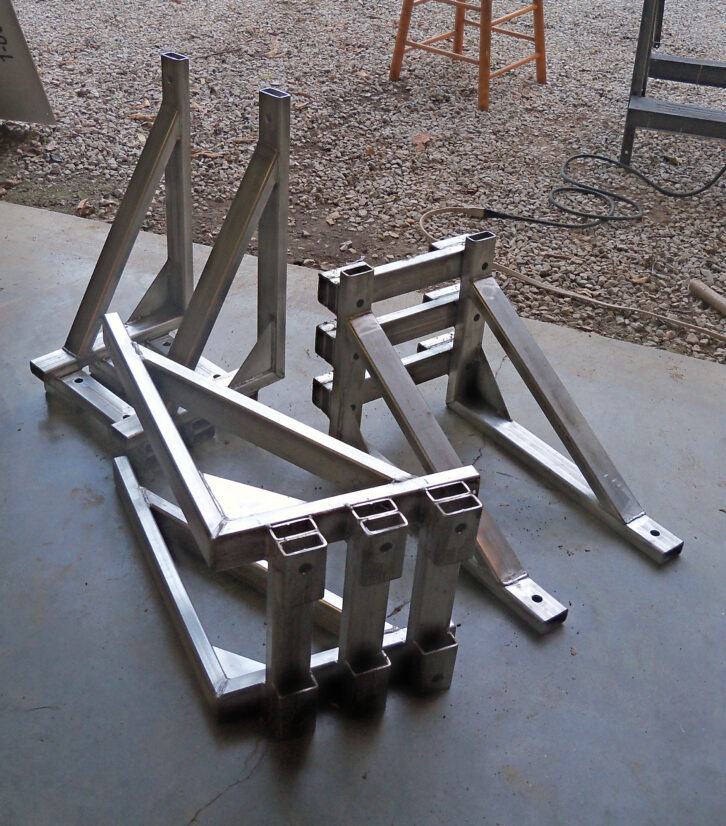
Jeff and Frank pondered what could be done with these. How about making shelf brackets?
Longtime readers will remember our story about an engineer who created a workbench and shop out of leftover Kindorf, a brand of metal framing product used to support electrical, plumbing and mechanical equipment.
Talk about rugged. Given that it weighed a ton, that workbench wasn’t going anywhere!
With such creativity as inspiration, Frank and Jeff rounded up a bunch of tools for the purpose of removing unwanted parts of the mounting brackets. Every tool visible in the second photo was used.
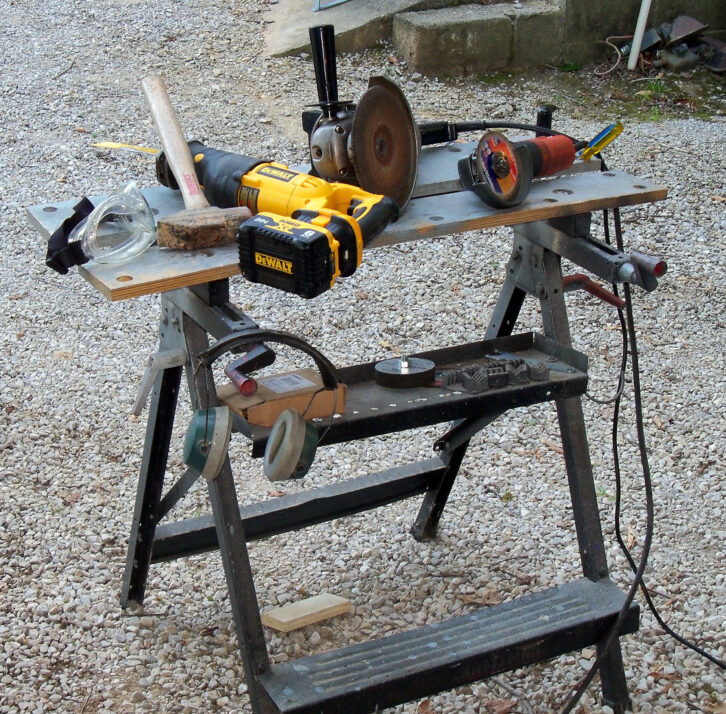
They fitted a small grinder with a cutting disk and a larger one with a grinding disk. The latter would be used to remove excess welding material after Frank and Jeff had cut away unnecessary parts of the bracket. (The brackets are stainless steel and will eat up the cutting disks quickly, so keep several disks at hand.)
A reciprocating saw could reach places the cutting wheel could not. Once the welds were cut through completely where possible, they used a two-pound sledgehammer to bend the unwanted material away from the “L” part of the antenna bracket, to weaken its second weld.
Next they used the cutting wheel to cut through the exposed, weakened remaining weld as far as the wheel would reach. They used the reciprocating saw to thin out the rest of the remaining weld. With the two-pound sledge they beat the unwanted material back into its original position. They continued to hammer, beating the unwanted material back and forth, making it hinge, until the weld fatigued and broke off.
Frank and Jeff say that if you embark on a project like this, you’ll likely find a better and faster way of removing unwanted material. Send us your tips!
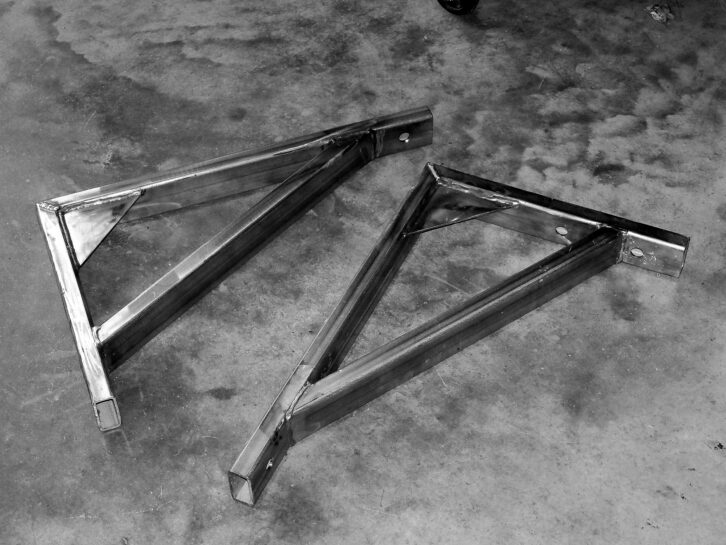
The third photo shows the finished product. These brackets will support nearly anything.
Good morning, TRS jack!
David Gale says he spent a year, a week and a day in Vietnam. Ten months of that time was at Armed Forces Vietnam Network (AFVN).
At the time David was one of six technicians on the radio side but the only one who’d been college-trained in broadcast engineering. The rest trained in other electronic servicing but not broadcast.
Because of his familiarity with consoles, turntables, tape recorders, cart machines and transmitters, he was able to fix many of the equipment problems that came up.
David recalls that his associates were scared of the Gates BFE-10C FM transmitter. One told him that when he hit the Plate On button, an arc followed his finger out to 6 inches or so!
When David inspected the rig, the only thing he noticed was that the high-voltage contactor mounted on the back door mount of the transmitter was badly pitted. He replaced the contactor with a spare from Gates. He hit the Plate On, and down she went.
David couldn’t see how changing out a simple three-leg contactor could induce this problem. He opened up the Arrow Hart contactor and found that two of the phases were physically cross-connected within the assembly. After the corrected the wiring, the contactor and transmitter worked fine.
David blamed Gates at the time, but the fault was probably Arrow-Hart’s. His warning for today’s broadcast engineer? Always check spare parts, comparing them to what is being replaced.
Here’s another note from David’s logbook of his days at Good Morning Vietnam:
David needed to figure out why a feed to their network stations was failing. It turns out that the headphones were wired in parallel to the console output. A tech had installed a shorting tip-ring-sleeve headphone jack as the headphone feed jack. When the tech plugged in headphones, everything worked fine. But as soon as a newsman would finish his report and yank out his headphones, the jack would do what it was designed to do, shorting the jack and the console output. But because headphones often were left plugged in, this sporadic problem was difficult to trace.
Do David’s memories stir up any similar experiences from your career? Send them to me at [email protected].
Workbench submissions are encouraged and qualify for SBE recertification credit. Email [email protected].